A man and his sextant

27 06 2025

Commander Phil Harper RN recently wrote to me about an unusual sextant. As I am no longer in a position to collect and write about interesting sextants, I invited him to write the following guest blog post. Ewen Southby-Tailyour, one of the subjects of the post, wrote most of the text, with Phil and me providing light editing.

The man

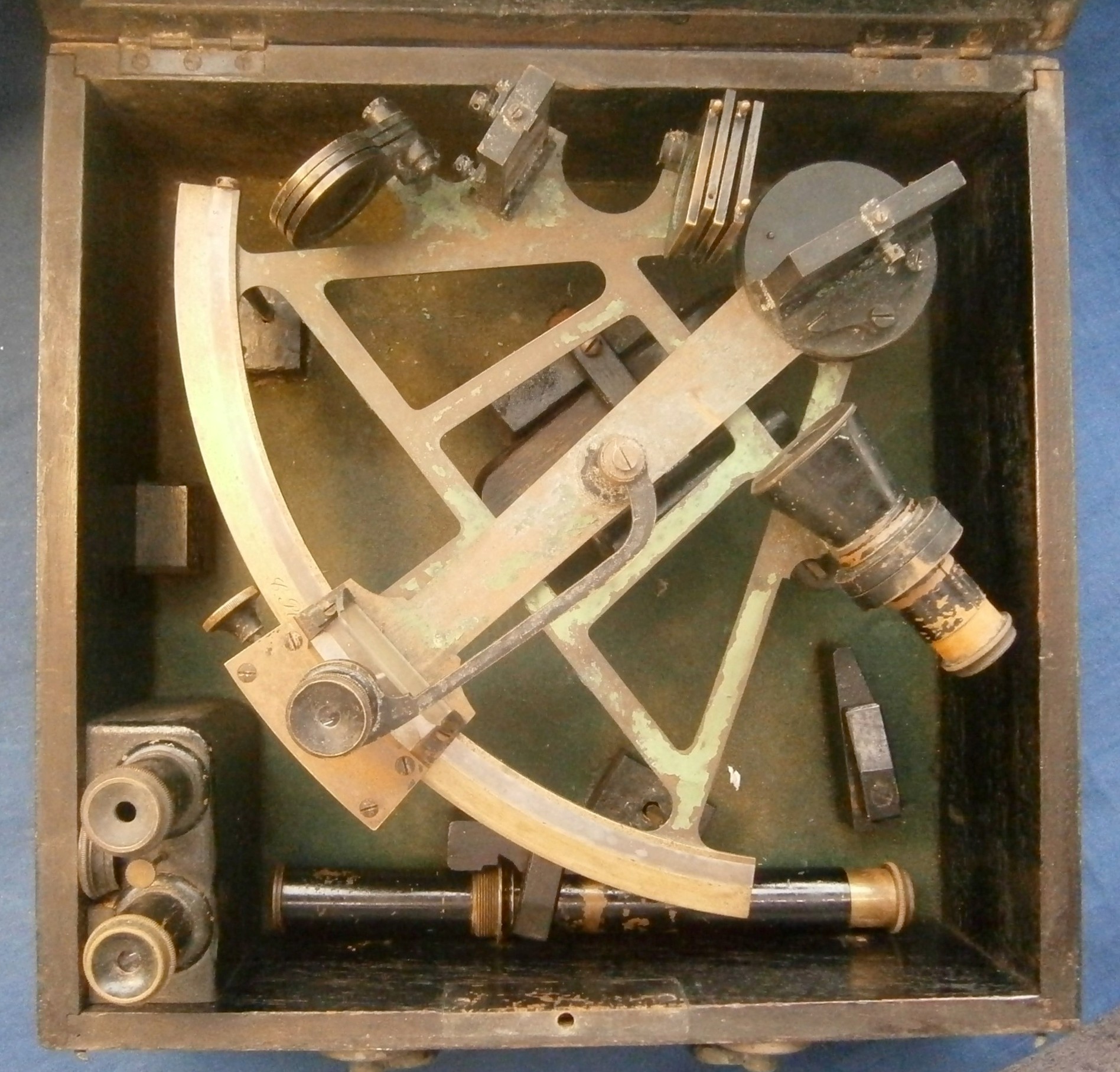
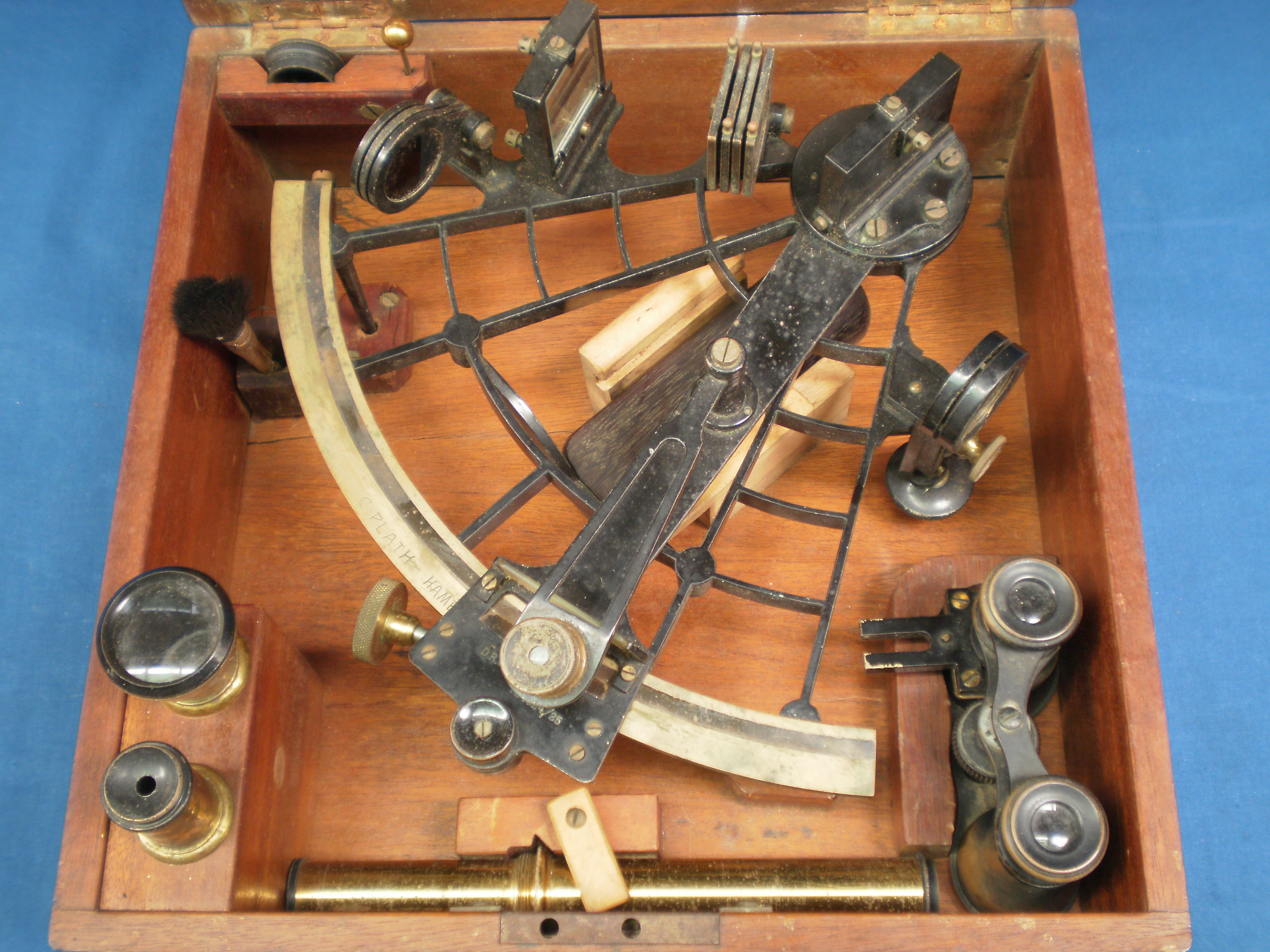
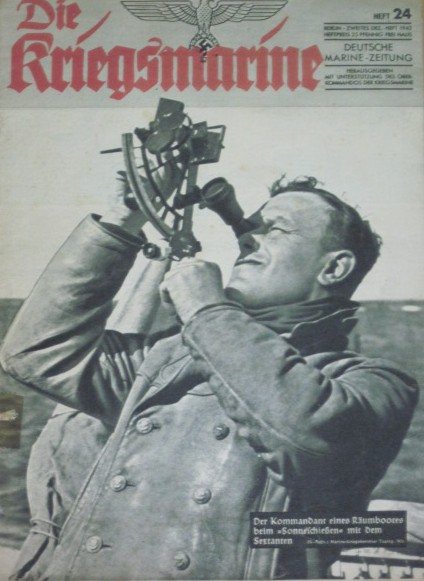
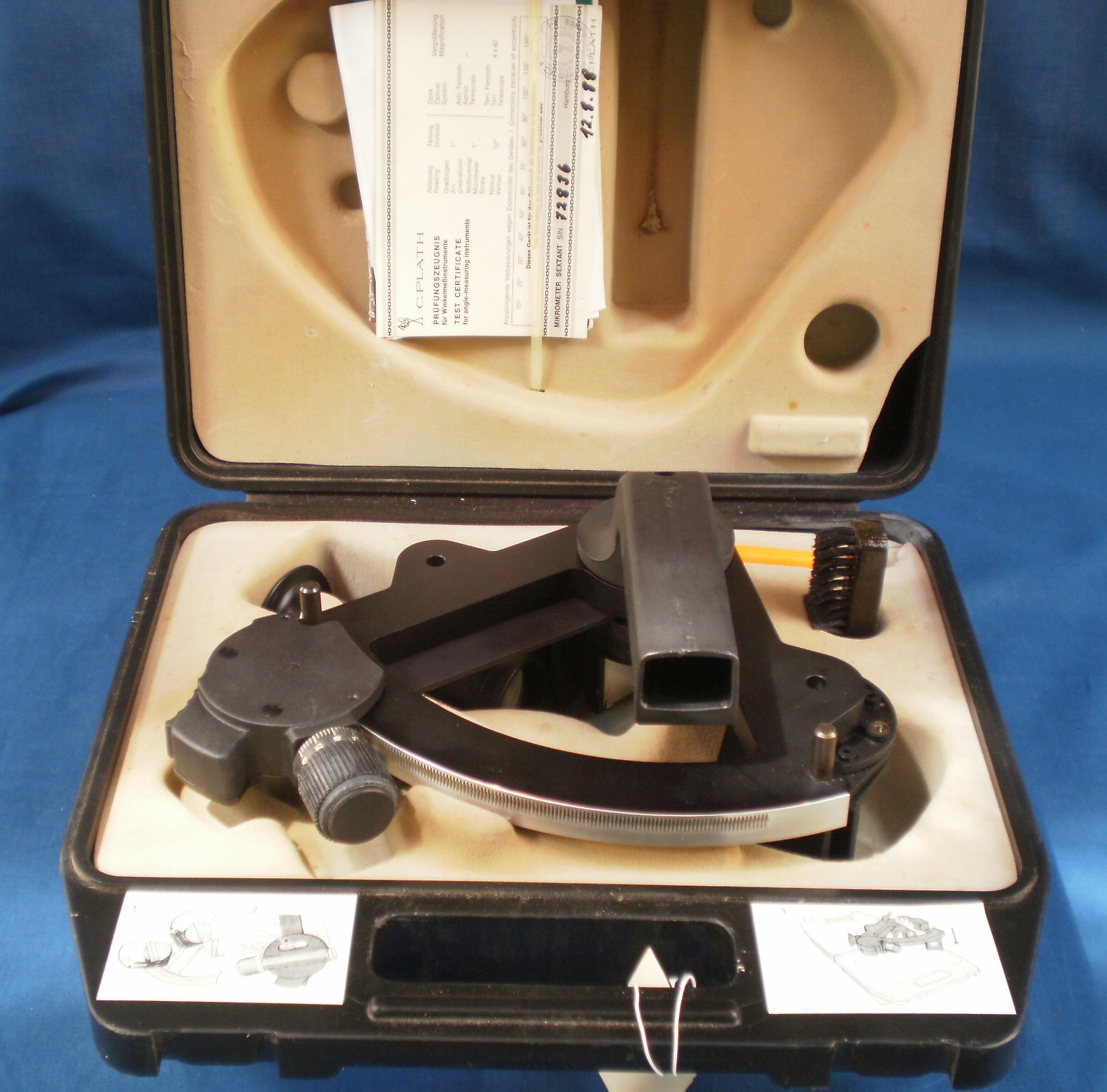
Few sextants carry their history with them, but C Plath 26276 is quite the exception.  It was built in Germany late in World War II and ‘liberated’ in Wilhelmshaven from U-3008 in May 1945, by Lieutenant-Colonel (later General) N H Tailyour who was then commanding officer of 27 Battalion Royal Marines, a unit within 116 Infantry Brigade Royal Marines that was attached to the Canadian First Army, and responsible for guarding about 200 German warships and submarines that had surrendered. 

Norman Tailyour had owned various yachts before the war, and knew well how to use a sextant. In 1947 his friend and mentor, Lieutenant-Colonel Patrick Phibbs OBE RM, bought the 35-ton, 56-feet Bristol Channel Pilot Cutter Olga, and Norman Tailyour was often invited to cruise along France’s Biscay and Brittany coasts, using C Plath 26276 to do the navigation. His son, Ewen Southby-Tailyour, a godson to Patrick Phibbs, sailed in Olga too, from the age of five. Even at a young age he often took sun sights with C Plath 26276 but, to begin with, left the figures for others to work out and plot.  

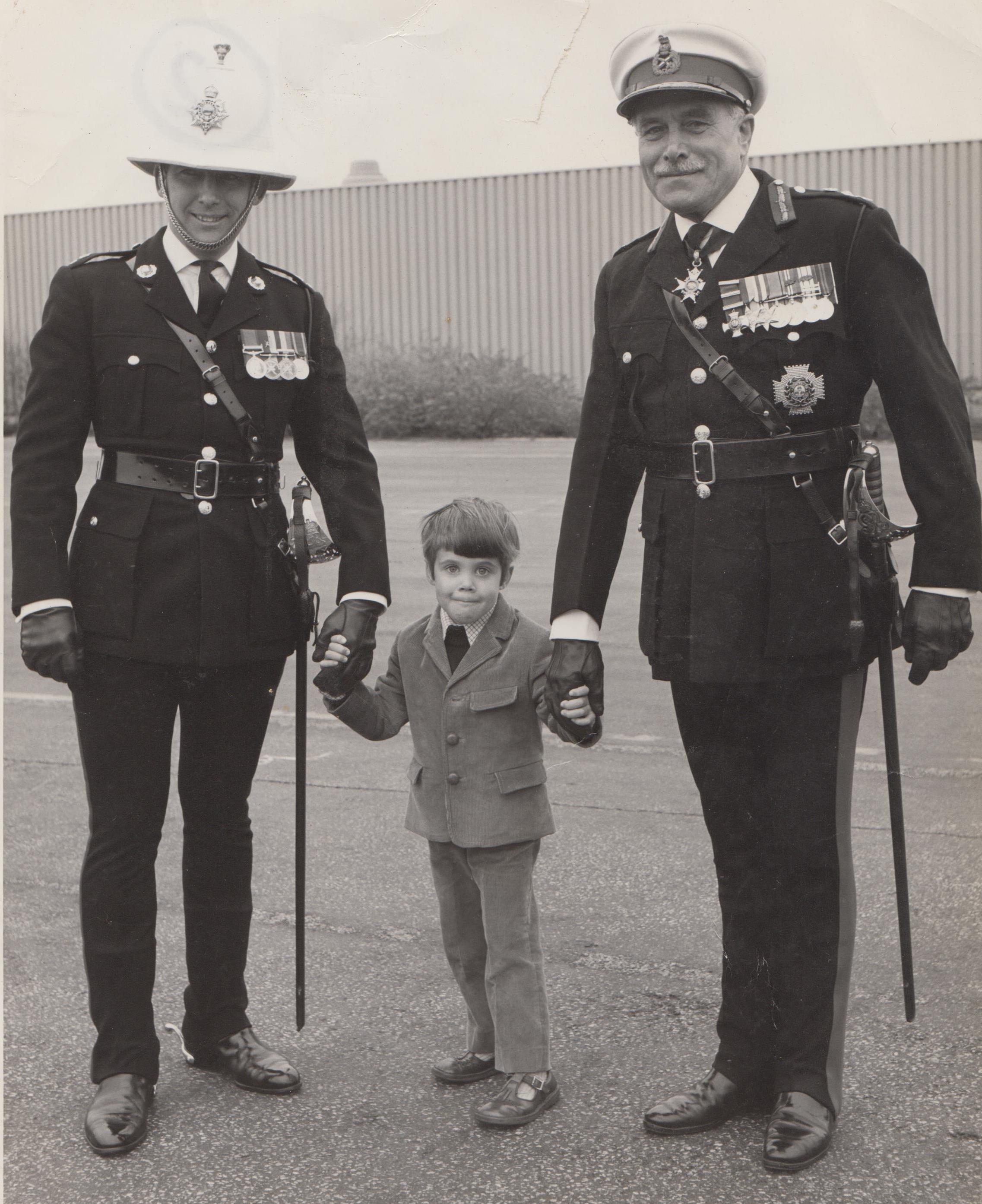
Fig 1: L to R, Ewen Southby-Tailyour, Hamish S-T and General Norman Tailyour

Fig 2: Ewen and sextant off Pebble Island, Falklands.
Fig 3: Ewen and sextant in the Denmark Strait
Fig 4: The sextant and a well-known book.

Ewen went to school at the Nautical College, Pangbourne in 1955 and was taught celestial navigation to ‘O’ Level standard. During the summer holidays on board Olga he could then produce his own intercepts and position lines. Joining the Royal Marines in 1960 he retrieved the sextant from Olga and used it in many and various Royal Ocean Racing Club (RORC) ocean races, notably as the navigator in six Fastnet races during the 1960s and 1970s.

In 1963 as the Seamanship Training Officer for the Landing Craft branch at Poole, C Plath 26276 was employed teaching celestial navigation, then between 1963 and 1964 it travelled with Ewen to HMS Anzio, a ‘landing ship, tank’ in the Persian Gulf. 

 In the mid-1960s he was the sailing master of the Royal Marines’ Windfall yacht Sea Soldier and introduced young officers to the sextant. 

When appointed officer commanding the amphibious detachment in HMS Fearless in 1973, C Plath 26276 was lent to the ship’s navigating officer, who preferred to use it rather than the issued sextant (presumably a much heavier Kelvin Hughes Admiralty 491).  In 1978, Ewen was sent to the Falkland Islands as officer commanding NP8901 and, naturally, C Plath 26276 went with him on the long journey south. It was used extensively, mostly for horizontal sextant angles of the islands, while carrying out amateur surveys of the archipelago. These surveys formed the basis of more than 100 pages of notes on the harbours, inlets and landing spots around the islands, notes which became superbly useful to the commander of the amphibious landing force in the Falklands War in 1982. Ewen was attached to the staffs of 3 Commando Brigade and the Commodore Amphibious Warfare, and his sextant joined him for the war, though necessarily seeing little use.

His survey notes later became the book Falkand Islands Shores, a work which is still in use today for those navigating around the wild shores of the Falklands. He was elected the UK’s Yachtsman of the Year in 1982 for this contribution to the success of the recovery of the islands. C Plath 26276 continued to be used professionally during assignments at Poole and deployments to the Arctic

Having owned four yachts between 1973 and 2022, after retiring Ewen cruised between the Denmark Strait (the strait between Greenland and Iceland) and the Biscay coast, always with C Plath 26276. This sextant was particularly useful during three voyages surveying the last five uncharted fjords of north-west Iceland, for which Ewen was awarded the Goldsmith Exploration award.

The sextant

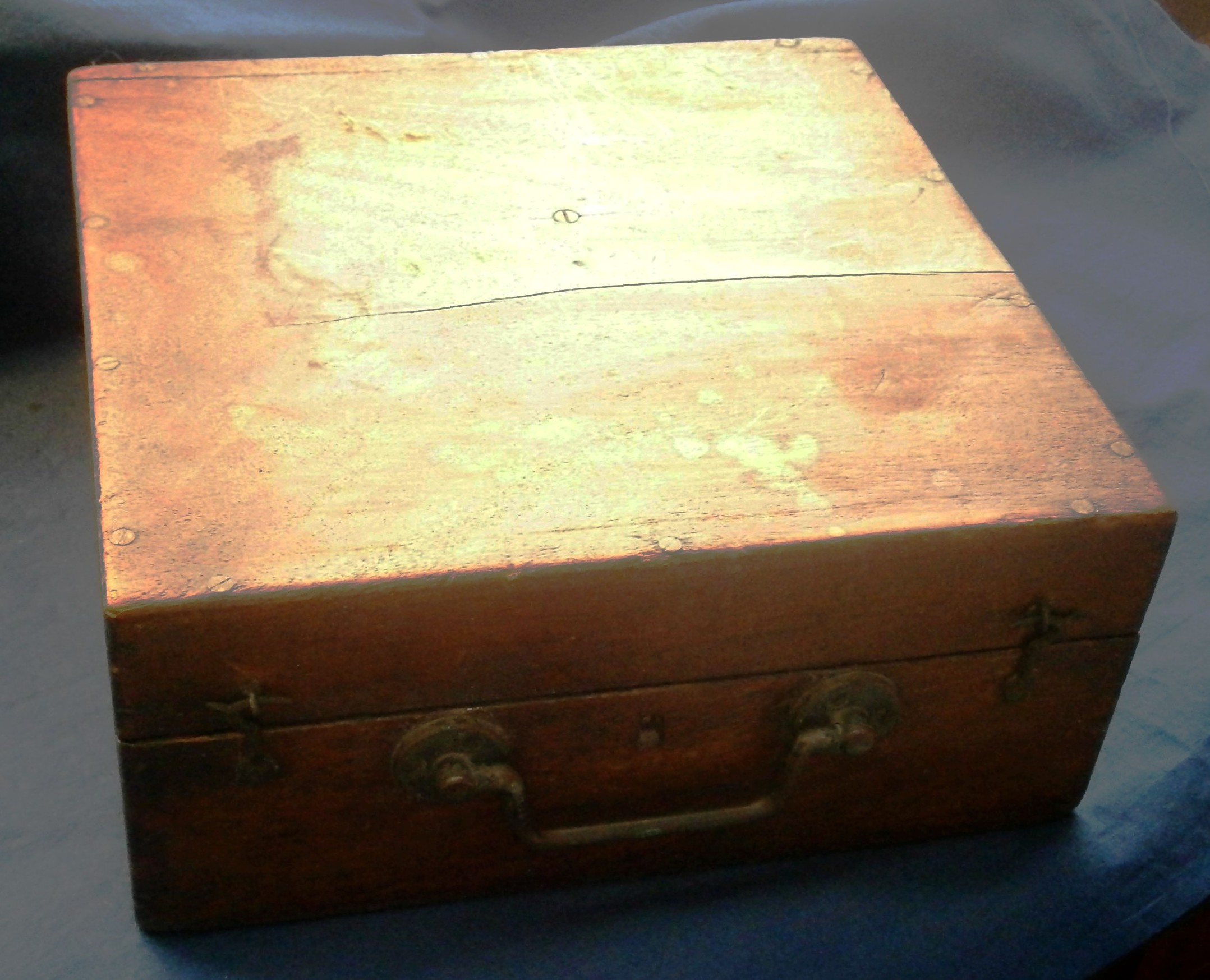
C Plath 26276 was, after 80 years of intensive use at sea, in some need of repair. Ewen, on the recommendation of mutual friends, brought it to Commander Philip Harper, a serving Royal Navy navigator and commanding officer. By this time the aluminium screws used to secure the hinges and clasps had largely rotted away and the joints of the box were coming apart. Many of the sextant parts were corroded, and both mirrors were in poor condition (the index mirror was almost completely destroyed, although Ewen claimed he could still take a sight with it!).

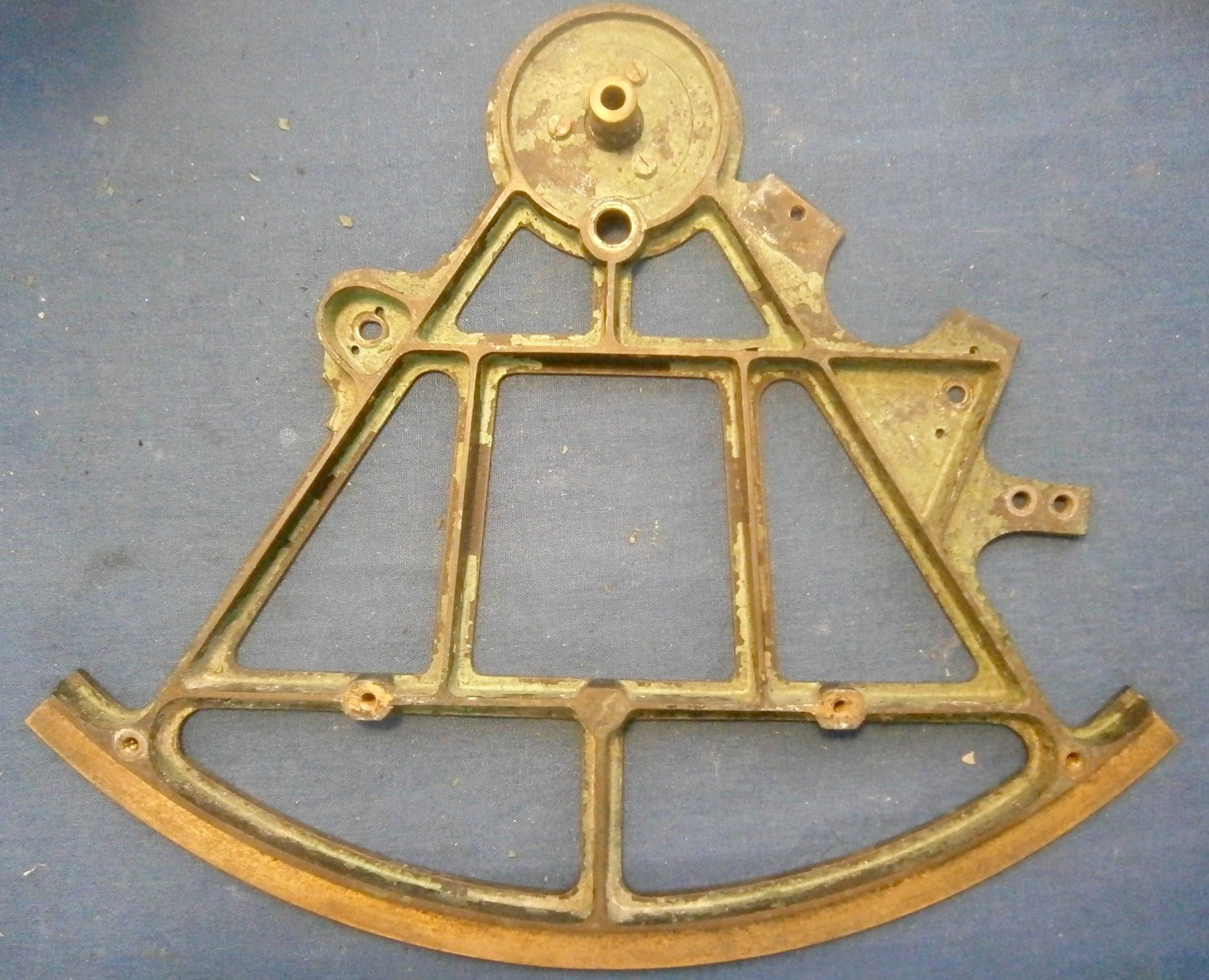
Philip cleaned, repaired and refinished the instrument, and repaired the box. The horizon mirror was professionally silvered, and a new index mirror was cut and the edges ground as advised in Bill’s blog article [see post for 11 February, 2009)]. The patina has been preserved, but the instrument is ready for another eight decades of hard use.

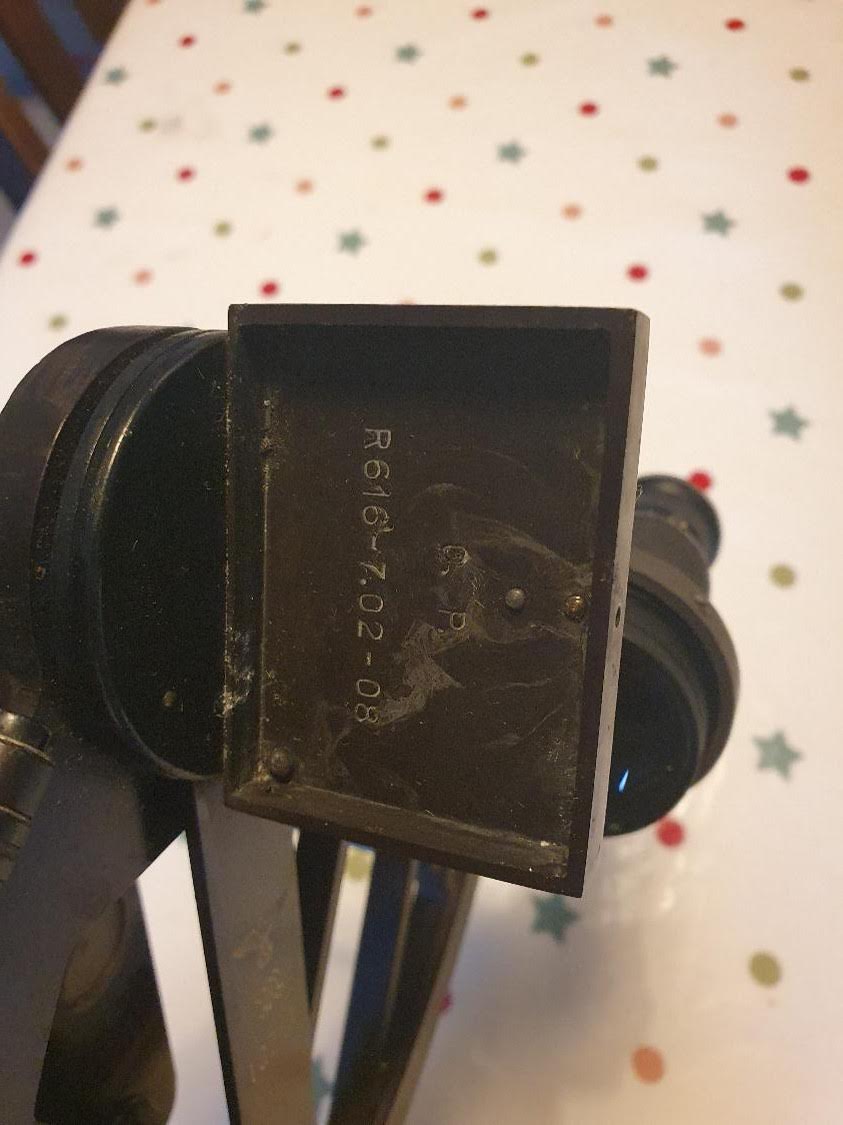
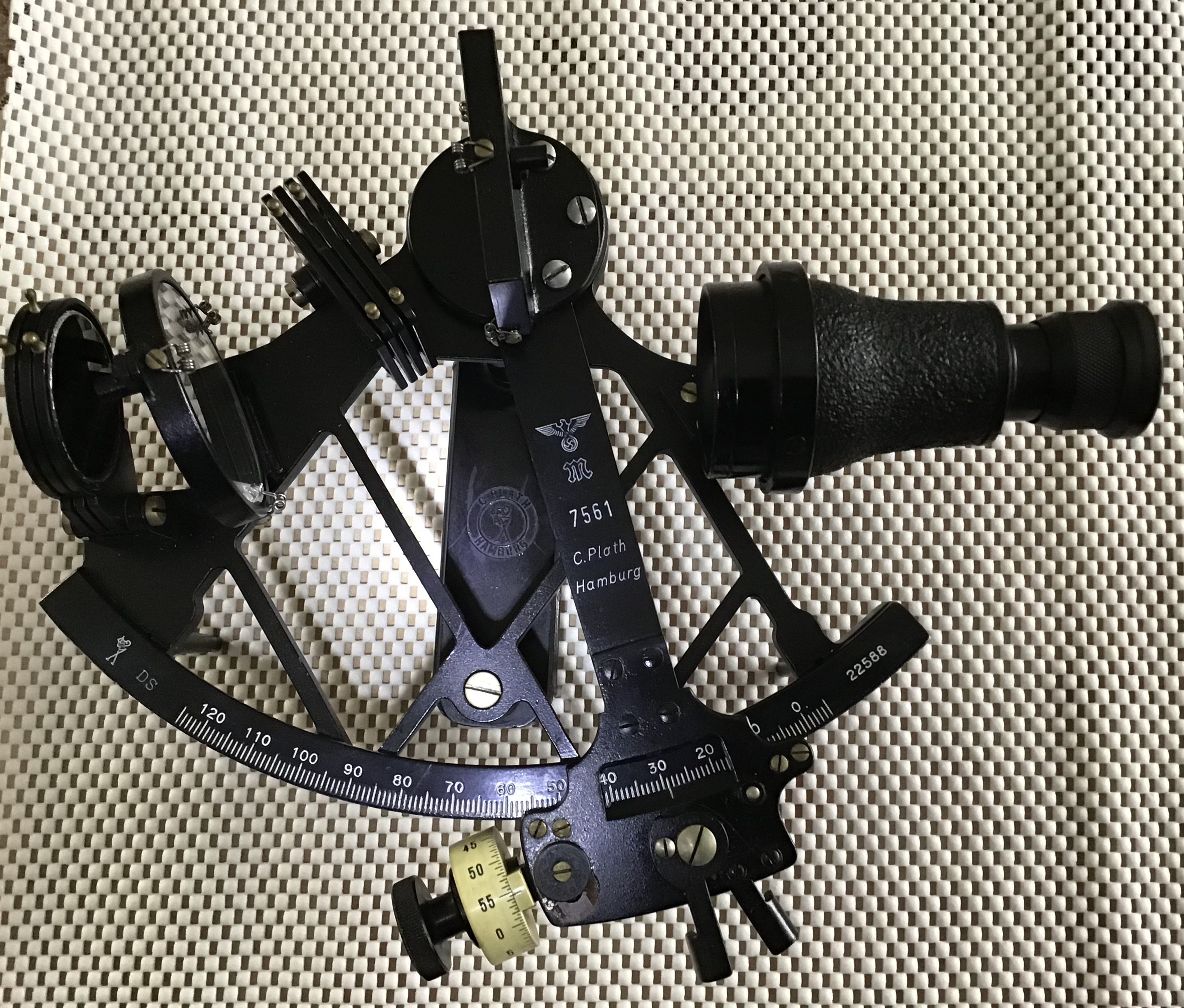
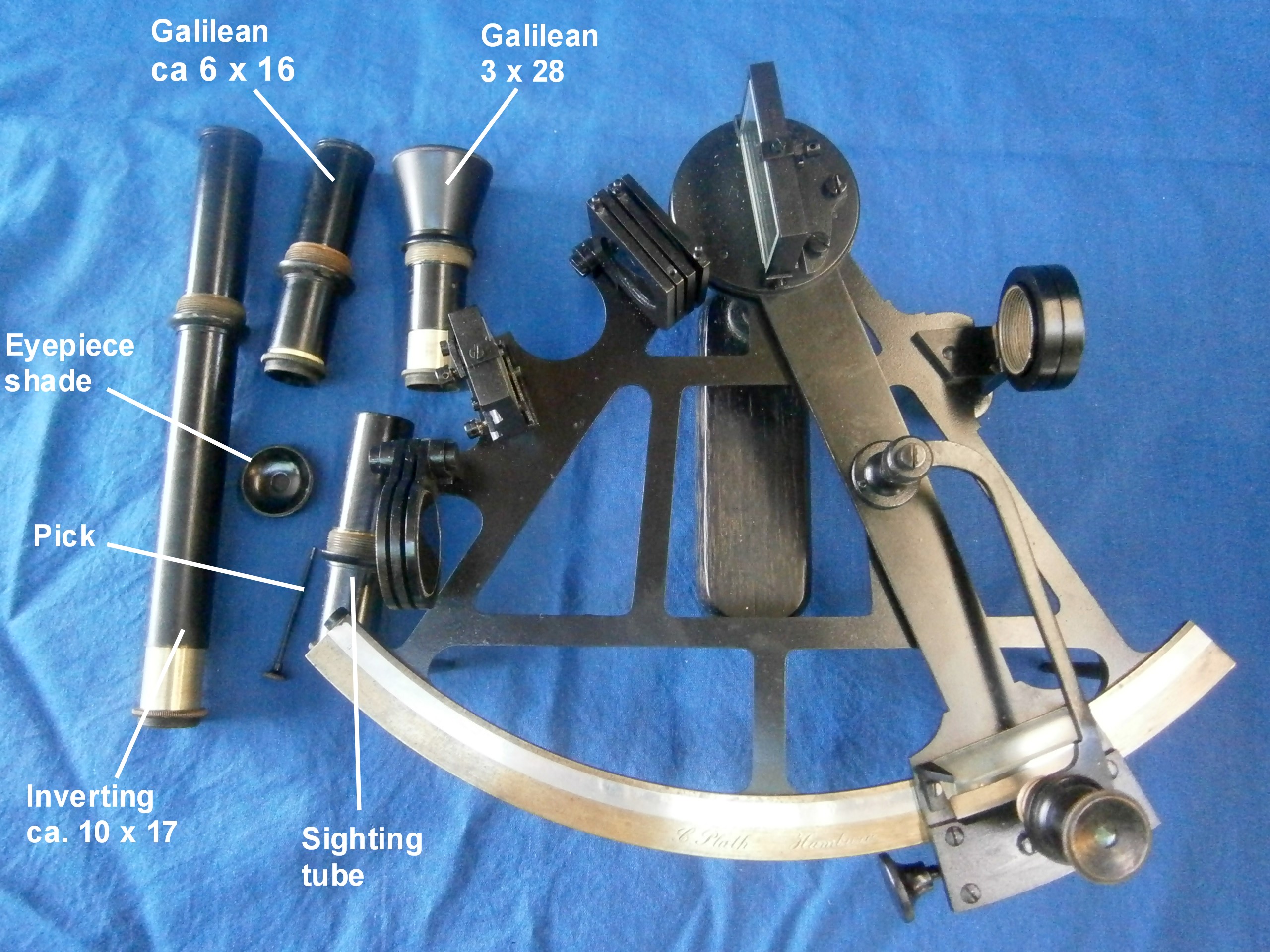
During the restoration, it became clear that there was something unusual about C Plath 26276. Even disregarding the extensive provenance, it was clearly a genuine wartime Kriegsmarine C Plath sextant, but the C Plath trademark (a stickman holding a sextant) was missing from both the arc and the handle. Figure 6 was taken to show these two logos in an otherwise identical sextant from ca. 1942. Fakes, of course, normally add the trademark to a non-original item, so this was more a cause for interest than concern. On removing the mirrors, the C Plath part markings were present (Figure 5), confirming that the parts had been made in a C Plath factory. But why were the trademarks missing?  Given the late serial number, it is surmised that this instrument was made up from parts in a machine shop in Germany after the C. Plath factories in Ostrołęka and Sopot in Poland had been overrun by the Red Army in late 1944 or early 1945. It would then have been delivered to the Kriegsmarine and subjected to an examination.  It seems by this stage of the war the Kriegsmarine merely stamped the certificates Entspricht den Bestimmungen der Kriegsmarine (“corresponds to the regulations of the Navy”) and Das Instrument is den fur Gebrauch aus fehlerfral zu bezeichnen (“the instrument is intended to be used without error”). The sextant would then have been issued to a ship or submarine. In this case, it went to U-3008.

Fig 5: Index mirror bracket showing C P logo

Fig 6: A standard wartime (1942) Kriegsmarine sextant in my collection.
Fig 7: 26276 handle. Note absent CP logo.

The U-boat

undefined
Fig 8: U-3008 after capture.

U-3008 was a new type of submarine – the Type XXI submarine Elektroboot, designed to operate at high speed underwater for extended periods. All Cold War diesel-electric submarines were based to a greater or lesser extent on this innovative German design. U-3008 was one of only two such submarines to complete a war patrol. She was launched on 14 September 1944 and commissioned on 19 October 1944 by Kapitänleutnant Fokko Schlömer. Kapitänleutnant Helmut Manseck took command in March 1945. The boat sailed on one patrol from Kiel on 3 May 1945, returning to Kiel on 21 May 1945. After the end of WWII, U-3008 was secretly transferred to USN for trials. She was scuttled in a series of demolition tests in 1954. The hulk was raised and towed to the Navy drydock at Roosevelt Roads where she was offered up for sale in 1955 for scrap.

What does the future hold for C Plath 26276? It seems that liberating sextants from captured enemy ships is something of a habit in the Tailyour family; Ewen’s son is the owner of a Kelvin Hughes sextant liberated from the Argentine logistic ship Bahia Buen Suceso in 1982. C Plath 26276 will therefore skip a generation and go to Ewen’s grandson, who is commencing a three-year degree course at Warsash Maritime School. As he aims to skipper super yachts worldwide, there is every chance that the instrument has much travel and use ahead of it.

Postscript

Ewen was pleased to read this blog and made a gift of the sextant to his grand son Jacob, as shown in the following photo.


A French sextant restoration

25 07 2022

During a lock-down period for Covid 19 in 2021, a large box arrived from a collector in Australia. In it were four antique sextants and a circle which Dave wished me to restore for him and over the intervening months I did just that. A few weeks ago, when New Zealand opened its gates again to overseas visitors, he came to visit his mother, and also made the trip up to the Far North to collect his instruments. During his visit, he was able to look over my few late eighteenth and early nineteenth sextants, and before he left he entrusted me with another sextant and a small box of spare parts, in the hope that I could restore it for display rather than actual use. Figure 1 shows the front or left-hand side of the instrument as received except for the index mirror bracket, which I had cleaned and painted before I had thought about photographing it. I had also removed heavy tarnishing from the scales by dint of patient rubbing with ammonia solution.

Figure 1: Front as found

Missing is any form of sighting device, the index mirror bracket, all the horizon shades, the tangent screw assembly and the shade screen for the vernier scale. A thumb screw half way down the index arm marks where a magnifier arm for reading the scales was no doubt placed. Figure 2 shows the rear or right-hand side as found.

Figure 2: Rear as found

It is somewhat unusual to find a silver-in-brass arc married to a wooden frame, in this case of heart ebony, a strong, dense and stable African hardwood. More usually, wooden framed sextants have ivory arcs glued in a rebate on the front of the limb, while early metal-framed sextants commonly had ivory arcs inlaid. Figure 3 shows one of the nine rivets that attach the arc to the frame and the maker’s name. I have not been able to find any details of Védy of Paris or indeed, whether he was a maker or merely a retailer. The fact that the instrument is numbered suggests the former. Perhaps some reader can tell me more?

The dividing of the scale is of high quality and it is known that Bochard de Saron acquired Jesse Ramsden’s first dividing engine in 1775 and made it available to French artisans until he literally lost his head in April, 1794, during the French Revolution. The state then continued to make it available to instrument makers, including the leading maker, Etienne Lenoir.

Figure 3: Main scale and name.

The mirror adjustments are complex and archaic at a time when most sextants of English manufacture had adopted the simpler method described by Peter Dolland in 1772 in a letter to the Astronomer Royal, Nevil Maskelyne, and published in Phil. Trans. 1772 62, 96 – 98. It was also described in Patent no. 1017 of 22 May 1772. “I have contrived the frame , so that the glass lies on three points, and the part that presses against the front of the glass has also three points exactly opposite to the points between which the glass is placed. This contrivance may be of some use; but the principal improvements are in the methods of adjusting the glasses,...” The method not only removes stresses in the mirror but also allow for simple adjusting of perpendicularity of the index mirror and removal of side and index error at the horizon mirror.

Figure 4 shows the means of adjusting out side error. The horizon mirror is held against a vertical bracket on top of a round base by means of a clip and two screws. The base is hinged on to a rotating base the shaft of which extends through the frame to a means of adjustment to be described below. An adjusting screw operates against a spring that surrounds it, allowing the base to be tilted and the mirror made parallel to the index mirror.

Figure 4: Means of correcting side error.

Figure 5 shows the end of the shaft of the rotating base. It is connected via a square on the end of the shaft to a sector that has a half-nut on its end which engages with a worm inside a fabricated brass box. The sector is retained on the shaft by a screw with a large head(not shown). The worm box is attached to the frame by means of two screws which engage with two threaded brass bushes let into the frame. The sector can be locked in place by means of a clamp screw. Rotating the squared end of the worm shaft in turn rotates the rotating base and allows fine adjustment of the index error. Figure 6 shows the assembly exploded.

Figure 5: Means of correcting index error.
Figure 6: Index error adjustment exploded.

In the box of possible spare parts was a sighting tube. Happily, the thread on its body was of a larger outside diameter and of a different pitch to the internal diameter of the existing telescope rising piece, so I was able to turn it down and cut a new matching internal thread. I was able to ascertain the pitch of the latter by pressing a piece of Plasticene into the thread, removing it and then using an engineering microscope to measure the impressed thread.

Figure 7: Telescope mounting

Figure 7 shows the telescope mounting. Avid readers of this blog will have noticed the similarity of the mounting to that shown in Figure 1 of my post of October, 2021, on a reflecting circle. This does not necessarily mean that the two instruments were contemporary, but rather that apprentices would copy masters, sometimes over several generations, or specialist makers of small parts would supply to “makers”, who were assemblers and finishers, rather like modern automobile manufacturers.

Figure 8 shows the mounting exploded. A large knurled nut holds a bush securely in the frame and the triangular stem of the rising piece slides in a triangular hole in the bush. A screw is held captive in the bush by means of a knurled thimble which has a square hole in it to match the square on the end of the screw. A countersunk screw(not shown) passes through the thimble into the end of the adjusting screw and tightening it secures the adjusting screw in the bush, allowing free rotation without up and down movement.

Figure 8: Telescope mounting exploded.
Figure 9: Tangent screw.

Reference to Figures 1 and 2 shows that the tangent screw with its nut and bearing were entirely missing, the sliding block was present and a mangled leaf spring remained. With the parts available, I was not able accurately to reproduce what was present before, but Figure 8 shows a closely similar appearance, the main difference being that the bearing was secured by means of a screw passing from the front of the index arm into its base. The original bearing was probably spherical and held in a spherical seat.

When the lock screw is tightened, the sliding block is locked to the limb and when the tangent screw is rotated the index arm slides over the block. When the lock is loosened, the index arm can be slid rapidly along the limb, while the leaf spring holds the arm in contact with the frame. The original spring and the little block that held it were too badly mangled to use and I had to make new ones. I resisted the temptation to use a piece of clock spring or a scrap of beryllium copper, and instead hammered a strip of brass to work harden it and make it springy as a contemporary artisan would have done. The resulting distortions had to be corrected by filing.

In the upper left of Figure 7 can be seen the way the index mirror is brought perpendicular to the plane of the arc. An adjusting screw with a square head is held captive in a tongue projecting from the index mirror bracket by means of a bar and two screws. There are two screws through feet securing the front of the bracket and their soles are slightly rounded to allow rocking as the adjusting screw is rotated in a threaded bush let into the top of the index arm. Peter Dollands invention, mentioned above, made these little complexities redundant. A mirror clip from the box of spare parts was easily modified with a file to fit the bracket.

There were three rather battered horizon shades in the box of parts and it was the work of a few minutes to make a shouldered screw and three washers to fit them into the existing bracket. I domed a further thin washer by placing it on the end grain of a scrap of wood, sitting a ball bearing in the hole and striking it hard with a hammer. This gave me a thin and stiff spring to adjust the friction when the screw was tightened. This type of spring washer is now known as a Belleville washer, patented in 1867 by Julien Belleville of Dunkirk. Fairly obviously, the principle was well known before that. A lock nut at the end of the screw then completed the assembly.

Figure 10: Horizon shades.

The index arm bearing followed the pattern shown in Figures 25 and 26 of my post for 11 March 2012 and it required only cleaning and greasing.

I used black laquer on brass surfaces, leaving screw heads bright as seems to have been the custom, and used black shoe polish to brighten the frame to complete the restoration.

Figure 10: Completed front view.
Figure 11: Completed rear view

The finished restoration is shown in Figures 10 and 11.

Postscript Murray Peake has kindly provided me with some details of the maker, Louis Félix Védy, 1811 – 1875. He was active in the middle of the nineteenth century and was a principle supplier to the Dépot de la Marine. He was made a Chevalier de la Legion d’Honneur in 1851. His apprentice master was Antoine-Francois Jecker, 1765 – 1834, who worked for six years under Jesse Ramsden.


A Late C18 Wooden Quadrant Restored

18 01 2020

Previous posts in this category include: “A C18 sextant named J Watkins”, “An Old Wooden Quadrant Restored”, ” A turn-of-the-century French sextant”, “A Half-size Sextant by Lefebvre-Poulin”, ” A Fine Sextant by Spencer, Browning and Co”,  “A C19 Sextant Restoration” , “Making a Keystone Sextant Case” , “Restoring a C. Plath Drei Kreis Sextant” , “Heath Curve-bar sextant compared with Plath” , “A Drowned Husun Three Circle Sextant”, ”Troughton and Simms Surveying Sextant” , “A Sextant 210 Years On” , “A fine sextant by Filotecnica Salmoiraghi”, “A British Admiralty Vernier Sextant”, “An Hungarian Sextant via Bulgaria” ,  “A Half-size Sextant by Hughes and Son” and “A Fine C Plath Vernier Sextant”, “Heath and Co’s Best Vernier Sextant.” and “An Early C19 Ebony Quadrant Restored”.

Two thousand and nineteen was a busy year for me and now that 2020 is upon us I find that I have not written a post in this blog for about a year, though not for want of trying, as I see that I got as far as writing the title of this one in August, 2019, having bought the instrument in April. My chronometer blog (www.chronometerbook.com) fared a little better, with one post. I have begun to make a catalogue of my nautical sextants and related instruments, and this morning found that I had omitted to describe a survey sextant that I acquired in 2013, so I will try to write about that after this one, in between mending and rating chronometers.
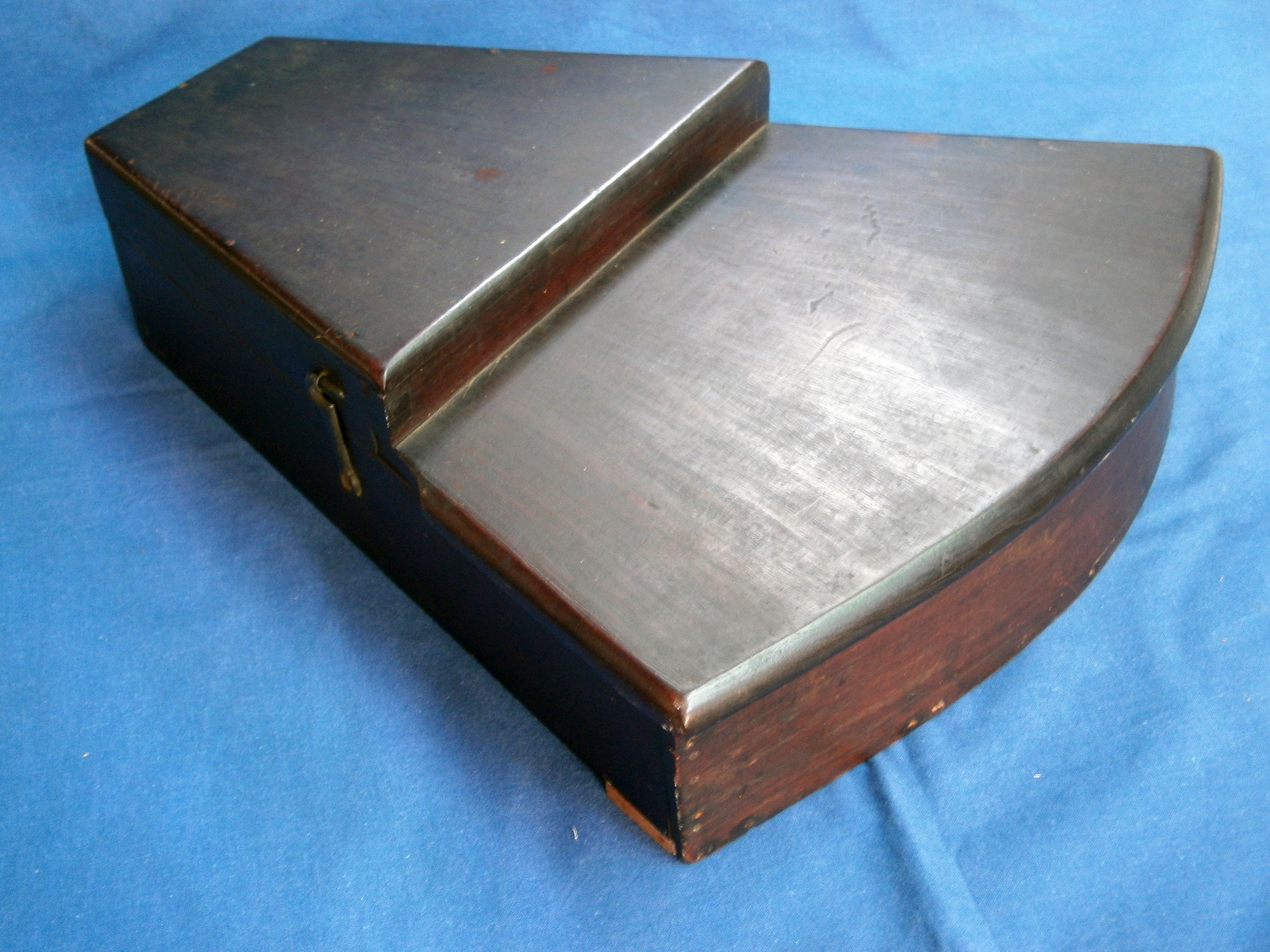
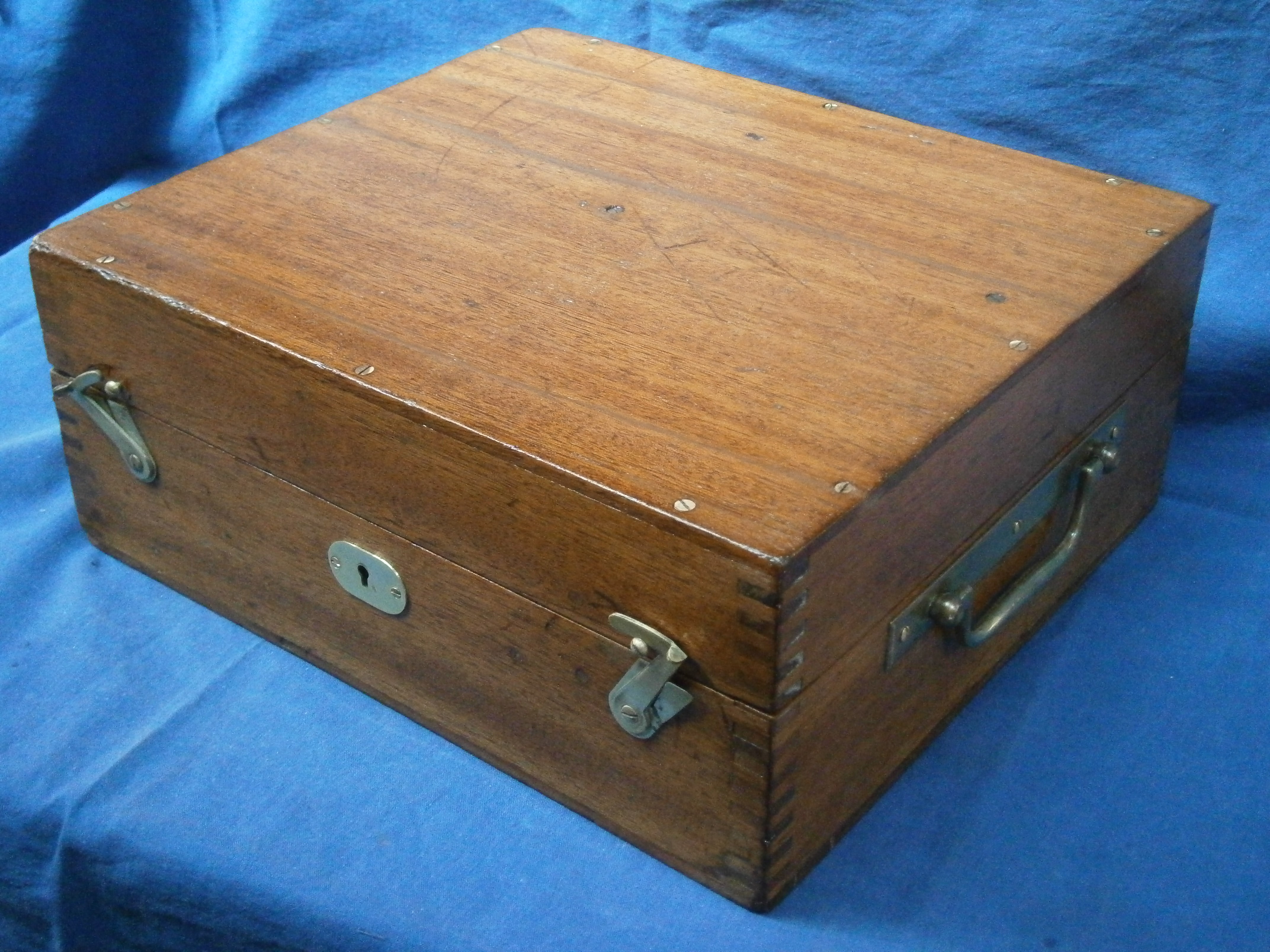
1 Case exterior

Figure 1) Case exterior.

All the photographs are of the instrument after restoration. For some reason, I did not think to take photographs as I proceeded. Except for a small area of the case at the bottom right and a re-positioned hinge, the case was intact. The stepped case looks rather archaic and I have come to associate it with early American instruments, or rather, instruments sold in America. If any one knows something different, I would be glad to hear of it. Where it is un-stained, the timber is light brown, but I am inclined to doubt that it is mahogany. Again, American readers may be able to inform me.

The octant came to me missing two of its legs and its peep sight. Fortunately, I could copy the remaining leg, and for the peep sight I had a model of the pillar that I could copy from a restoration described in my post of 13 June, 2018.
2 Label

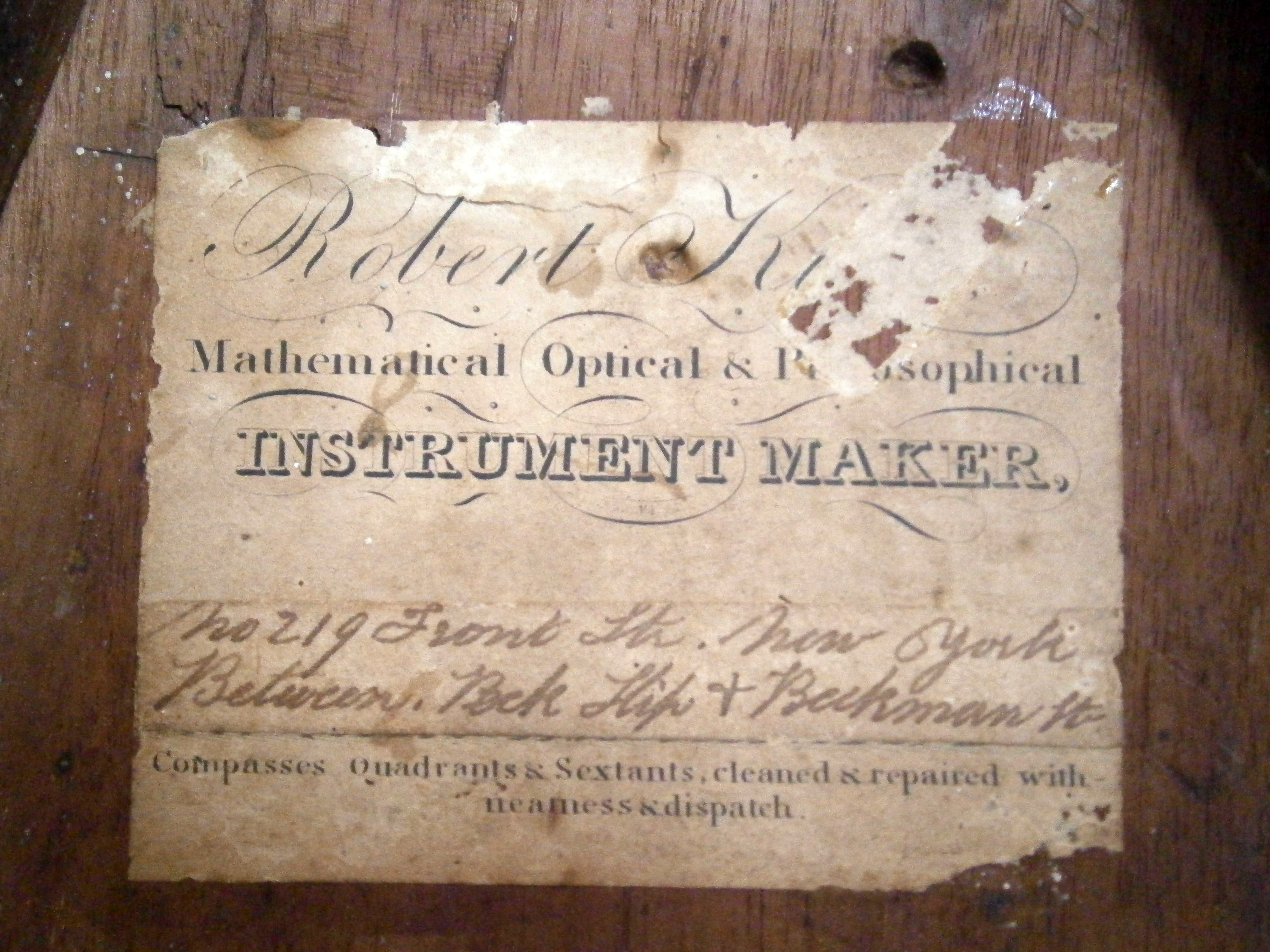
Figure 2: Seller’s label.

A seller (there may have been others) was “Robert King of 219 Front Street, New York.  Between Beekman Street and Peck Slip.” The hand-written address is pasted on top of the rest of the label. All these names still exist, but unless 219 was down an alley way, it has been replaced by a modern-looking frontage. Perhaps someone in New York can add information that it not available by my having looked on Google Earth. I have not been able to discover when Robert King was active as it is unfortunately a very common name. Very many instrument makers did not actually make the instruments that they sold and this applies particularly to sextants,  because of the requirement for a large and expensive dividing engine. It may be that they sometimes assembled instrument from major parts and possessed enough skill to carry out overhauls and repairs. (See end note).
OLYMPUS DIGITAL CAMERA

Figure 3: Divider’s logo.

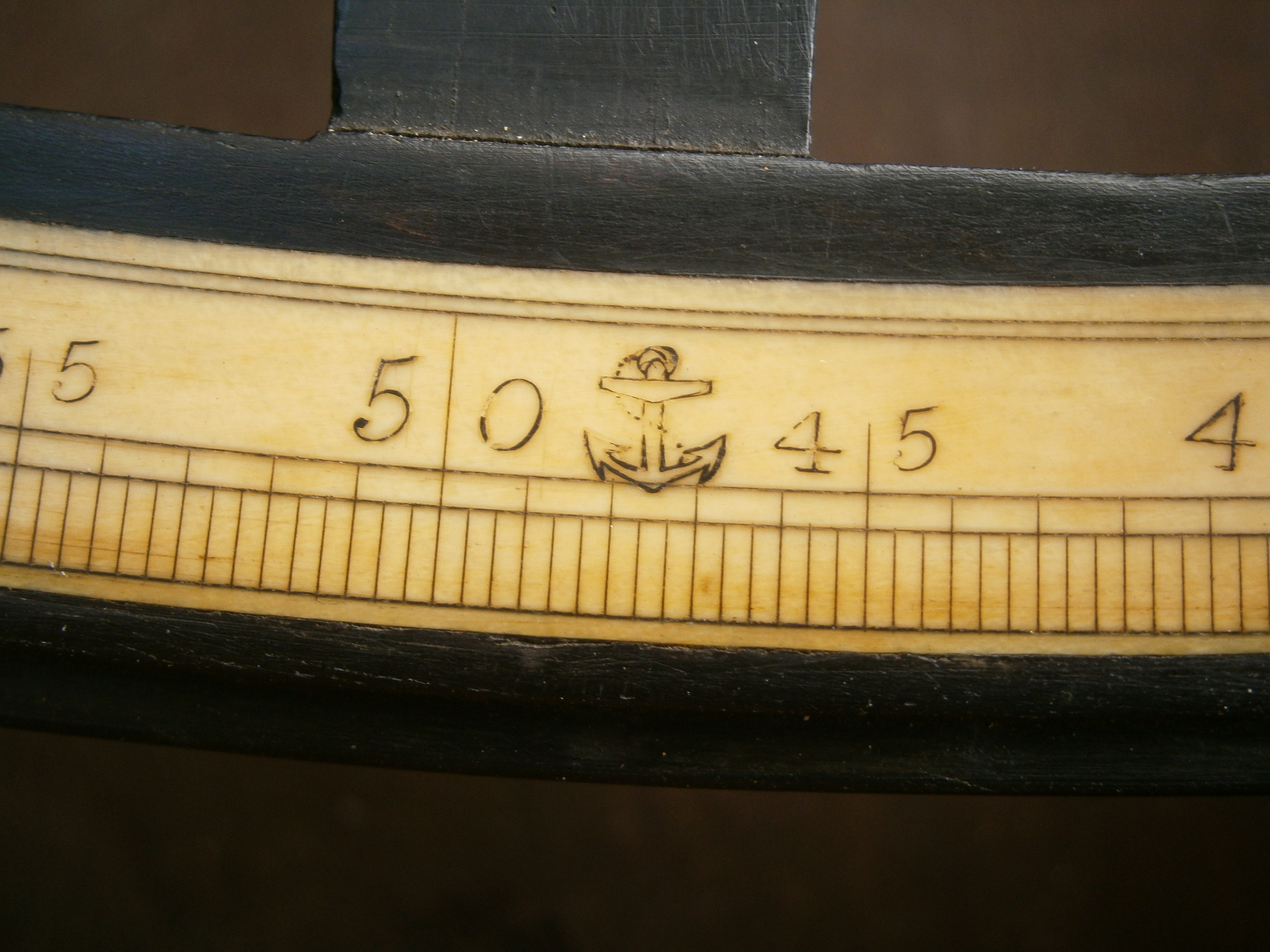
We can be sure that King did not make the frame of this instrument and it is very unlikely that he made any other parts. Figure 3 shows the central part of the arc, which has a very clear fouled anchor logo. This is usually associated with instruments divided by Jesse Ramsden after completing his second dividing engine in about 1774, with the logo flanked by the initial letters I and R. It may be that Matthew Berge, who took over the business after Ramsden’s death in 1800, continued to use the logo as a sign of excellence, though without the initials. Berge’s price list for 1801 shows him selling “Hadley’s Octants in ebony with ivory arches” for between £2  5s (£2.25) and £5  5s (£5.25). Families of the time could get by on about £40 a year and be comfortable on £100, so even a cheap ebony octant represented a considerable investment.

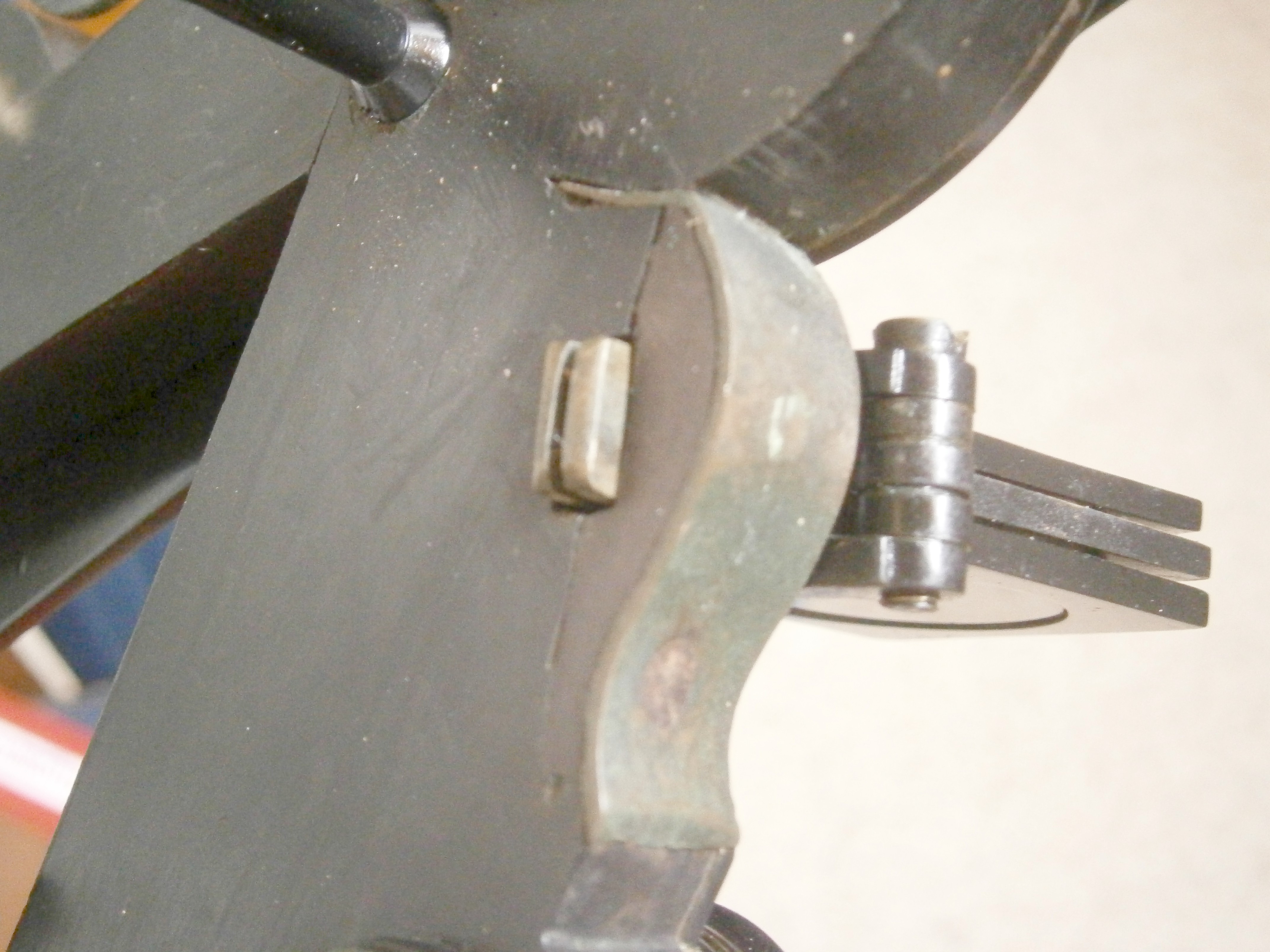
However, King may have carried out a repair on the octant as shown in Figure 4.  An area of weakness where the index shades are mounted could have led to splitting of the ebony frame along the grain. This area has been reinforced by letting in a slip of brass, secured at one end by a screw.
Repair 002

Figure 4: Repair to frame.

Early quadrants, which were divided by hand, necessarily had to have large radii, of about 380 mm (15 ins), and they were not provided with a handle. My quadrant has a radius of about 290 mm (11.5 ins) and has no handle, so while the design is archaic, it must have been made in the 1770s or later. Another ebony quadrant that I have is of about 250 mm (9.8 ins) radius and has a typical handle, so is probably later.

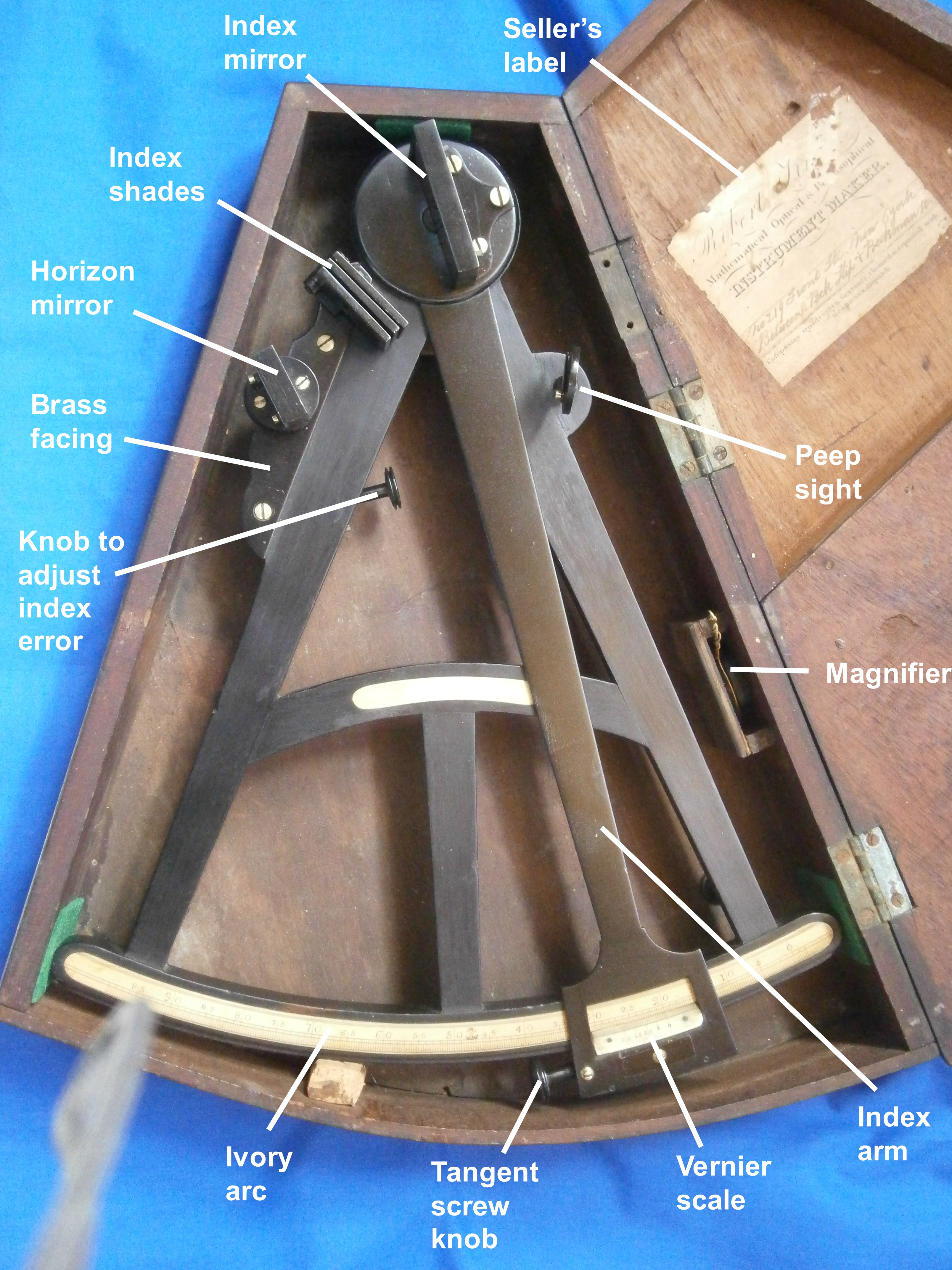
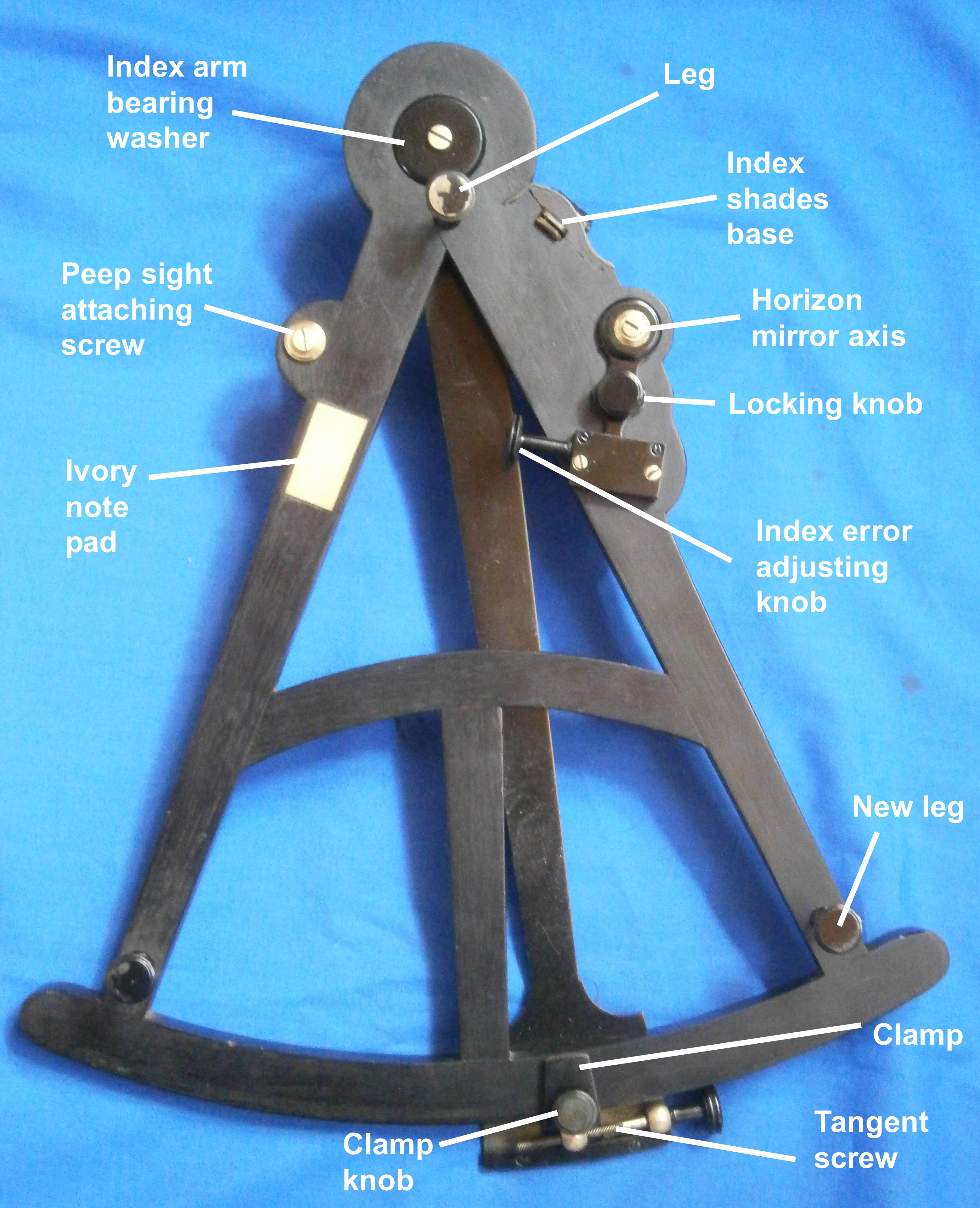
Figure 5 shows the octant in its case with the major parts labelled for the benefit of those people who have yet to buy a copy of “The Nautical Sextant.”
3 GA front in situ

Figure 5: Octant in its case

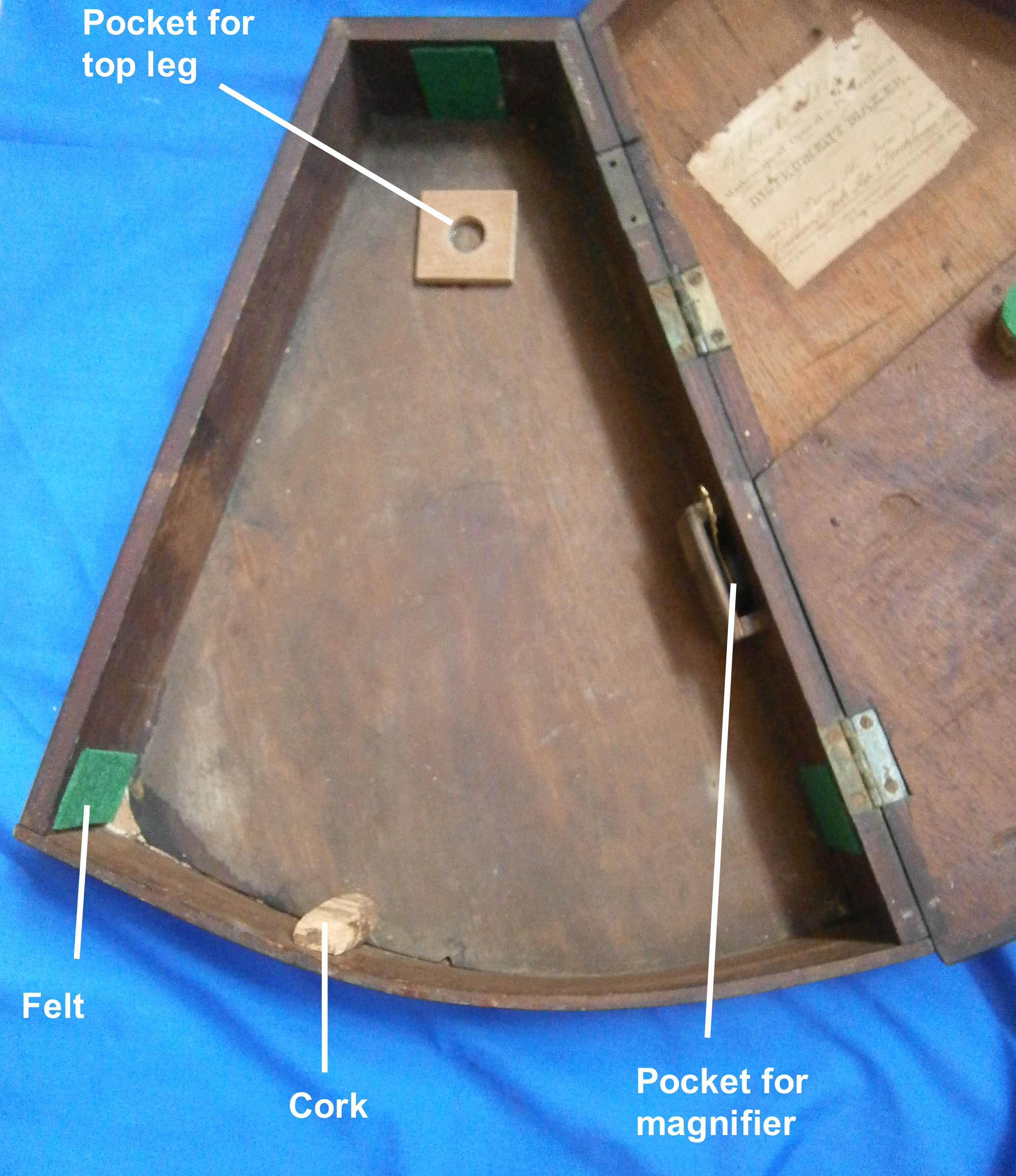
As is usual with keystone cases, the octant is a tight fit and the curved part of  the case is not, as one might expect, a segment of a circle, but its radius increases from left to right, so  the index arm has to be set over to the right. I have added pieces of felt at each corner to the rectangle of cork that prevents the index arm expansion from resting against the inside of the case.
15 Case interior

Figure 6: Interior of case.

Just visible in Figure 6 is a circular piece of cork, faced with felt, attached to the lid. This sits on top of the transverse member of the frame and, with a pocket for the top leg which I have added, prevents the octant moving about when the lid is closed.

Figure 6 shows a rear view of the instrument out of its case. The frame is made of heart ebony, a hard, black, stable and very dense African hardwood. The index arm and most of the other fittings are of brass, while the arc and note pad are of ivory.
4 GA rear

Figure 7: Rear (right hand side) view.

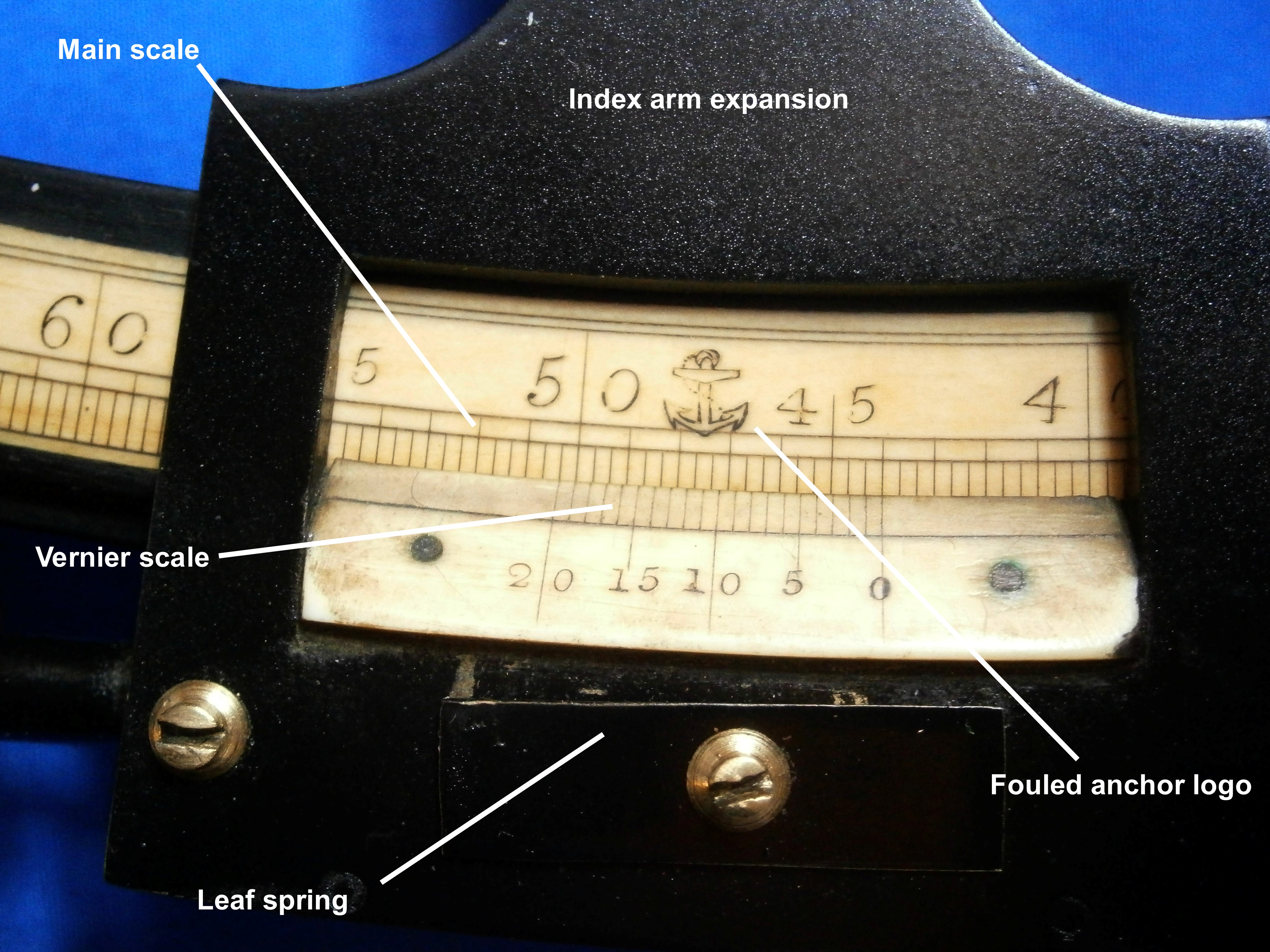
Figure 8 shows details of the scales. The main scale is divided to 20 arc-minutes and the vernier allows readings to a precision of 1 minute. The scales are very well preserved. Ivory tends to shrink in a dry atmosphere and often the glue that holds the main scale inlaid into the limb gives way at one end. The vernier is as usual riveted to the index arm and shrinkage often causes the ivory to crack around one of the holes.
5 Scales

Figure 8: Details of scales.

When wooden frames gave way to ones of bronze, ivory for the scales continued to be used in cheap instruments, rather than scribing  divisions directly into a brass limb rivetted to the frame. The sextant described in my post for September 17, 2018  is the only one I have seen where this has been done. Usually, an arc of silver was let into the limb, as the pure silver was unlikely to divert the scriber like the hard spots often found in the brass of the era.
8 Tangent screw detail

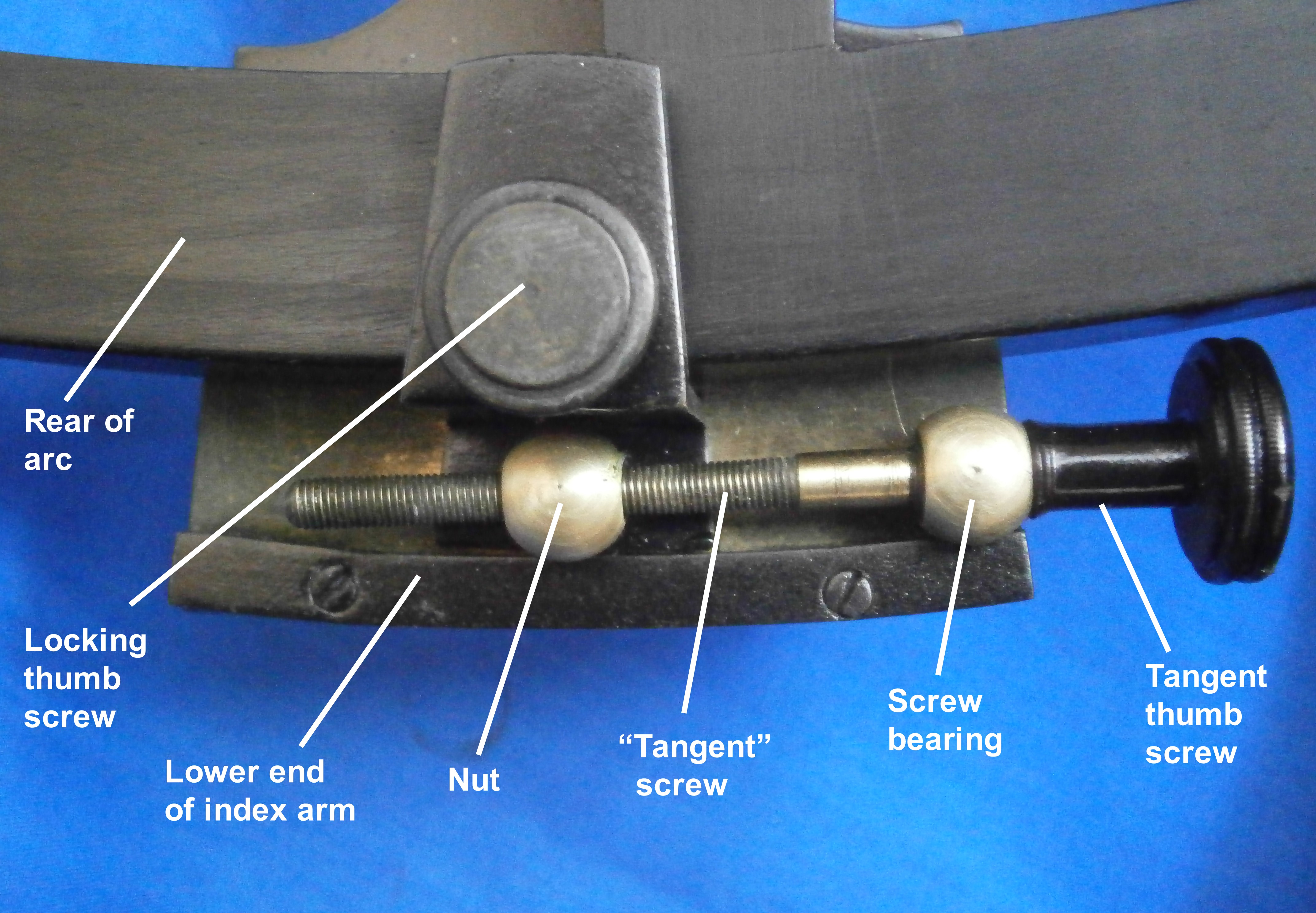
Figure 9: Tangent screw details.

The mechanism for fine adjustment of the index arm is shown in Figure 9. Releasing the “clamp” by unscrewing the locking thumb screw allows the index arm to move freely so that a body can rapidly be brought down to near the horizon. Then the Z-shaped piece of metal shown here and in Figure 10 is clamped to the limb. The nut is also attached to this piece of metal or “clamp”. The tangent screw is held captive in its bearing on the right of Figure 9 and the bearing is attached to the index arm, so that when the screw is rotated the index arm is moved slowly one way or the other about a curved guide formed for the base of the clamp on the back of the index arm.
Tangent end view 002

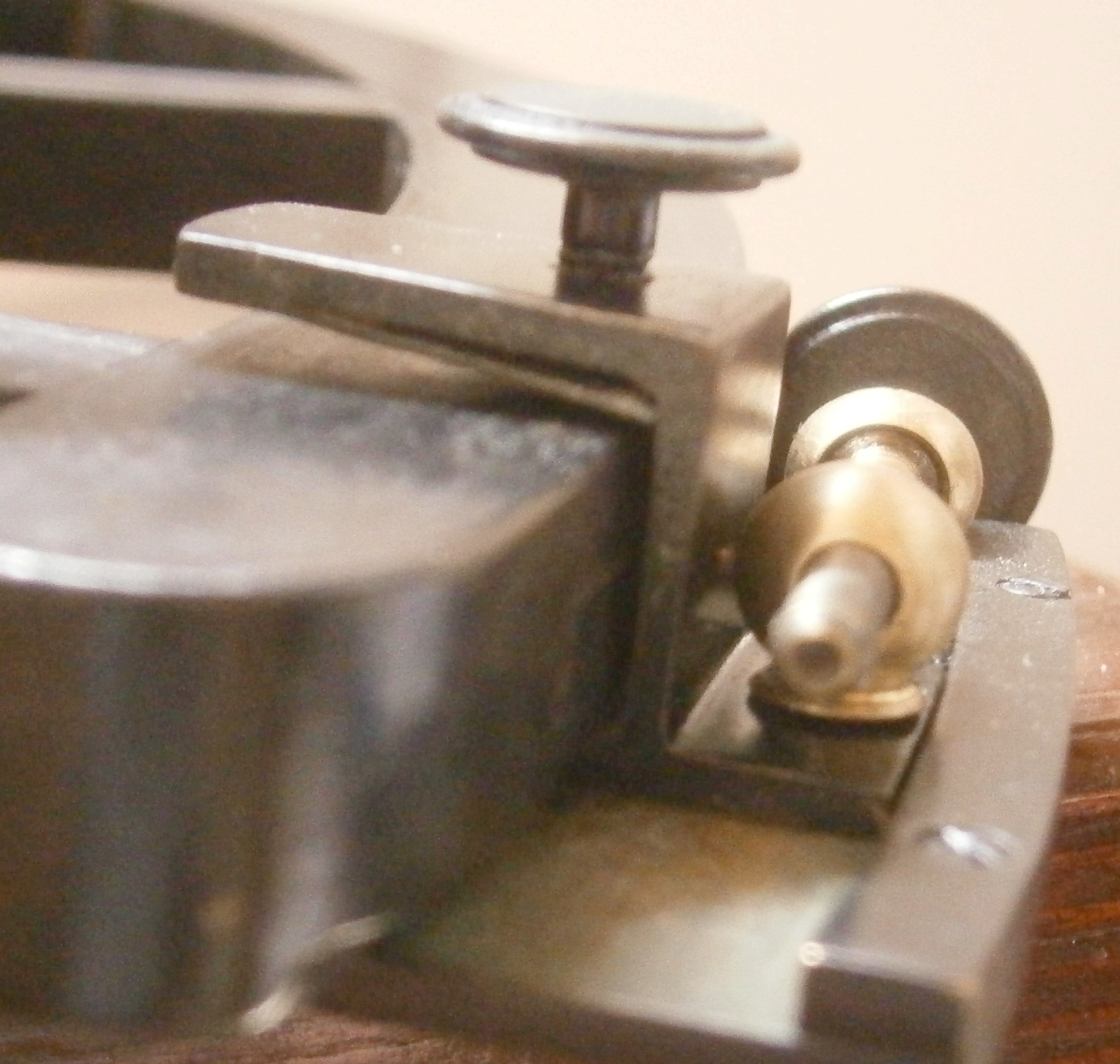
Figure 10: End view of tangent screw clamp.

A piece of spring steel protects the back of the limb from the tip of the clamp screw. What is difficult to show in either photo is that there is a short tongue projecting at the base of the “Z” and this slides in a rebate on the front of the limb – except when the clamp screw is tightened.

As the peep sight was missing altogether, I had to use the pillar from another sextant as a guide to its shape, and then saw and file up the shape of the disc part from sheet brass.  I then inserted the disc into a mortice machined into the top of the pillar and secured it with solder.
6 Peep sight eye side

Figure 11: Peep sight from eye side.

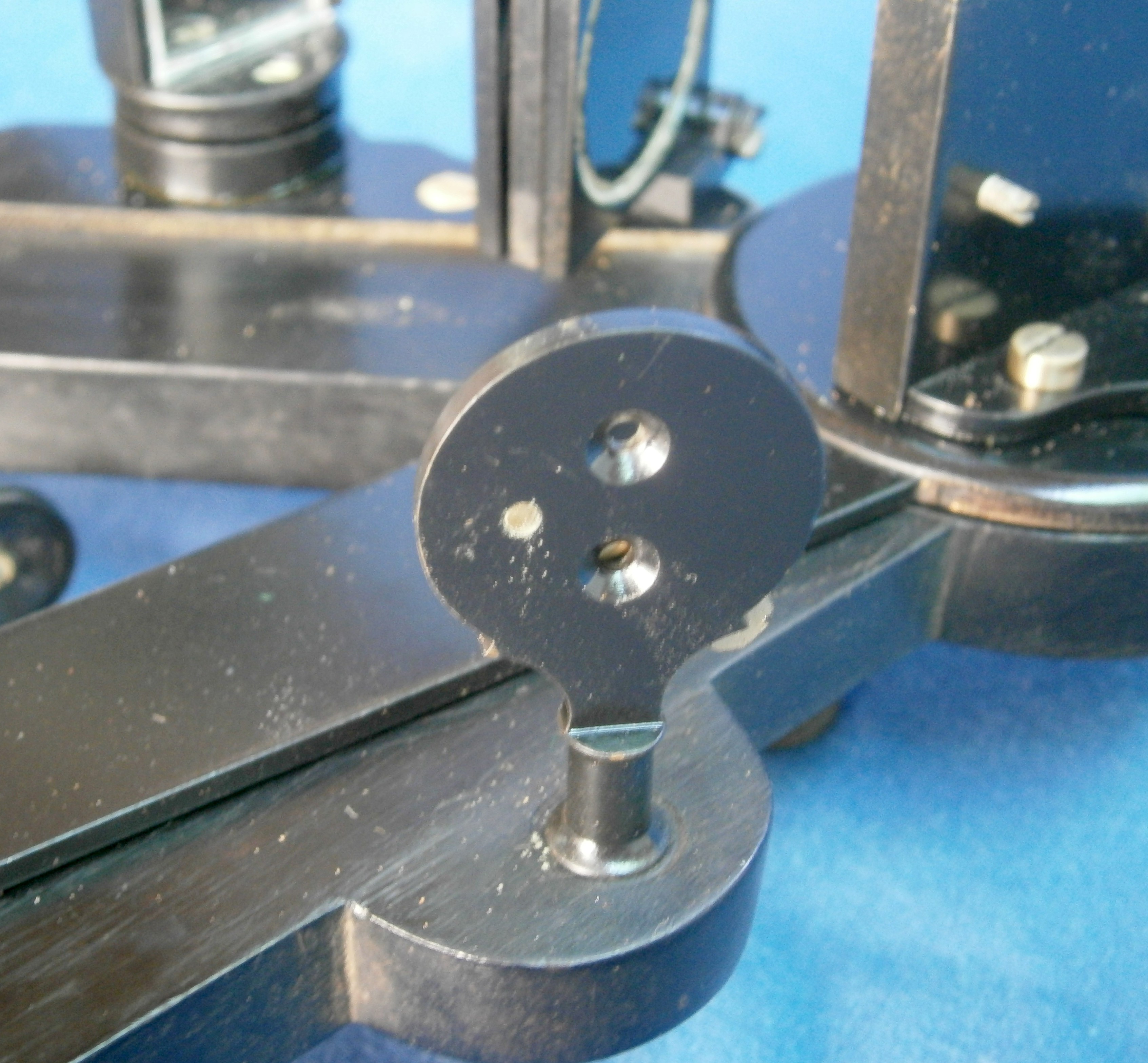
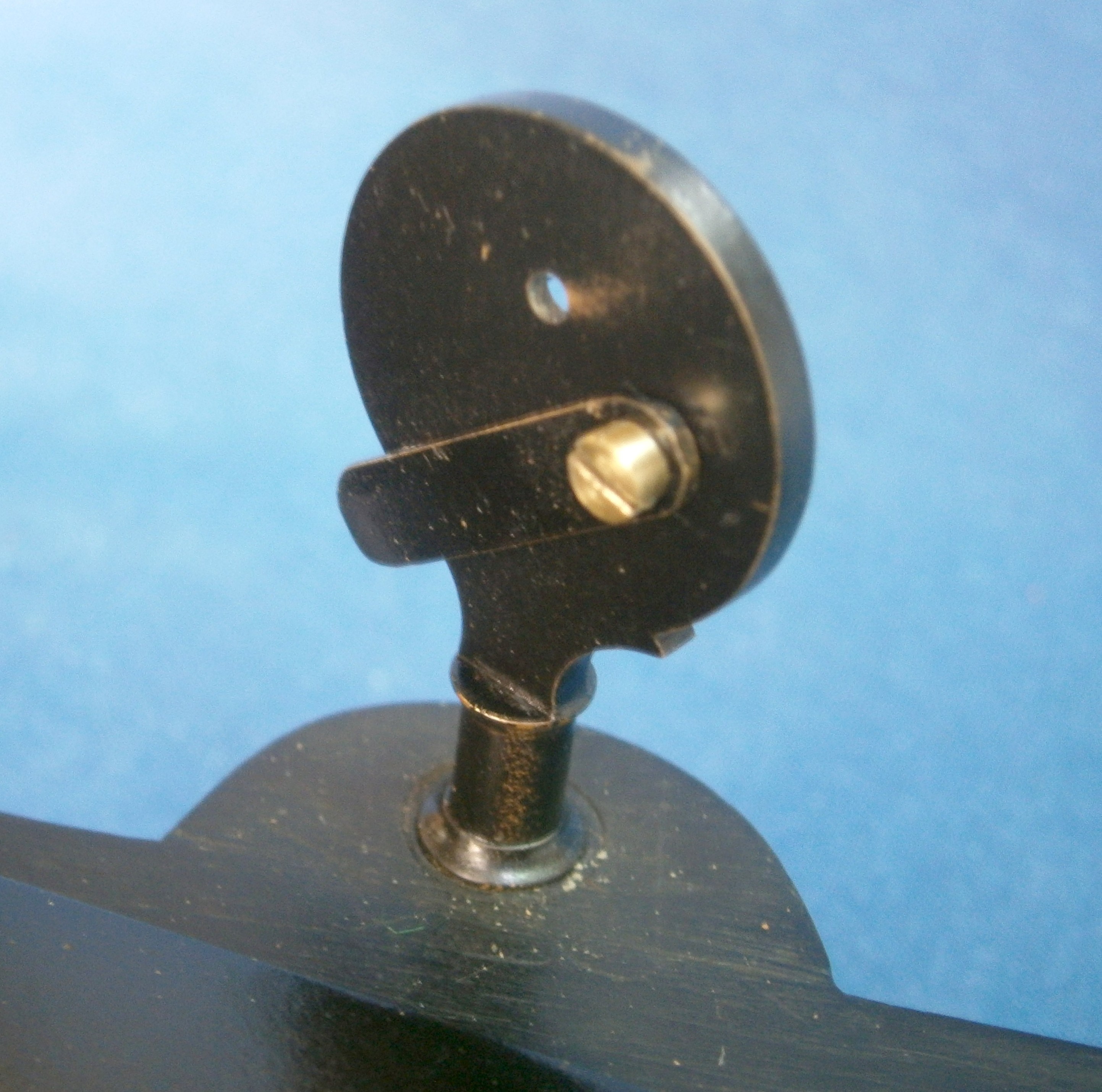
The centre line of the two holes lines up with the horizontal centre line of the horizon mirror. The hole nearer the frame lines up with the junction of the plain and silvered parts of the mirror, while the other hole allows a larger view of the horizon for when its contrast is poor. The shade shown in Figure 12 can be rotated to obscure one or the other of the holes.
7 Peep sight

Figure 12: Rear of peep sight.

Flint glass was essential to make achromatic lenses, but in the eighteenth century it was difficult to obtain in large pieces, so that telescopes were not only expensive but had relatively small apertures of 16 to 20 mm.

When a sextant or octant was used only for taking the noon altitude of the sun for latitude, a peep sight was perfectly adequate for a “normal” eye, which could resolve an arc-minute, in keeping with the precision of the instrument. A normal eye is usually quoted as 6/6 vision (20/20 in the USA), but many young people have 6/4 vision or even better, meaning they can resolve detail at 6 metres that a “normal” has to be at 4 metres to resolve.

When it became necessary to resolve 10 arc seconds (one sixth of a minute) in order to measure lunar distances between the moon and the sun or stars, telescopes became nearly essential, though that great navigator, humanitarian and scientist, Captain James Cook, did not use one until  his second voyage of exploration. On January 15th, 1773, he wrote in his log “…we can certainly observe with greater accuracy with the telescope when the ship is sufficiently steady which however very seldom happens, so that most observations at sea are made without…”  With the wider field of view available with a good modern telescope it is easier to use one, but on my voyages aboard HMB Endeavour, which rolls a lot, I usually brought down a body without the telescope and then added the telescope to my modern sextant to make the fine adjustment and bring the body to sit accurately on the horizon.
Index bearing 002

Figure 13: Structure of index bearing.

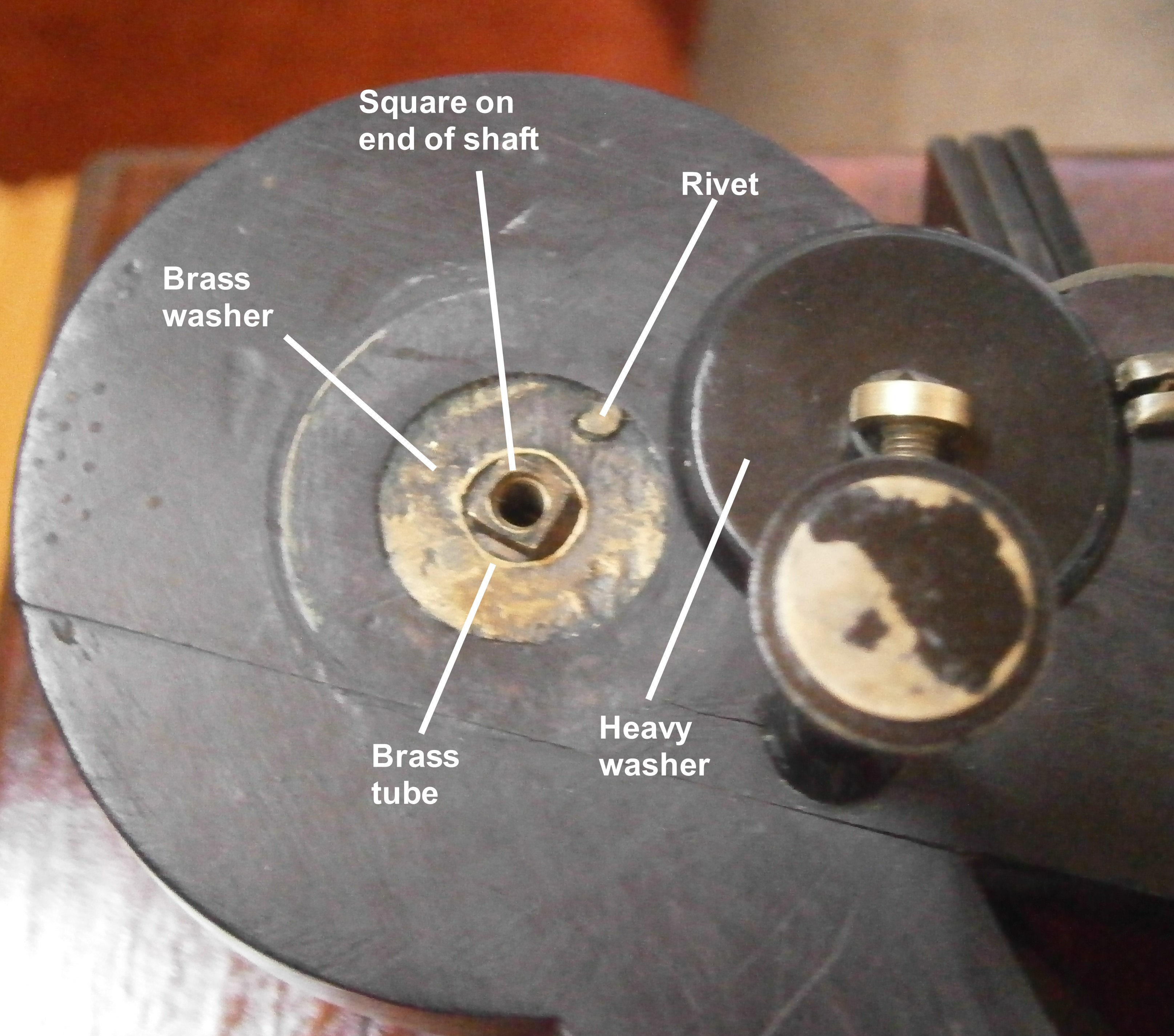
Figure 13 shows the structure of the index bearing. Strictly speaking, it is that which encloses the journal or shaft, but loosely the word is used to include both. There is a brass washer let into each side of the frame and the two are held together by two rivets. The washers enclose a short piece of brass tubing, which forms a bearing for a plain parallel shaft attached to a large circular table on the front (left) side of the octant. This carries the index mirror. Originally, a piece of parchment separated the table from the frame. As it had fallen apart, I replaced it with a thin sheet of nylon.

On the back or right hand side a heavy brass washer with a a square hole fits closely over the square on the end of the shaft, so that it turns with the shaft without rotary motion being transmitted to the securing screw and loosening it. There is no provision for taking up wear, but as it is not an instrument of the highest precision and the shaft is lightly loaded and always moves slowly, no wear is to be expected. An old author (I forget which) made reference to what we would now call “stick-slip” or “stiction”  and suggested that having achieved contact of a body with the horizon and clamped the index arm, it  might continue to move a little without the tangent screw having been touched. I have never been able to observe this. It may be that the author had over-tightened the bearing.

With further development of octants and sextants, a tapered bearing was adopted almost universally, as it allowed for fine adjustment, though the narrow adjusting screw was prone to be over-tightened and broken off by heavy-handed mariners who did not understand the bearing’s structure.

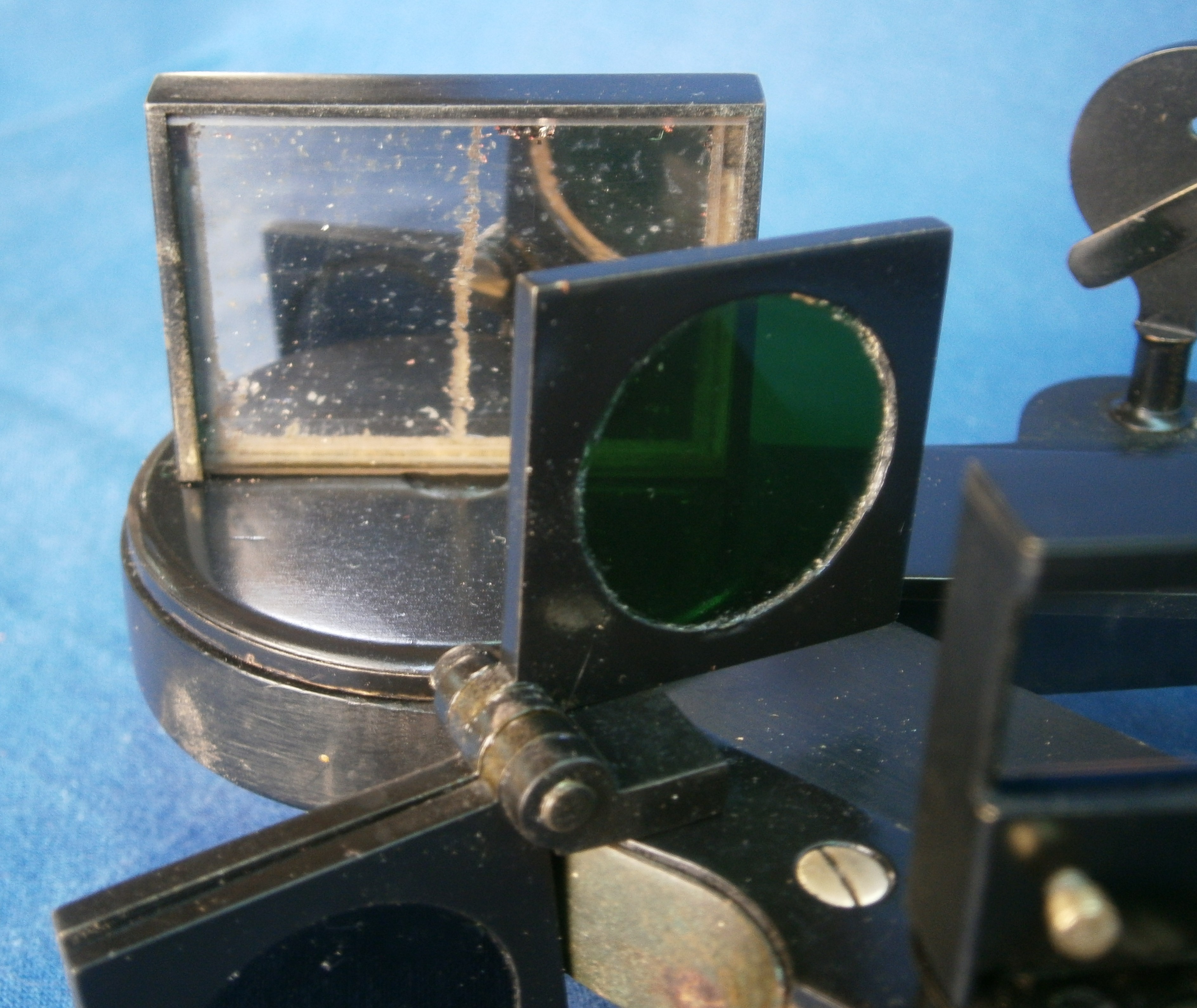
Figure 14 shows the front of the index mirror and its bracket. The “silvering” was probably made from an amalgam of tin with mercury and it was coated with protective sealing wax. While I have replaced the very badly decayed horizon mirror, I have left the index mirror in place as it is still just about usable for demonstrations. The clip that holds it to its bracket is archaic as it applies pressure to three edges of the mirror. From the middle of the eighteenth century it had been appreciated by the Dollonds that to avoid straining and distortion of the glass, it should be restrained at three points only, and seated under these points on three nipples.
9a Index mirror front

Figure 14: Front of index mirror and bracket.

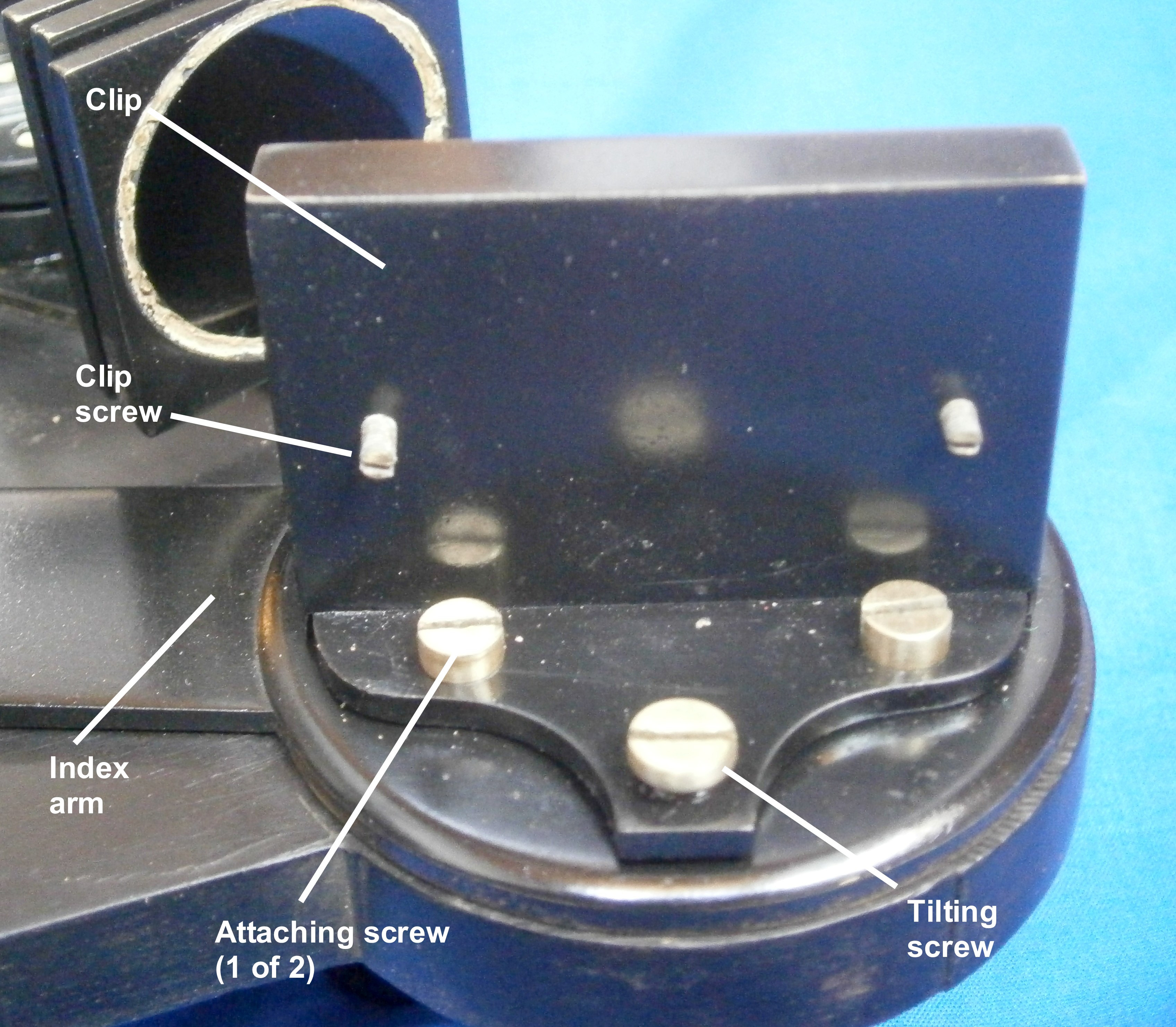
The rear of the clip (Figure 15) has two screws that pull the mirror clip backwards so the the edges of the mirror are held against narrow raised edges of the right angled bracket. The underside of the  base of the bracket is slightly curved so that it can be tilted slightly by the tilting screw so that the mirror can be brought to a right angle with the plane of the arc. This is an effective way of doing so, but if not properly understood, the thread of the tilting screw could be stripped or the base bent by a heavy-handed adjuster.
9 Index mirror rear

Figure 15: Rear of index mirror bracket.

The base of the index shades can be seen in Figure 3 at the top right. Figure 16 shows the shades and the base in detail.
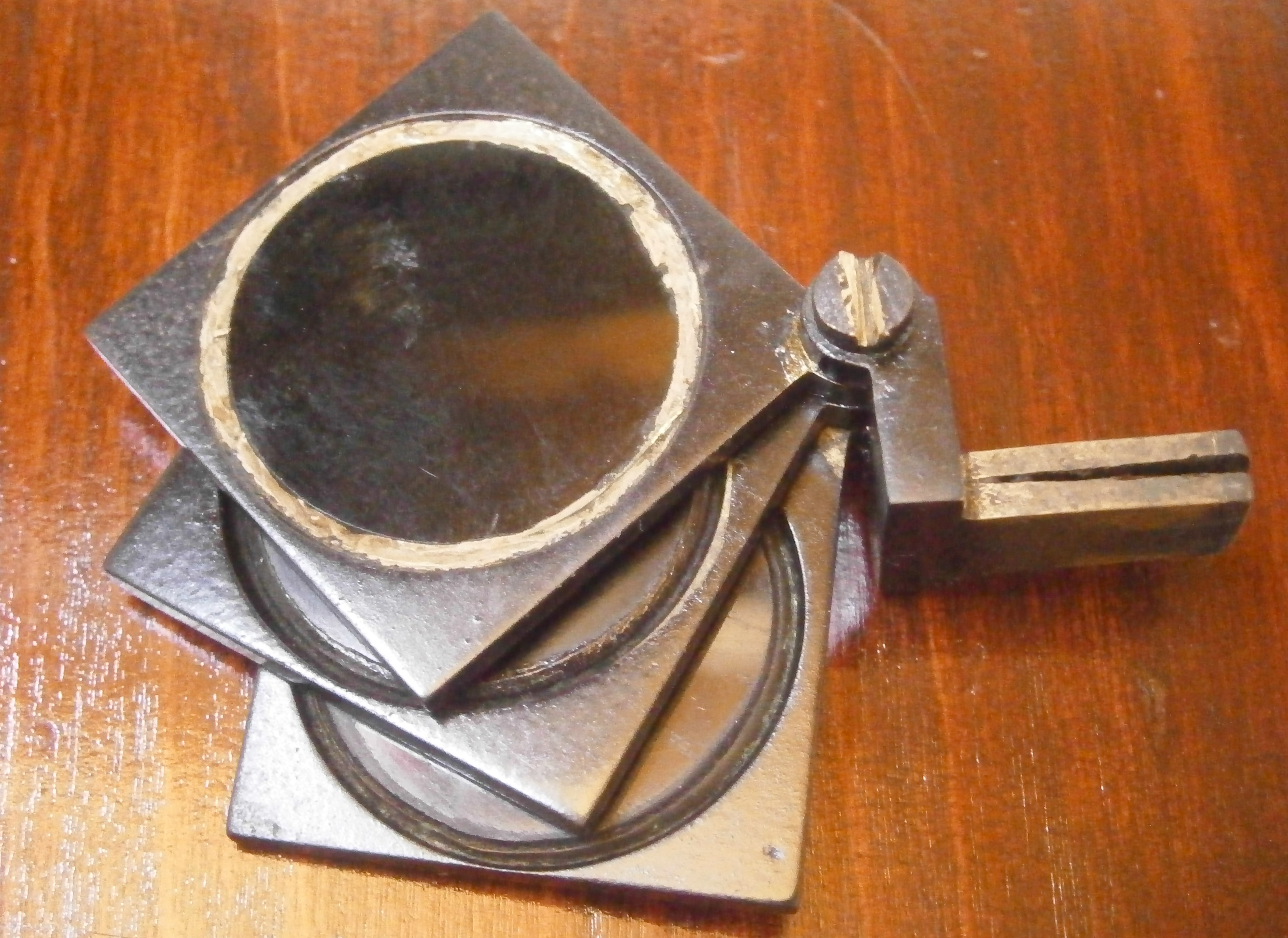
16 Shades

Figure 16: Index shades.

The glass of a shads was usually held in its frame by swaging or deforming the metal over the bevelled edge of the glass, and this can be seen in the bottom two shades. In the top one, the glass seems to have worked loose and is held by antique putty which I have left in place. The shades are separated by washers and held together in a fork which can be closed up by the screw so that they do not flop around. Note in passing that the slot in the screw is vee-shaped, having been formed by a file rather than by a saw, a reflection on the expense and difficulty in the era, of working steel to make a hack or rotary saw.

The split in the base to make a spring allows the shades to be removed easily, an archaic and unnecessary feature in this instrument and presumably a left-over from the time when octants were sometimes fitted with back sights which needed the shades to be moved in position, as in the one I described in my post of June 13, 2018. A brass facing was attached to the sextant by two screws, with a slot for the shades and holes for the horizon mirror base and its adjustment (Figure 5).

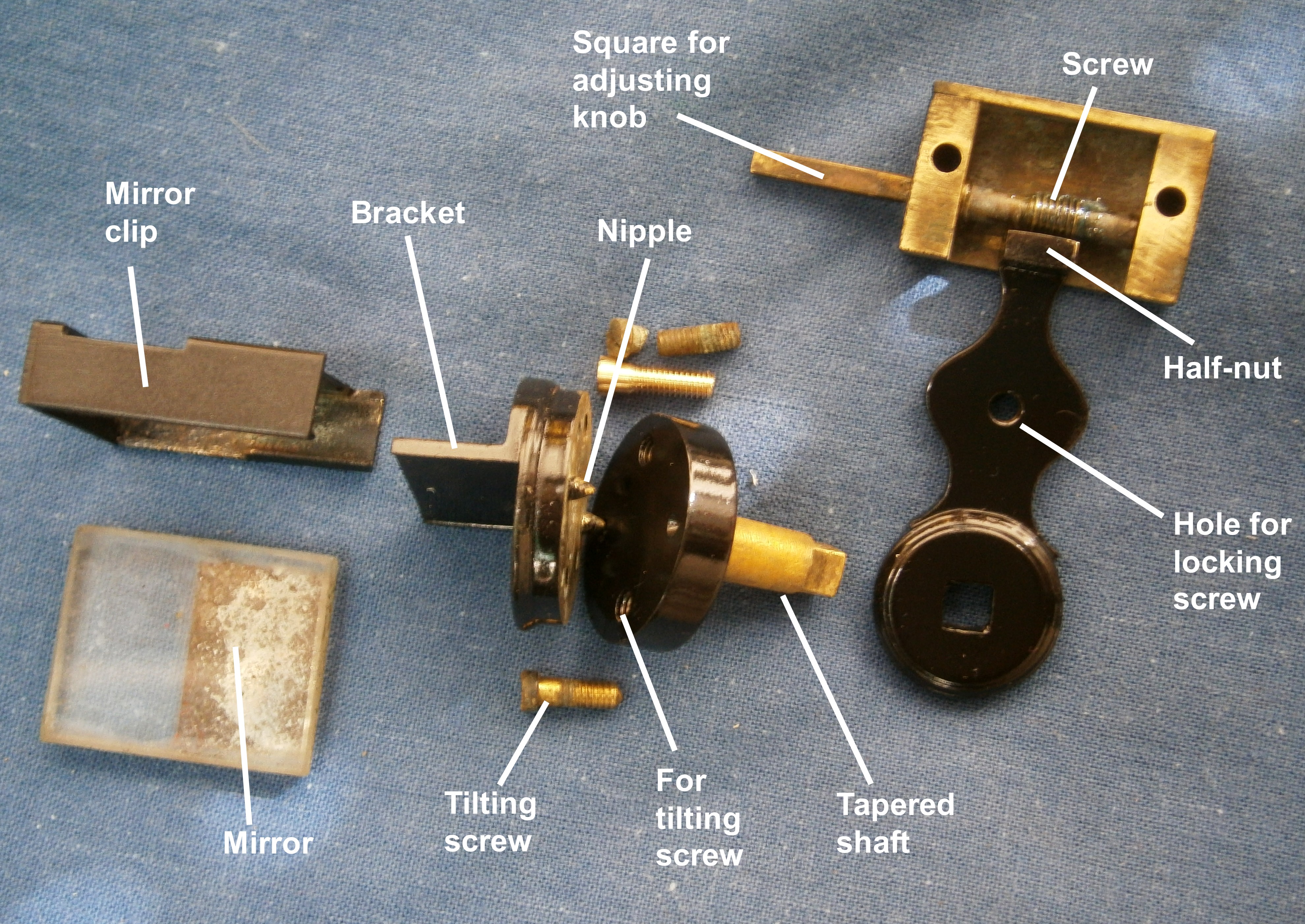
The horizon mirror has a complex arrangement for adjustment. The mirror is held by the clip against a bracket in the same way as for the index mirror. The bracket lies on top of a circular base which can be tilted about an axis of two short pins or nipples by means of two screws to remove side error (see Figure 19 for the details). The base has a short tapered shaft with a square formed on the end which passes through the frame and a straight crank, to be secured by a washer on the other side.
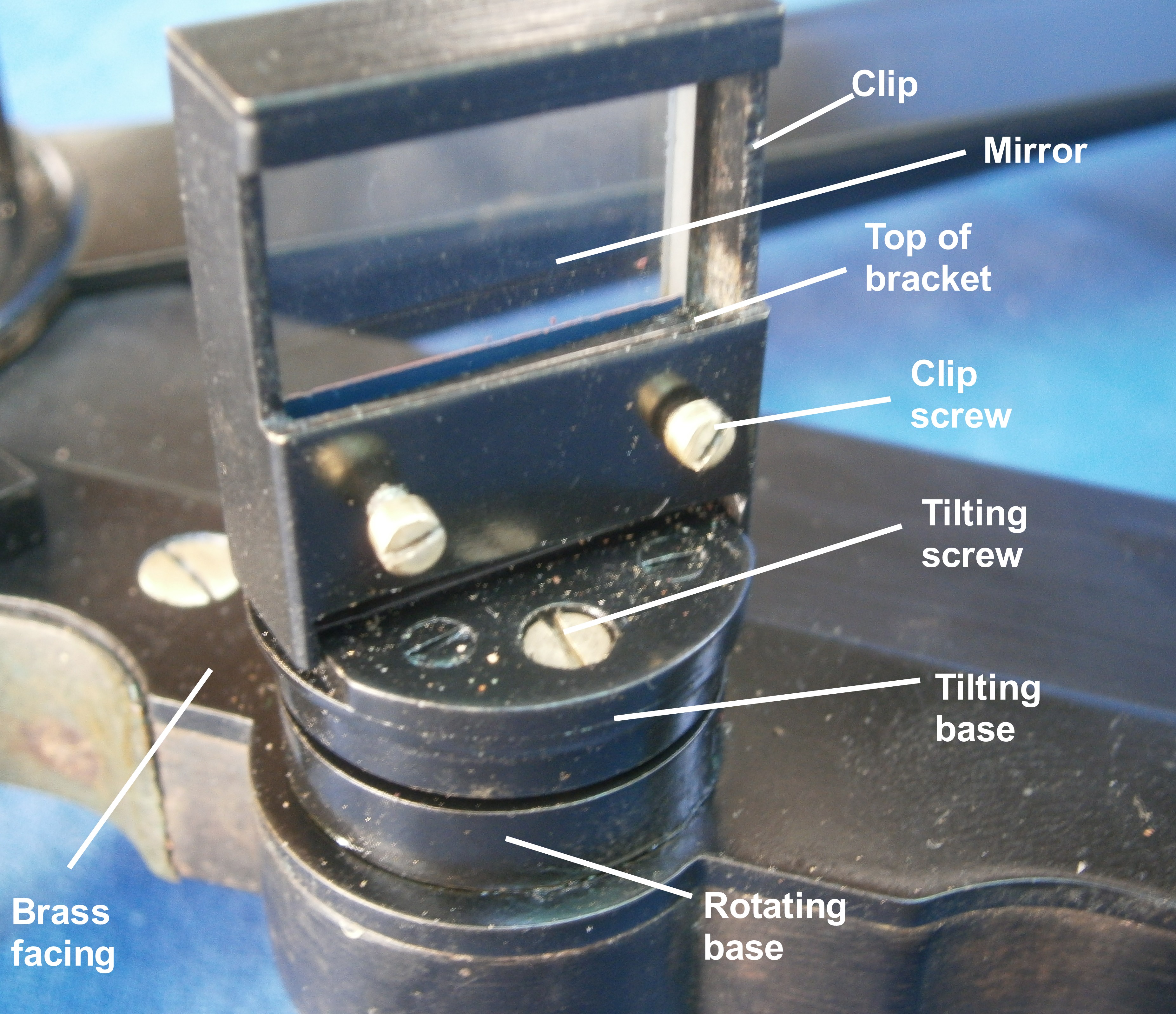
11 H mirror detail

Figure 17: Horizon mirror and bracket.

The base can be rotated through a small angle to remove index error  by means of a half-nut formed on the end of the crank and a worm screw, and locked in place by a locking screw (Figure 18). The exploded view in Figure 19 perhaps makes the arrangement clearer.
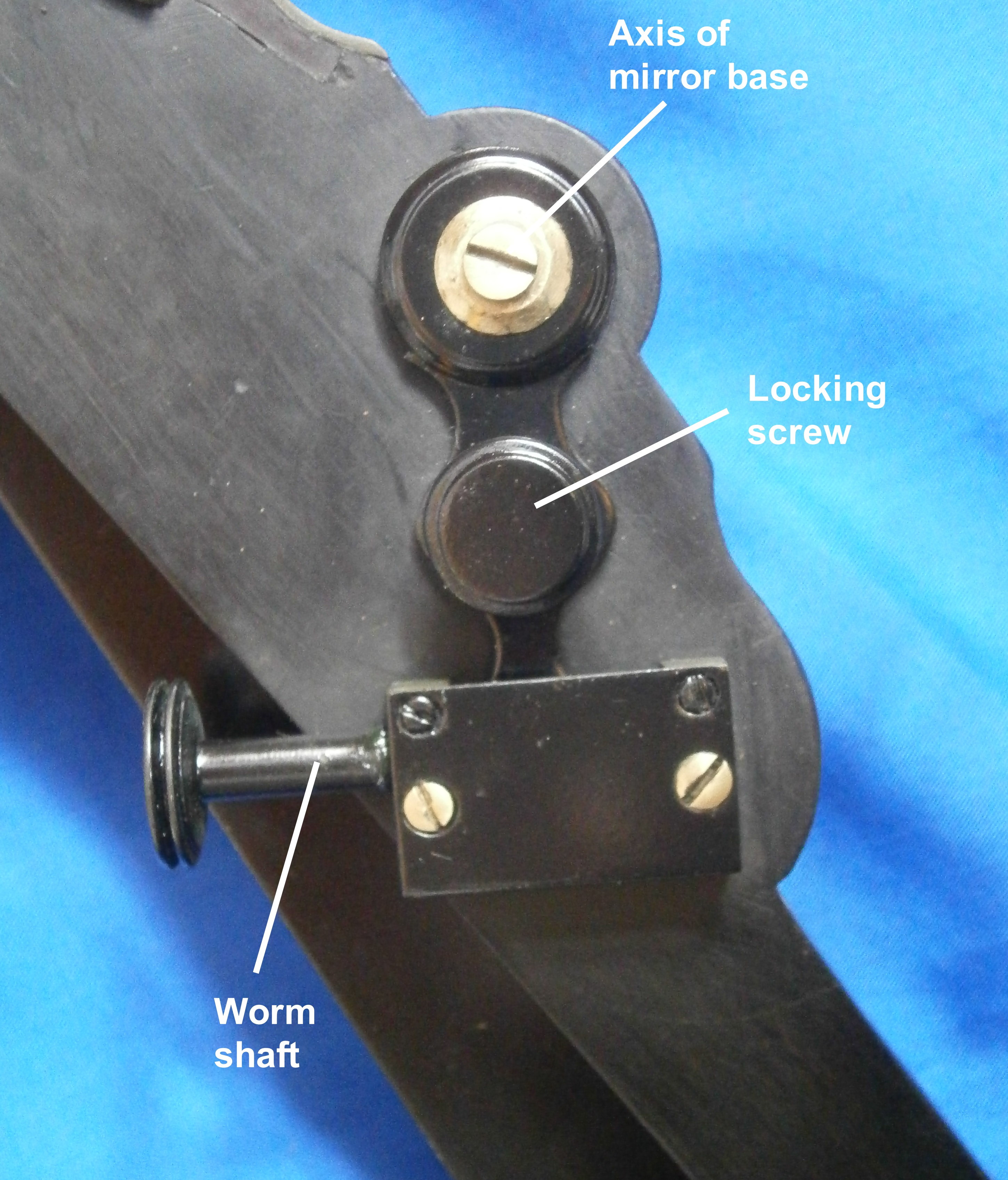
13 Horizon adjust

Figure 18: Horizon mirror index adjustment.

When I removed one of the tilting screws it lost its head and I was obliged to make a new one. The old and the new can be seen in Figure 19, lying above the rotating base.
14 Horizon adj exploded

Figure 19: Horizon mirror adjustments exploded.

I have not illustrated an important addition to the octant, the handle,  because none was provided. It is likely that this was a basic octant without frills.

You can find many details about the structure of sextants up to modern times in my book “The Nautical Sextant.” available through Amazon and good nautical booksellers like Paradise Cay and Celestaire.

End Note: Murray Peake has been much more patient than I have in tracking down some details of Robert King:

A Thaxter compass in the National Museum of American History has a seller’s card by Robert King whose dates are given as ca. 1769 to 1868, “…an instrument maker from England who spent most of his career in New York City.”

An auction site also lists an octant with King’s label. This is 17 inches in radius, made of mahogany, except for the lower end of the index arm and is fitted with a back sight. It is a very early octant and was probably divided by hand by a specialist in the art.

Robert King appears in Longworth’s New York Register and City Directory for 1812 and 1817, living in Elm Street. By 1827 he is in Lombard Street and left there in about 1833 for 18 Monroe Street. He appears for the first time in Front Street in 1837/38, but at 212, not 219. By 1845/46 he is accompanied by R King Jnr and by 1850 he is no longer listed.

Presumably, King knew his own address. Perhaps 212 was his residence and 219 his workshop or vice-versa?


A French Hydrographic Sextant

13 01 2019

2 a case inside

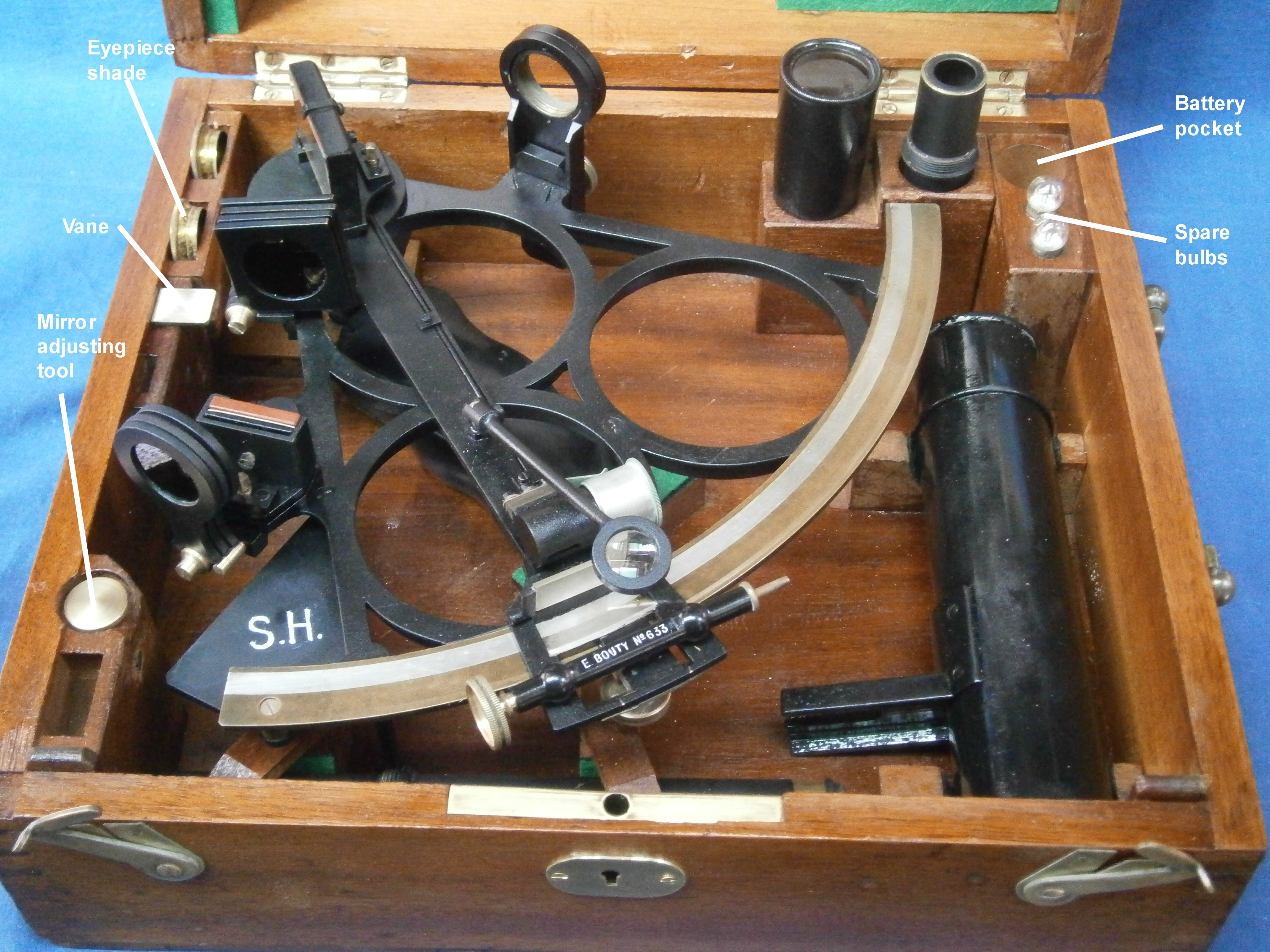
Figure 1: Sextant in its case.

I recently acquired for a relatively modest sum the three-circle vernier sextant shown in Figure 1. Attached at the front corner of the frame is a plate engraved with the letters “S.H.” or “Service Hydrographique (de la Marine)” or French Naval Hydrographical Service, formed in 1886 as successor to the “Dépôt des cartes et plans de la Marine”, founded in 1720. The plate seems to serve no other purpose that I can think of  than as an identifier.

3 a e bouty name

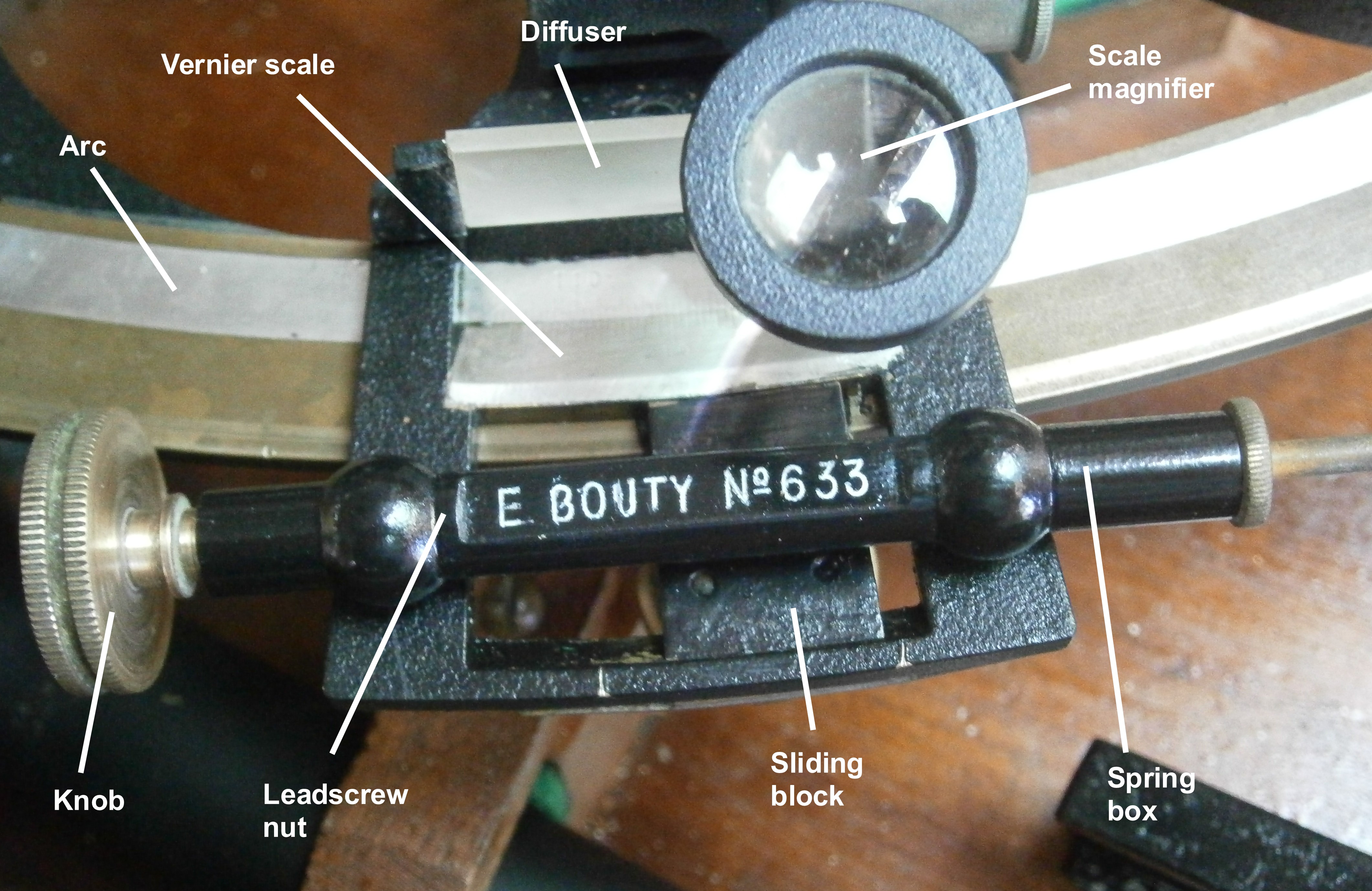
Figure 2: Front of the tangent screw mechanism.

Engraved on the front of the tangent screw mechanism is the name “E. Bouty”. Edmond Bouty (1845 – 1922) was a physicist in the Science Faculty at Paris, but I cannot find that he was an instrument maker, nor is there any other name on the sextant. It may be that his contribution was the design of the scale lighting system, about which more later. It is not even clear that the sextant is of  French manufacture, as at the left end of the limb are the letters “D.S.” indicating Deutsche Seewarte, the German Hydrographical Service, but the frame, of about 180 mm radius, differs in detail from that of C Plath’s Dreikreis sextant.

2 b frame turning marks

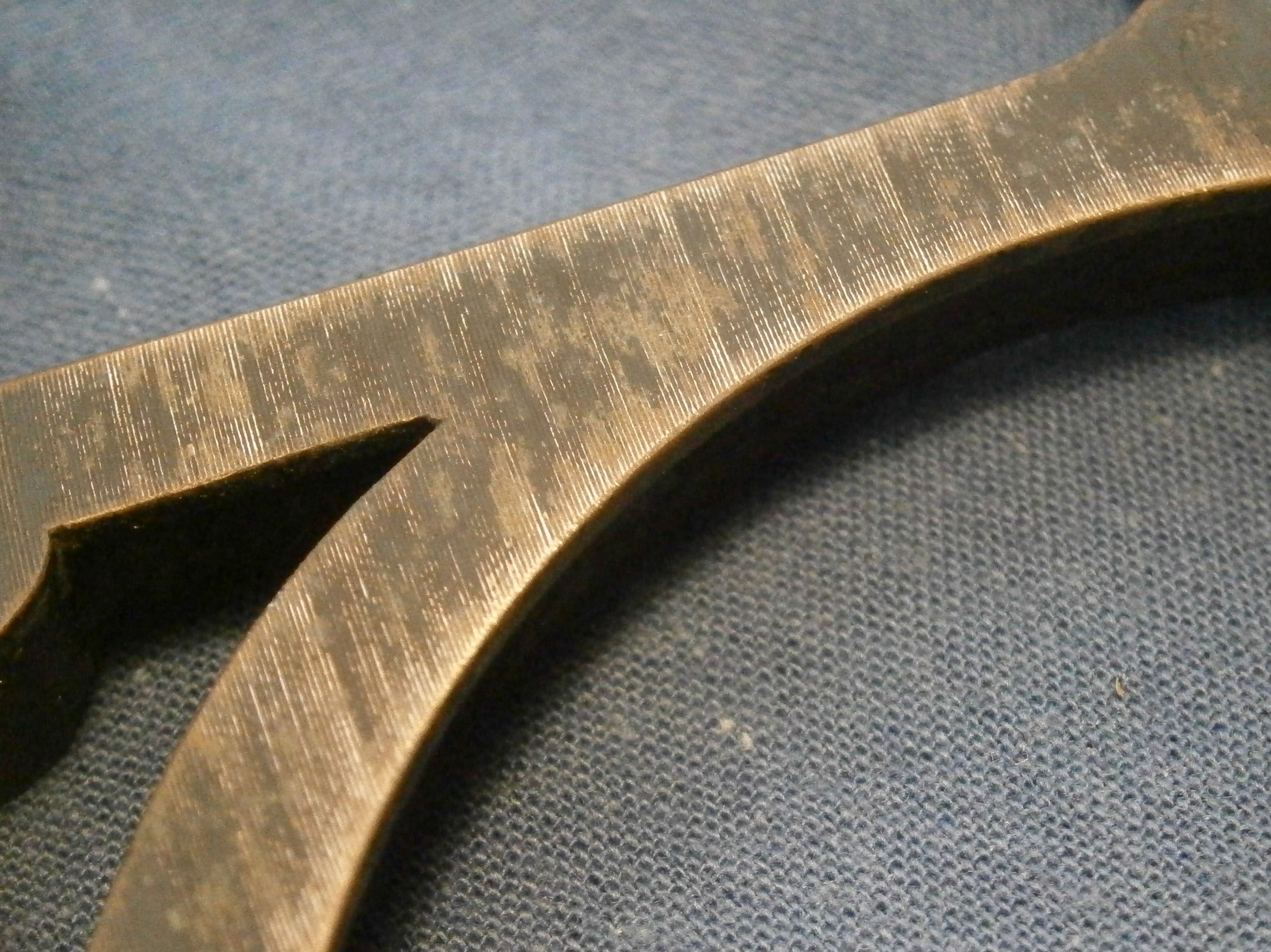
Figure 3: Turning marks on front of frame.

The bronze frame is of no particular interest except that when clearing old and perished paint from the frame during restoration I noticed marks (Figure 3) that showed that it had been faced in a lathe, giving a small clue to the manufacturing process.

3 c spring nut

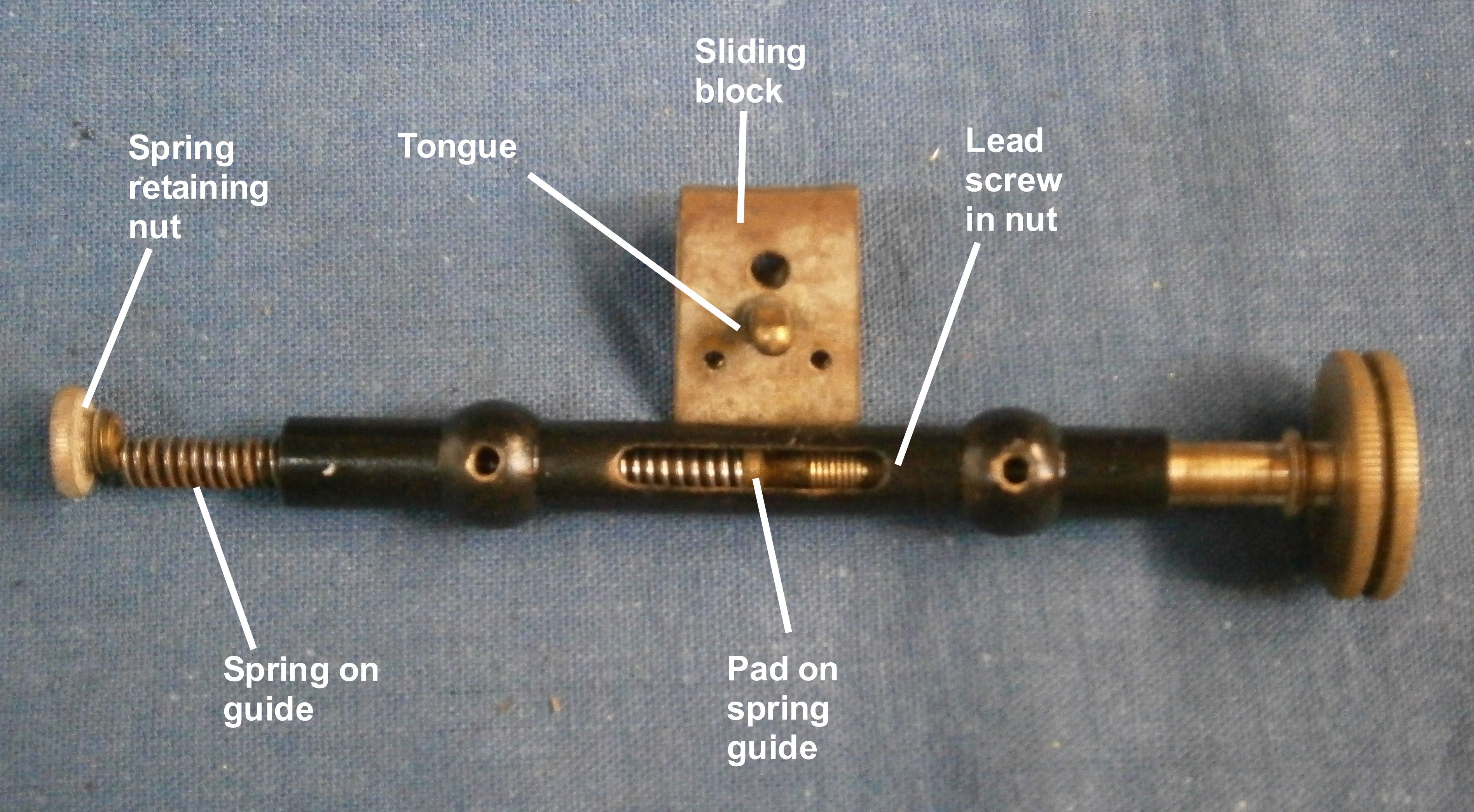
Figure 4: Spring box detail.

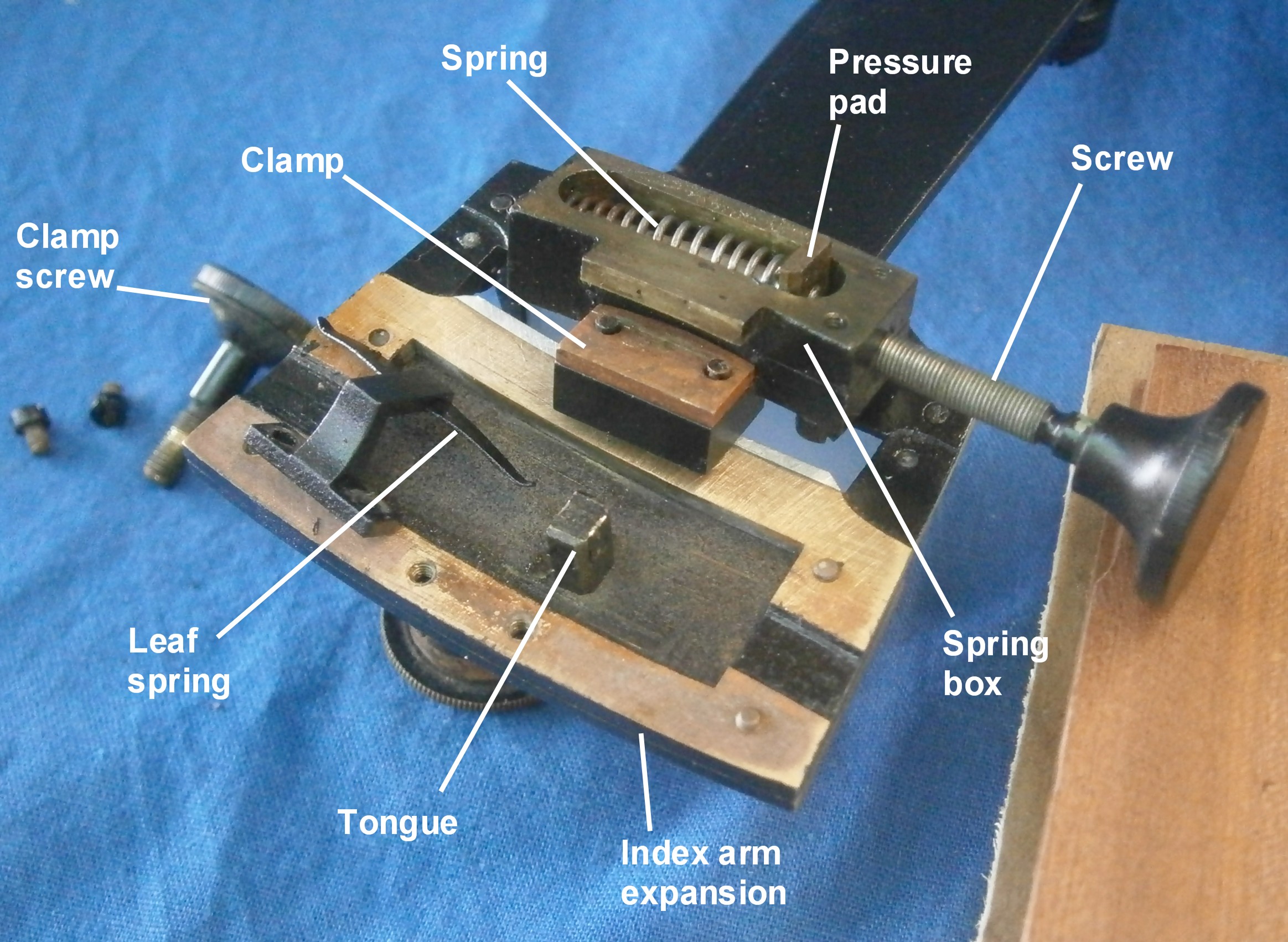
Returning to the tangent screw mechanism, the spring box is shown exploded in Figure 4. A tongue on the sliding block is trapped between the end of the tangent screw and a long spring mounted on a guide and retained by a nut. The end of the guide can be seen on the right of Figure 2.

3 b clamp

Figure 5: Exploded view of index arm clamp.

The sliding block is retained in its slide in the lower end of the index arm by the retaining spring on the upper right of Figure 5, while the clamp screw and its leaf spring bears on the back of the limb. In use, the clamp is slackened and the index arm moved approximately into position, when the clamp is tightened, thus fixing the sliding block to the limb. Turning the tangent screw thus moves the index arm about the sliding block against the pre-load of the helical spring as a means of fine adjustment. In truth, it is the index arm that slides rather than the sliding block, but as no one else had given it a name, I decided to do so when writing “The Nautical Sextant.” This system of applying pre-load was used in many vernier instruments such as vernier theodolites and gun aiming systems. as well as in several makes of sextant.

4 perp adjust

Figure 6: Index mirror bracket.

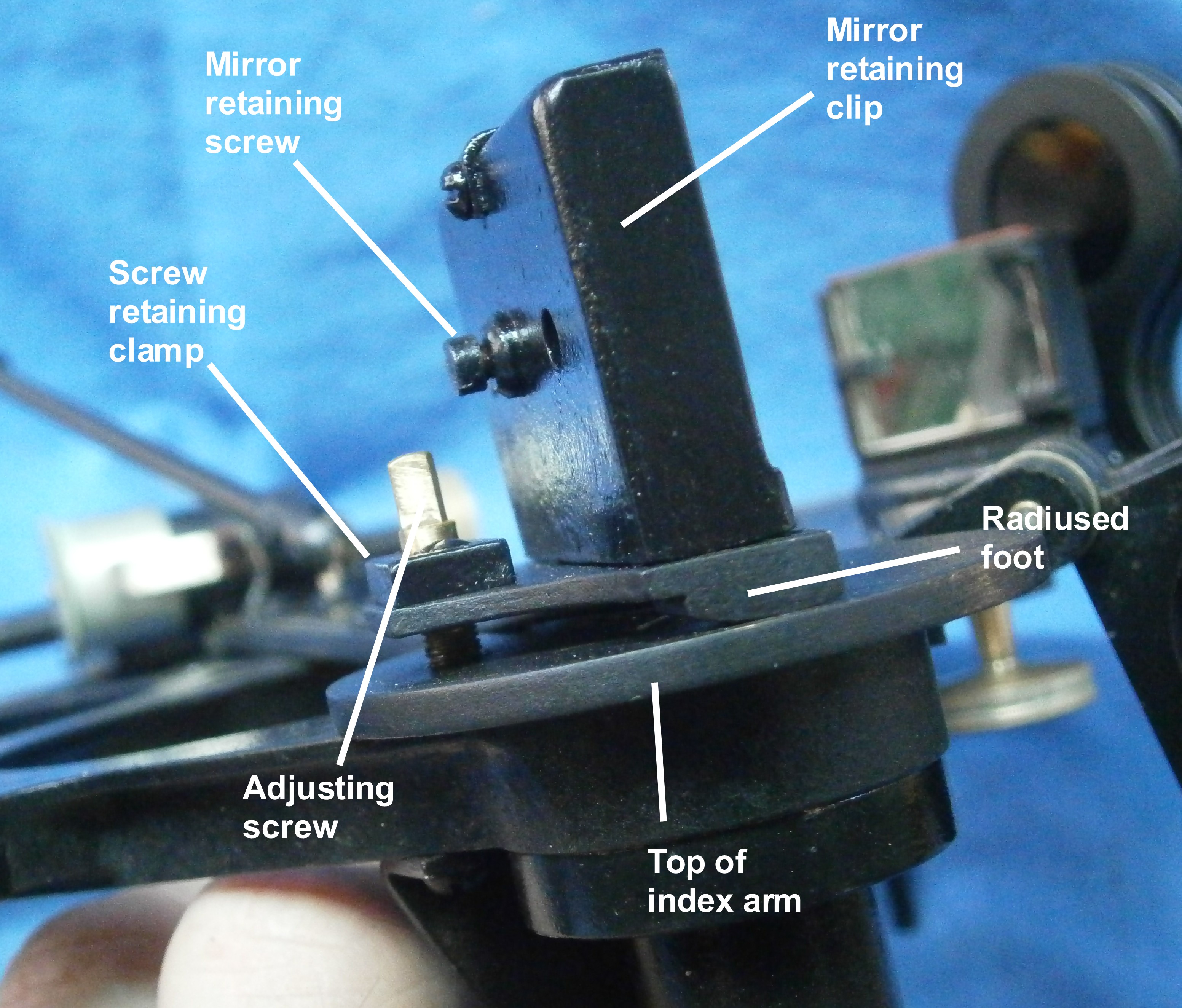
The index mirror is held against a vertical bracket by means of a clip which is tightened against the bracket by means of a screw bearing on the back of the bracket. The mirror is made perpendicular to the arc of the sextant by a system that seems  to have been used only by French makers. Two screws attach the radiused feet of the bracket to the upper end of the index arm and the end of a screw held captive in the base of the bracket can then rock the bracket to bring the mirror square to the plane of the arc..

5 side error

Figure 7: Horizon mirror bracket.

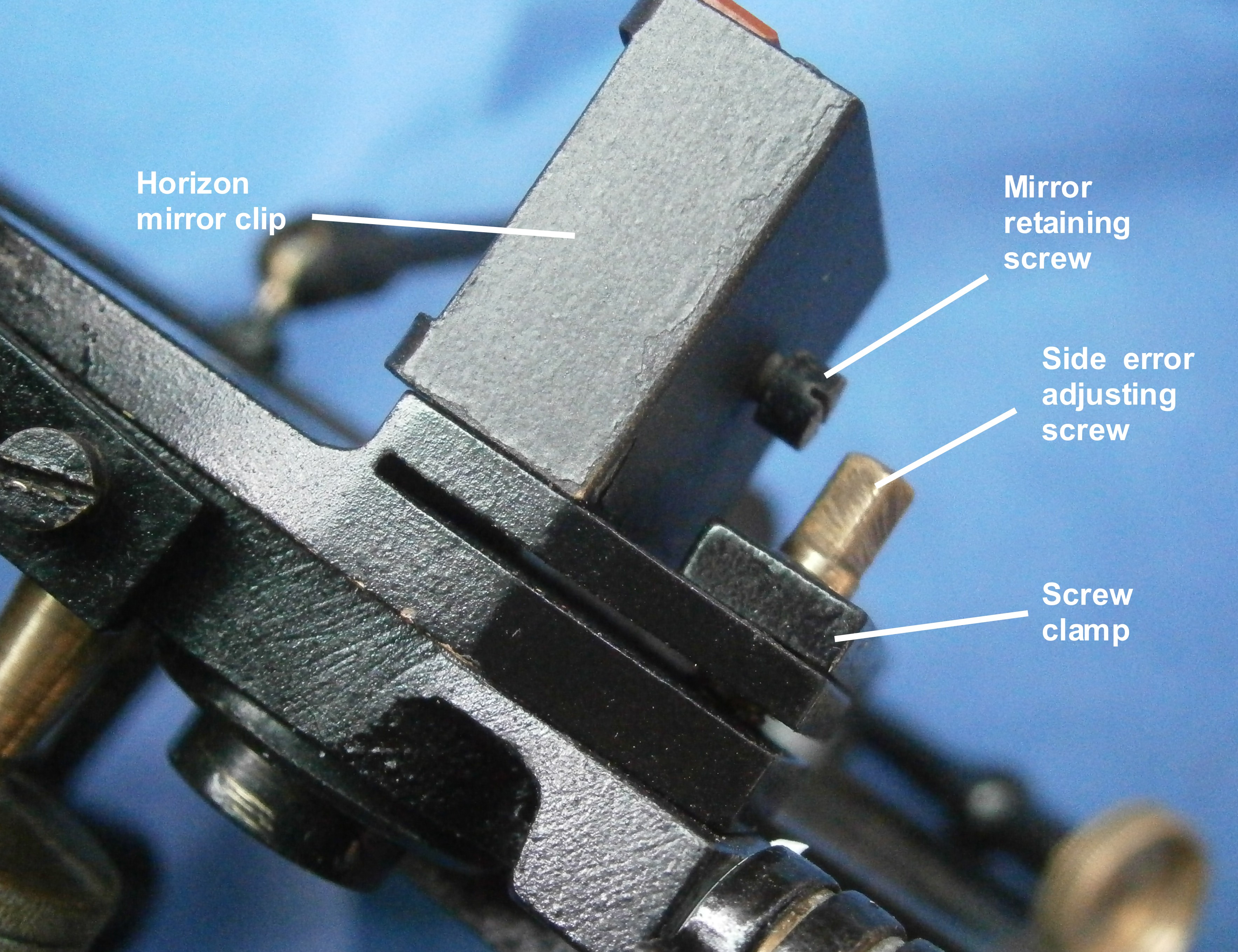
Figure 7 shows a somewhat similar method of adjusting out side error of the horizon mirror, but in this case a deep slot cut nearly through the base of the bracket gives flexibility to the the adjustment by means of another captive screw.

7 horizon mirror

Figure 8: Horizon mirror detail.

The detail shown in Figure 8, as well as making clearer how the mirrors are held against their brackets, shows that the horizon mirror bracket can be adjustably rotated about an axis vertical to the plane of the sextant, in order to adjust out index error. Note that the mirror is fully silvered, which means that the direct view of the horizon does not pass through glass and that the edge of the silvering of the mirror can be given better protection against corrosion. It does however result in a smaller area of overlap of the direct image of the horizon and the  reflected  image of the observed body when using a Galilean telescope. Enter “Freiberger yacht sextant” in the search box at the top of the page for a discussion of why this is so.

6 index error

Figure 9: Detail of index error adjustment.

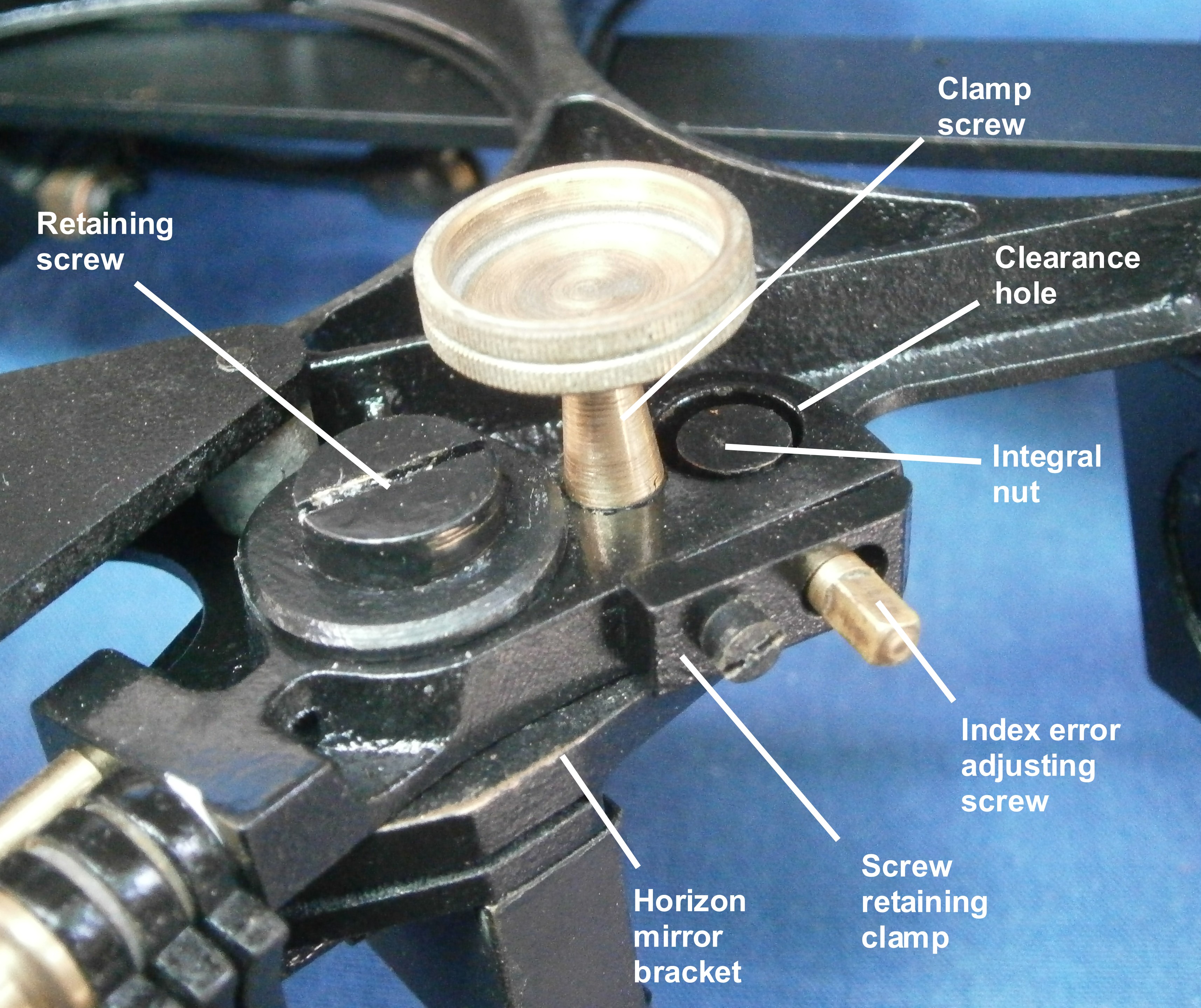
Figure 9 gives more detail on the index error adjustment. There is a boss as an axis on the underside of the horizon mirror bracket that passes through the frame and is held by a retaining screw. A further boss passes through a clearance hole in the frame  and has an internal thread tapped in it as a nut. The index error adjusting screw, held captive in the frame by a screw and clamp, engages with the “nut”, so that when the adjusting screw is turned, the whole mirror bracket rotates. When adjustment is complete, the bracket is locked in place by a  clamp screw..

This is a rather complex means of adjustment of the horizon mirror, which had long been achieved much more simply by means of   a pair of screws bearing against the back of the mirror, while lugs on the mirror clamp provided spring loading. Elegant though it may have seemed to its (?) French inventor, it is unnecessarily complex., though perhaps no more complex than the solution adopted by Brandis and its US successors.

9 battery handle

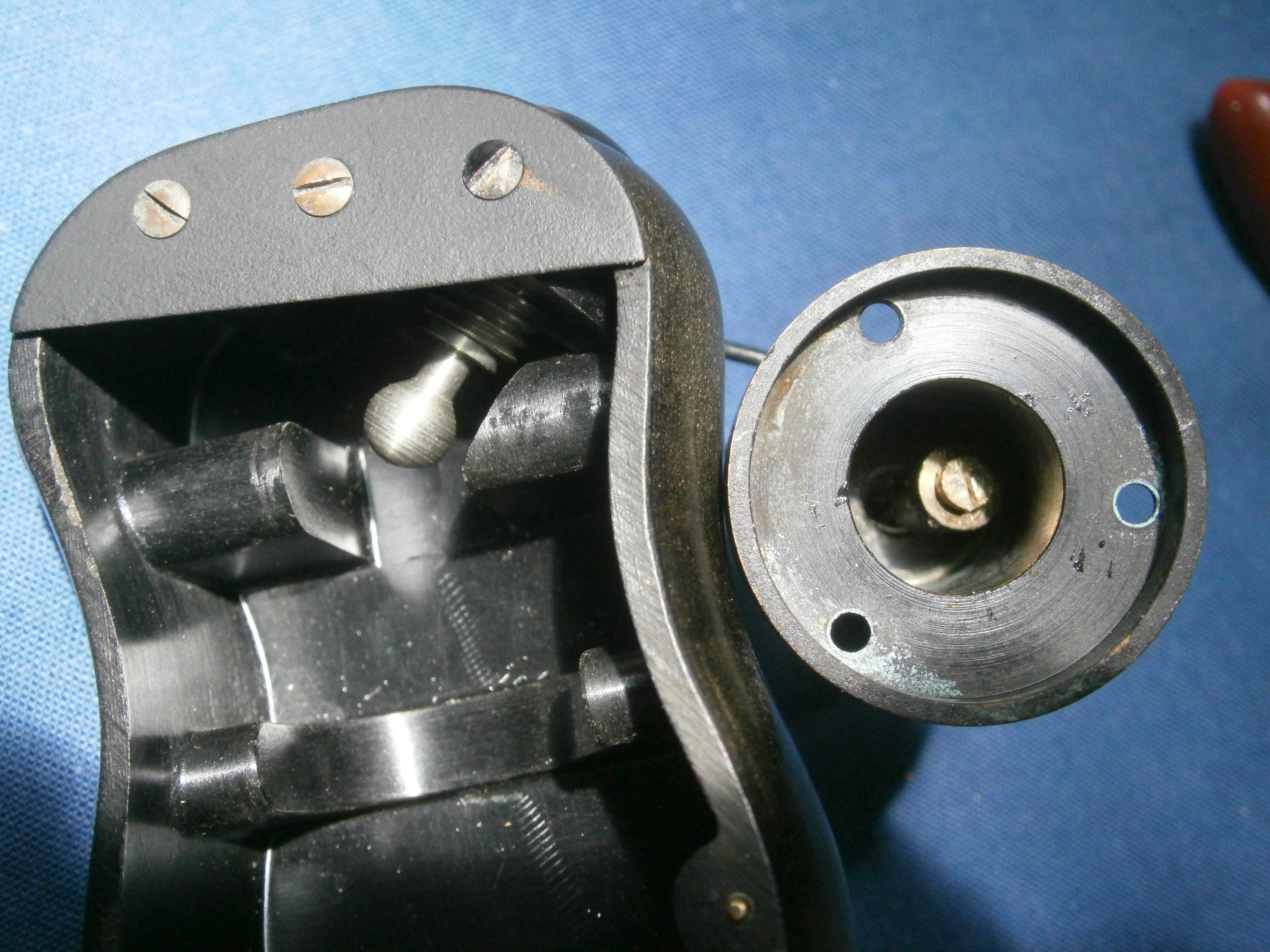
Figure 10: Interior of battery handle.

This sextant represents perhaps one of the earliest ones to light the scale in poor light. Scale lighting had to wait for the development of suitable dry batteries in the 1890s and of miniature flashlight bulbs with robust tungsten filaments in about 1904.

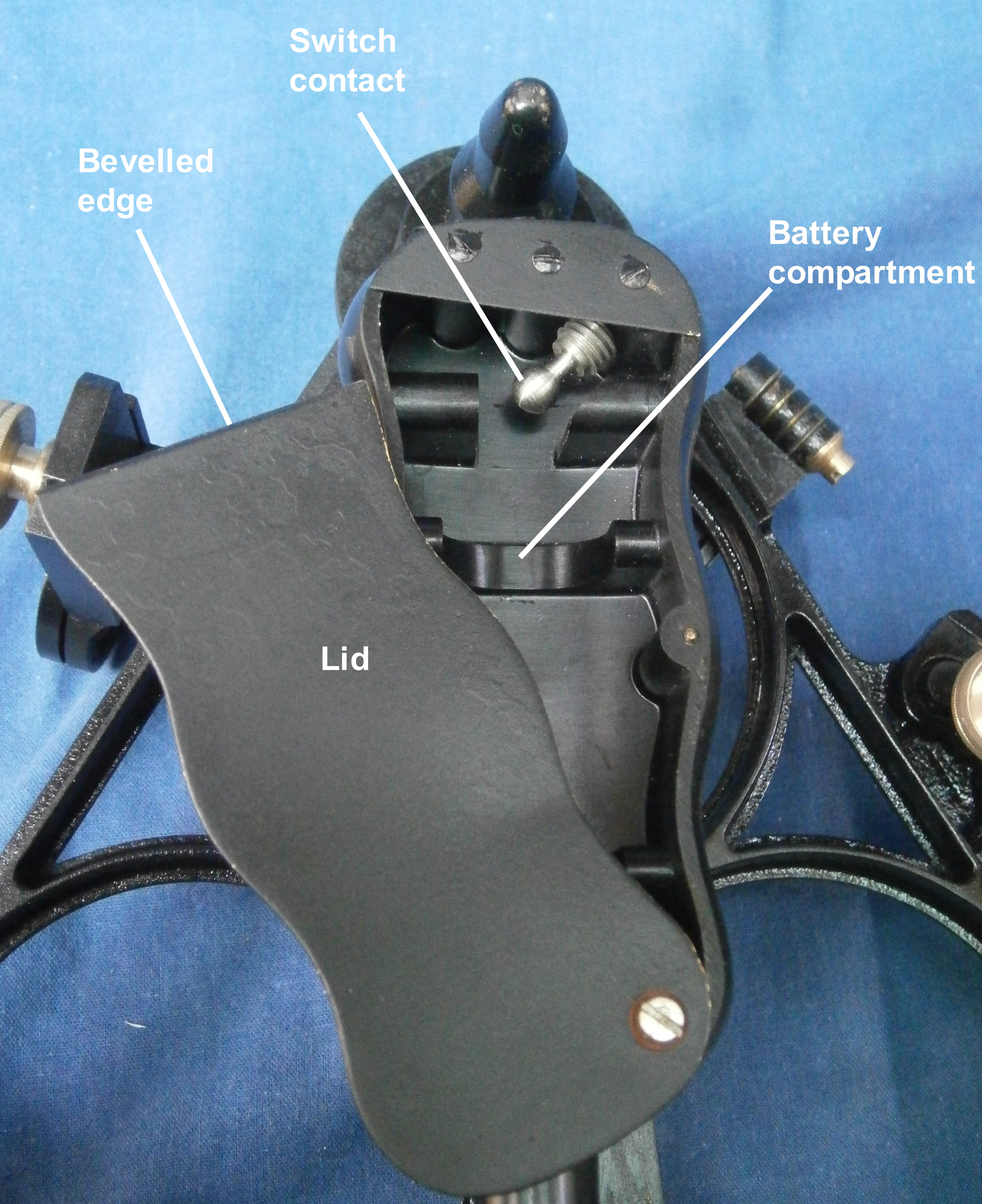
Figure 9 shows the interior of the Bakelite handle which accepts a 3 volt 2R10 battery.  A screw at the lower end holds the negative pole of the battery firmly in electrical contact with the frame of the sextant and at the upper end a spring loaded switch plunger makes contact with the positive pole. The top end of the lid is bevelled and the lid itself is slightly bowed, so that when rotated closed it remains in place.

10 b handle to bearing

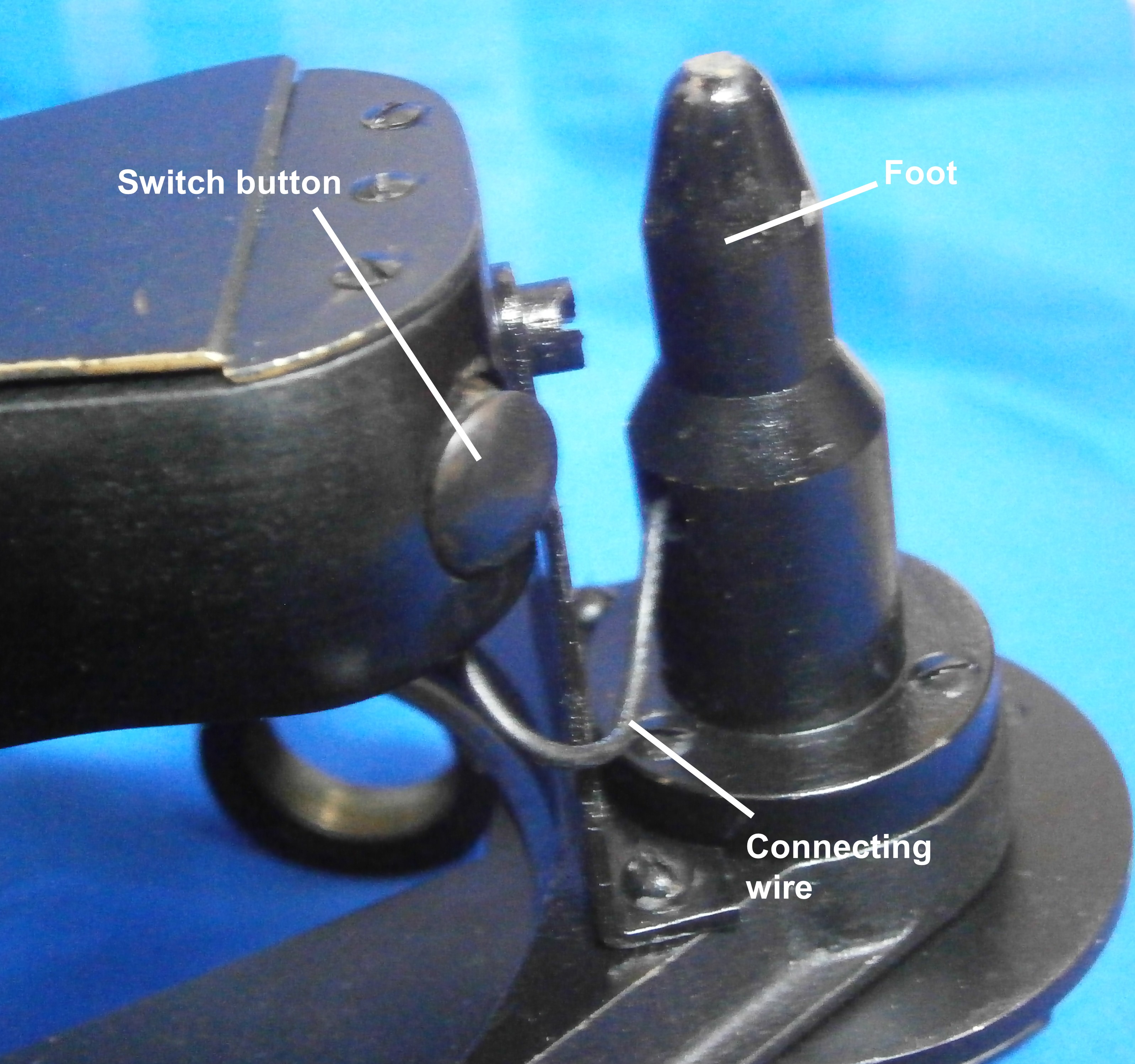
Figure 11: Wire from handle to foot.

A wire passes from the body of the switch to the foot (Figure 11), inside which is a spring loaded brass plunger (Figure 12).

10 a switch to contact

Figure 12: Inside of foot.

The index arm journal is hollow and a wire passes up its centre to an insulated contact on the end, to make electrical contact with the contact inside the foot (Figure 13).

11 a journal contact

Figure 13: Insulated index arm contact.

The other end of the insulated wire passes down the index arm in a machined groove to a clip held on an insulator block (Figure 14).

12 lighting system

Figure 14: Lighting bulb holder.

The clip makes contact with the outside of the bulb holder and thence to the central contact on the bulb. The outside of the holder is insulated from the brass interior, which is threaded for the bulb. The brass interior fits snugly in the cylindrical shade which is attached to the index arm and hence the frame, thus completing the electrical circuit. Most subsequent makers contented themselves with a simple loop of insulated wire to conduct electricity to the bulb, but this more complex and no doubt more expensive system has the merit of not flexing any wire. Like most complex systems, however, there is more to go wrong.

13 rising piece in situ

Figure 15: Rising piece.

The telescope rising piece (Figure 15) is simpler than that of many of its early 20th century competitors and it has a rectangular mortice machined in its face to engage closely with a tenon on the telescope bracket, so that it can be slid up or down to vary the amount of light from the horizon entering the telescope. Collimation is standard, by means of a tilting telescope ring held in place by two screws.

8 index shades

Figure 16: Shades mounting.

The shades make none of the usual provisions to prevent movement of one being transmitted to its neighbours. Resistance to rotation is given by means of a Belleville washer, a conical washer with the characteristics of a short, stiff spring. Since these date from about 1870, they add no clues to the age of this sextant.

15 telescopes

Figure 17: Telescope kit.

The kit of telescopes shown in Figure 16 is for the most part standard, with a 4 x 24 mm Galilean “star” telescope for general use and a 6 x 16mm Keplerian “inverting”  telescope. By the twentieth century, this latter probably received little use except for artificial horizon sights to rate chronometers in out-of-the-way places of known longitude. The large 3 x 36mm Keplerian telescope is of interest as it has a wide angle eyepiece with an eye lens of 25 mm aperture. This gives an image nearly as bright as the 4 x 24mm telescope (the extra lens in the eyepiece causes some loss of light) and with a field of view about four to five times wider.

1 a case exterior

Figure 17: Case exterior.

The mahogany case was much battered and stained, and with several shrinkage cracks, so it was gratifying to be able to restore it to the state shown in Figure 17. It looks decidedly English and placing the handle on the side follows Henry Hughes and Son’s practice, but neither the sextant frame nor the mirror mountings  are consistent with this.

If you enjoyed reading about this sextant, you may also enjoy reading my “The Mariner’s Chronometer“, also available via Amazon.com.


A later Shackman sextant: a guest blog post.

14 03 2018

John Triplett recently wrote to me about a Shackman sextant that he had acquired and kindly agreed to write a guest blog post. In what follows, comments that I make are shown in blue.

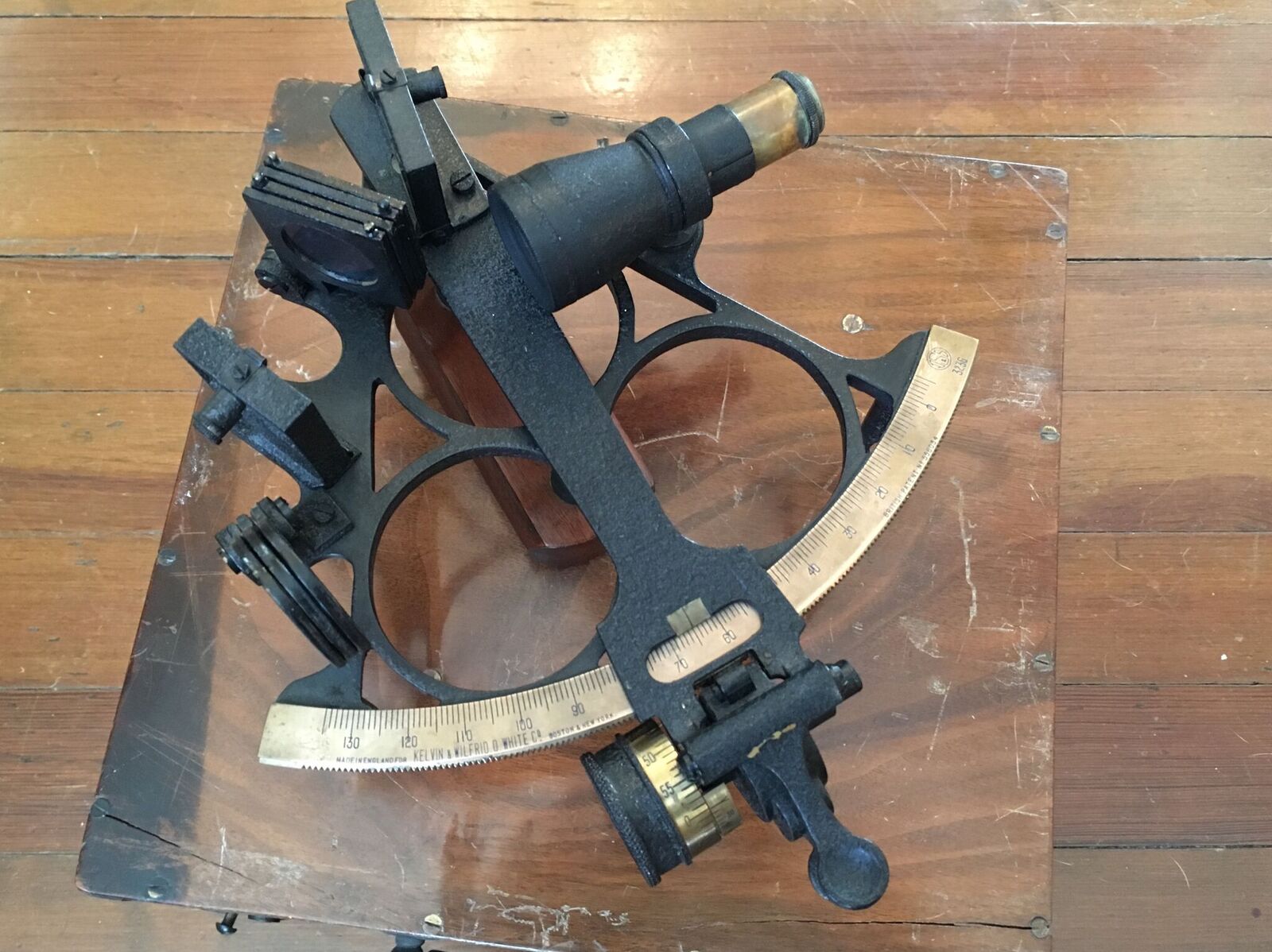
It wasn’t very long after I first read Bill’s blog entry on Shackman sextants (https://sextantbook.com/category/shackman-sextant-and-link-to-ramsden/) that I had the opportunity to acquire one, and at an extremely reasonable price.  I found the design to be unique and interesting, and wanted to see it up close.  I found this sextant in a recent eBay auction that was listed referencing its reseller, Kelvin & Wilfrid O. White of Boston, and not its maker, D. Shackman & Sons (Figure 1).

IMG_3143_preview

Figure 1: The sextant sitting on its case.

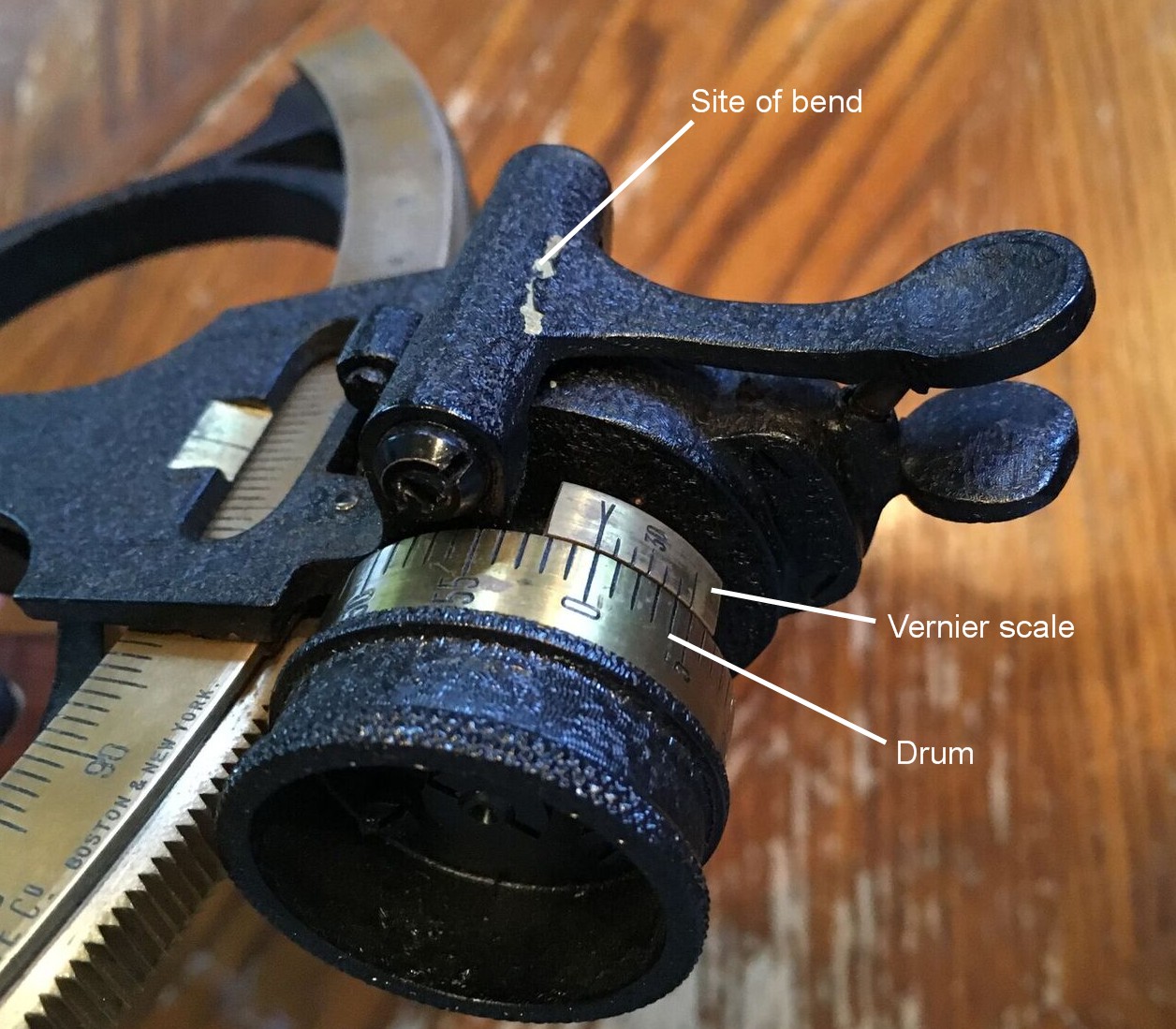
In making some needed repairs (the index arm was bent away from the limb and had to be straightened), it soon became apparent that there are some design differences between Bill’s sextant and mine.  My sextant has a later serial number (No. 3236) than Bill’s (No. 2262), and that does seem speak to some of the differences between the two pieces.  As of this writing, there is another Shackman sextant being offered on eBay (again, resold by Kelvin & Wilfrid O. White) with a serial number (No. 2097) even lower than Bill’s, and having characteristics of Bill’s earlier number, specifically the short tail and leaf spring on the index.    No. 2097 also has a 30” micrometer with a single index line, not a 10” micrometer with a vernier, so, either different precisions were made by Shackman, perhaps some for survey purposes and others for higher precision needs in navigation, or the more precise vernier was a later revision. Most non-British makers had by this time begun to abandon the vernier, perhaps recognising that errors due to uncertainty about the dip of the horizon tend to swamp instrumental errors, which in any case are sometimes of the order of 30 seconds. If greater precision is needed, it is easy to estimate to 0,2 degrees, but such precision is likely to be devoid of meaning, given that the instruments were calibrated at only 30, 60, 90 and 120 degrees.

It generally appeared to be in fine condition, very clean, and showing very little use.  As for the needed repairs, my best guess is that this sextant was dropped early in its career at the US Merchant Marine Academy (as the property label on the box suggests), and, once the owners discovered the nature of the damage, it was simply shelved and forgotten.  (This long convalescence is further evidenced by the light damage to the lid of the box:  papers left on the top for a long period resulted in a stark bleaching/darkening pattern from a masked exposure (See Fig 1.)  Some disassembly was required, and this process uncovered some of the aforementioned differences.

The noted differences to my No. 3236 are:

  • ‘Paddle’ or ‘spoon’ grip extensions on the index and worm that improve manipulation and placement of the micrometer movement. One of the ‘spoons’ is deformed from the drop impact. See Figure 2 for close up view.
  • Copy of IMG_3295_preview

    Figure 2: Damage to release catch “paddle”.

  • The leaf spring has been replaced with a coil spring and plunger system that applies and maintains the pressure of the worm against the rack. The spring slides in and bears on a curved groove on the underside of the opposite paddle grip (Figure 3).
  • Copy of IMG_3294_preview

    Figure 3: Radial helical pre-load spring.

  • The index journal bearing system has seen a design change from the keyed washer to a spring and washer. (This was discovered when the index arm was removed from the frame for repair.) This is such a strange arrangement that I think it must be a later and rather clumsy repair. The washer under the head of the screw does not seem to have a square hole, so there is nothing to stop the washer from working the screw loose as the latter rotates with the journal (Figure 4).
  • Resulting in part from some of the above changes, the later sextant is positioned differently in the case to allow room for the elongated worm assembly.

Ironically, the strength of the ribbed arm casting Bill references in his original blog either worked well or not at all, depending on how you look at it.  It certainly preserved the alignment of the ribbed section of the arm, but fully transferred the bending moment into the weakest part of the arm at the hole for the journal mount.  In agreement with Bill’s assessment, this inherent weakness certainly makes the arm rib a questionable design point, and an overkill in manufacturing.

As for the spring-and-plunger system, this could be considered the Achilles’ Heel of this design.  The spring seems, to me, to be undersized and understrength. Once the spring becomes weakened to a critical point, there is no longer sufficient pressure to keep the worm against the rack; the user has to consciously add the needed force by hand. (Perhaps this too was a later repair. The spring seen in Figure 3 should perhaps be a larger one that fits outside the fitting in which the foot of the spring presently sits.)  It is especially annoying in that it occurs mostly when you are trying to use it normally.  The worm tends to fall away from the rack rather than onto it as does, say, a Hezzanith Endless Tangent Screw.  When turned ‘backwards’, the worm tends to ‘bite’ the rack and assist the spring in holding against it; when turned ‘forward’, the worm throws itself away from the rack and works against the spring.  This tendency was especially pronounced when I first received the sextant and the rack and worm were dry.  After the repair, a proper oiling to the contacting parts greatly mitigated this effect, but it is still noticeable

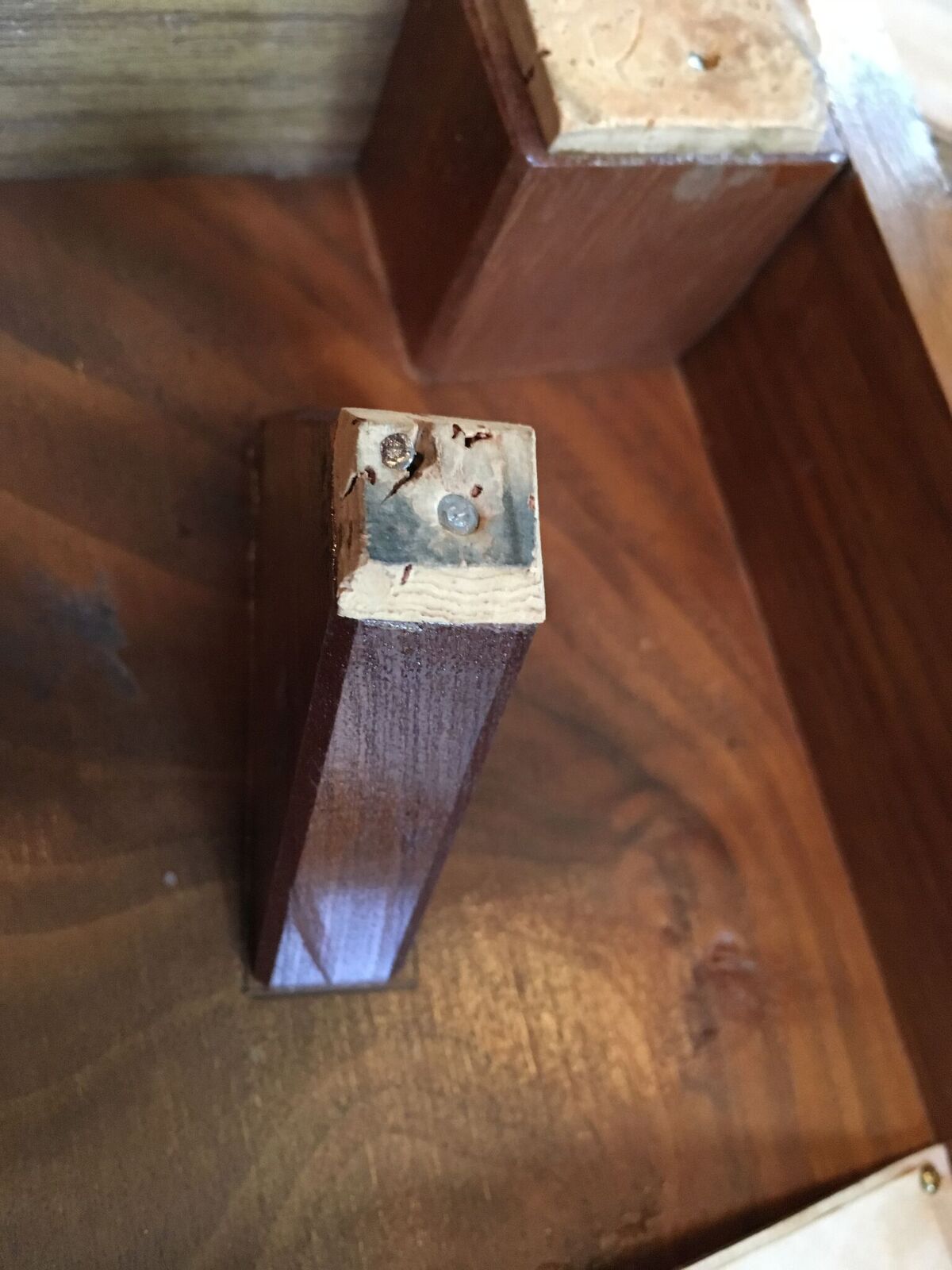
Another observation on an avoidable issue is the cork padding on the case top braces that contact the ends of the limb and the scope.  In addition to being glued down, they are actually nailed in place.  My example has some shoddy factory work in this aspect as one nailed head was bent over, leaving the edge higher than the cork.  The bronze surface at the left end of the limb is fairly mangled up from years of contact.  Was this really necessary?  Simply gluing it would have been just as effective and far more maintenance friendly for replacement.  Happily, the DS&S logo on the other end has fared much better. Shackman’s were manufacturing jewellers pre-war and probably did not make the case. It may well be that more careful woodworkers were doing war work deemed to be more important, e.g. making the all-wood Mospquito aircraft.
IMG_3302_preview

Figure 4: Shoddy workmanship.

The Shackman sextant is, aesthetically, a very attractive piece.  The simple and elegant all-black frame is highlighted only by the bronze of the limb and truly tangent micrometer (and maybe some exposed scope slide), which, while giving a striking appearance, is also quite functional and uniform for usage – the eye is naturally drawn to the scales that need to be read, and in somewhat of a progressive manner.  Also, for a non-engineering, non-optical firm, Shackman’s optics are very good (although they could have been subcontracted).  The telescope is very bright and clear, noticeably more so than those of my instrument by Buff & Buff, a maker known for excellent optics.  It is not a perfect design, as Bill points out, and suffers from some over complexity and confusing ideas that needlessly reduce its functionality in other ways and, quite possibly, its accuracy.  While the solid bronze casting is strong and rigid, its significant weight is felt rather quickly when trying to make an observation.  Still, I find it to be, overall, a rare, unique, and lovely design that makes for a desirable addition to a collection, and I am enjoying becoming more familiar with it.

Thank you, John.


Hughes and Son Admiralty pattern micrometer sextant

14 02 2018

I wrote about a Hughes and Son Admiralty pattern vernier sextant on 23rd June 2011, concentrating on its telescopes, its rising piece for the latter and its sealed mirrors. Recently, I acquired an Admiralty pattern micrometer sextant, probably part of a batch ordered in the closing days of WWII. The main difference is in the micrometer mechanism while the index arm bearing, mirrors, shades and telescopes are essentially the same as in the vernier sextant, certified in March of 1939, so I will not cover that ground again. Figure 1 shows the instrument as advertised by the seller, who seems to have photographed it through a light green filter. This explains the green cast to the blue-grey paint (I have removed the bright green background).

As bought

Figure 1: As bought.

The sextant was in a rather grubby condition, with paint beginning to perish and flake off in parts. I suspect it had been well-used, rather than spending nearly all its life in a cupboard.

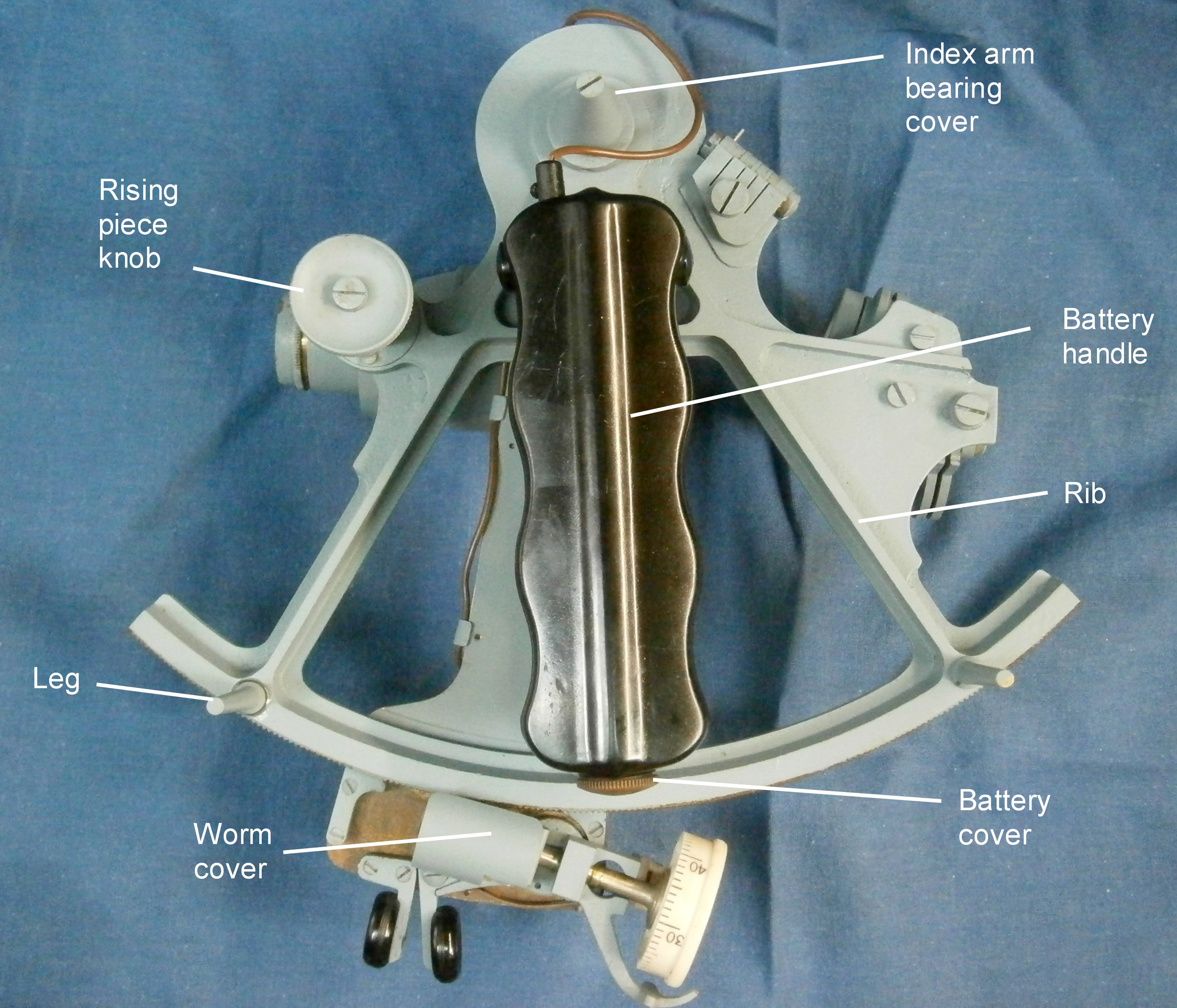
Figure 2 shows the front view after a complete strip-down and restoration. In it I have labelled the main parts of a micrometer section for the benefit of newcomers to my site, and those who may not yet have purchased my book “The Nautical Sextant”, which looks in great detail at the structure of these instruments.

A 1 GA front

Figure 2: Front view of restored sextant.

Figure 3 shows the rear (or right hand side when in use). Here it is possible to see why this sextant, weighing in at 2.05 kg (4.52 lb) is so heavy. The cast bronze frame is very heavily ribbed compared to most other sextants, and features like the rising piece, the Index arm bearing cover and the complex arrangements for sealing the mirrors have all added to the weight. Earlier Hughes and Son instruments with scale lighting made the battery handle out of wood, but this one is of molded Bakelite with a brass battery cover. Happily, it contained no batteries nor signs of corrosion.

A2 GA back

Figure 3: Rear view of restored sextant.

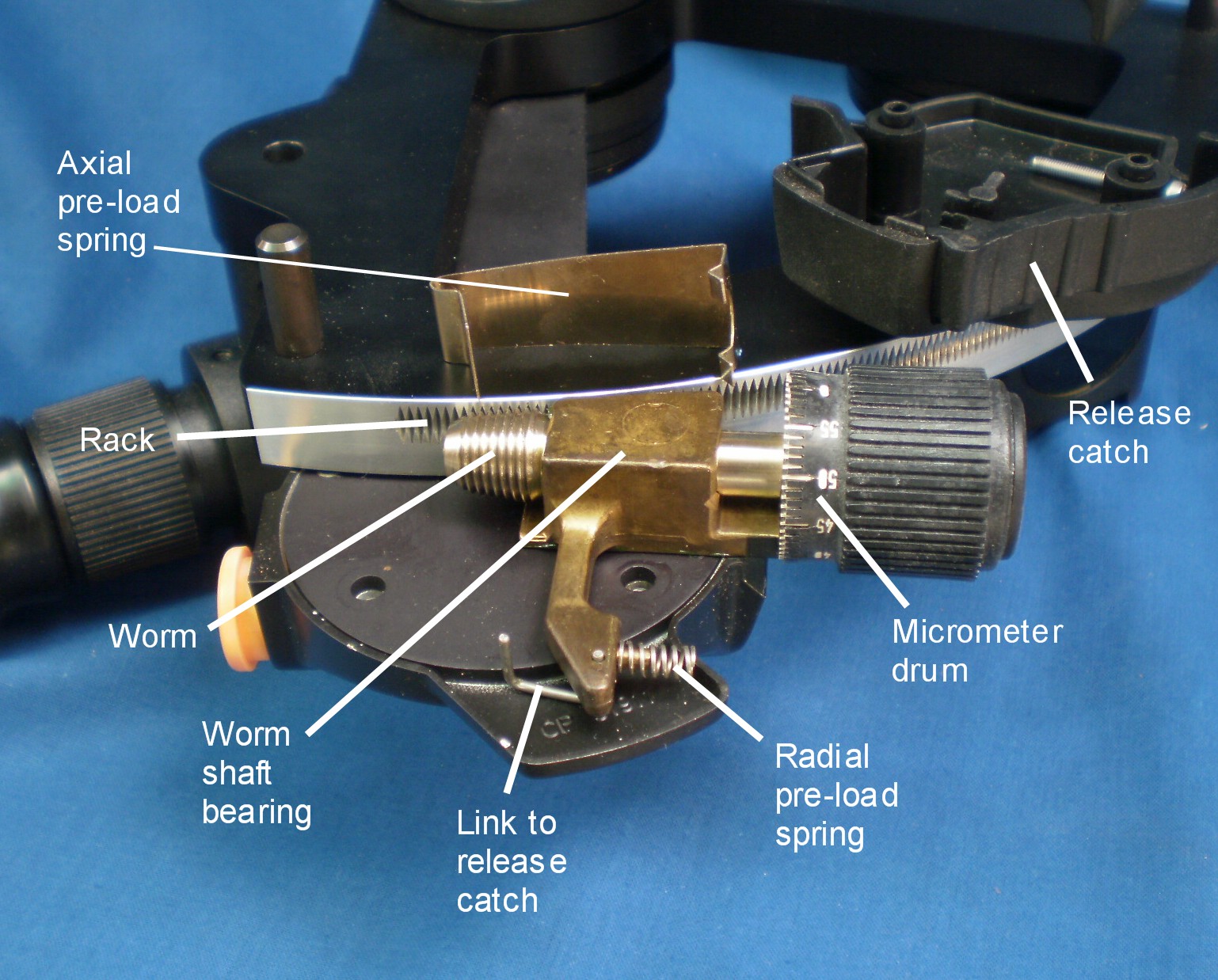
Figure 4 shows details of the micrometer mechanism. The worm engages with the rack, which is cut into the edge of the limb. The rack is in essence a segment of a worm wheel having 720 teeth. Also cut into the edge of the limb is a groove which accepts the free edge of the two keepers. These prevent the index arm from lifting off the limb.

A3 micrometer detail

Figure 4: Details of micrometer mechanism.

The axial pre-load spring, which is shown out of place, is U-shaped with one upright of the U being forked to embrace the worm shaft and press on the flange immediately to the left of the thrust bearing. The worm shaft inside the bearing is conical, so it aligns the shaft axially and radially with a further bearing providing more radial guidance. This spring is a simpler solution to providing thrust pre-load than the more complicated systems used by Hughes and other makers prior to WW II.

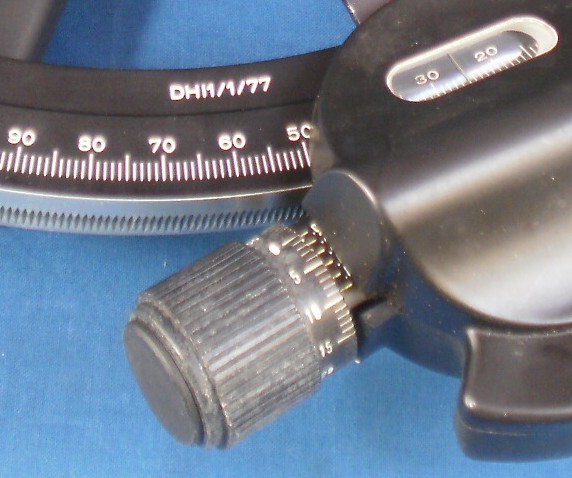
The worm is held in engagement with the rack by a beryllium-copper radial pre-load spring. A simple cam bears on an arm extending from the swing arm on which the bearings and worm are mounted. When the release catch is operated, the cam causes the swing arm to rotate around a substantial bearing  and the worm disengages so that the index arm can be swung rapidly to a new position. When the release catch is let go, the spring swings the worm back into engagement with the rack and rotation of the micrometer drum provides fine adjustment.

There is a guard extending from the swing arm to provide some protection to the micrometer drum and the worm shaft. The shaft is often bent when a sextant is dropped or knocked and, as replacement parts have long been unobtainable, a whole worm and shaft have to be made. See for example “A Worm Turns” on this site on 23rd June 2011. The worm itself receives some protection from a sheet metal cover, seen in Figure 3.

Figure 4 shows the front of the index arm in the area of the worm. The screw that secures the axis about which the swing arm rotates has been removed to show a washer that is prevented from rotating by two pins into the swing arm, so that the screw can be adjusted to remove end shake in the bearing, while preventing movement of the swing arm from loosening or tightening the screw.

A4 micrometer front

Figure 5: More micrometer details.

There seems to be little point in providing a vernier to the micrometer, as the racks of this era often had errors in excess of 0.5 minutes and in any case, observation errors due to uncertainties about refraction and dip would often swamp instrument errors. Most makers after WWII abandoned micrometer verniers, but some were still made, presumably to satisfy conservative mariners and military procurement officers.

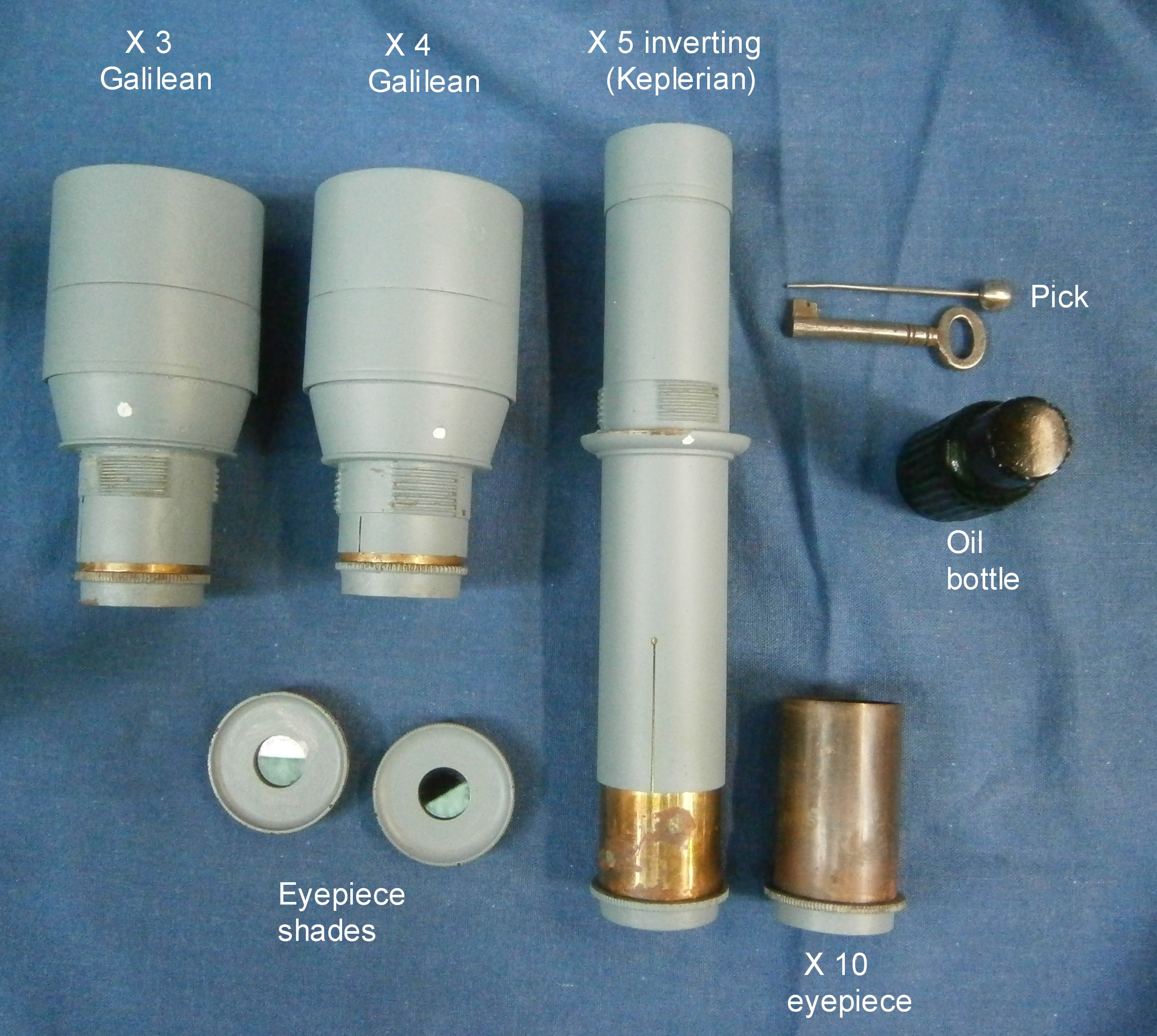
This instrument was provided with a fairly comprehensive kit of telescope and tools, shown in Figure 6.  Most mariners probably never used anything other than the Galilean (“star”) telescopes in the 20th century.  The higher powered ones were probably used mainly for artificial horizon shots in ports of known longitude to correct chronometers. This was made obsolete by the advent of radio time signals, but Tamaya in particular continued to provide them to the very end of sextant manufacture.

A6 telescopes etc

Figure 7: Ancillaries.

The eyepiece shades are useful for finding the index or zero error of the sextant by looking at the sun or moon, but again, most mariners would simply have used combinations of horizon and index shades, or used the horizon to avoid strain on the neck from looking up at the sun.

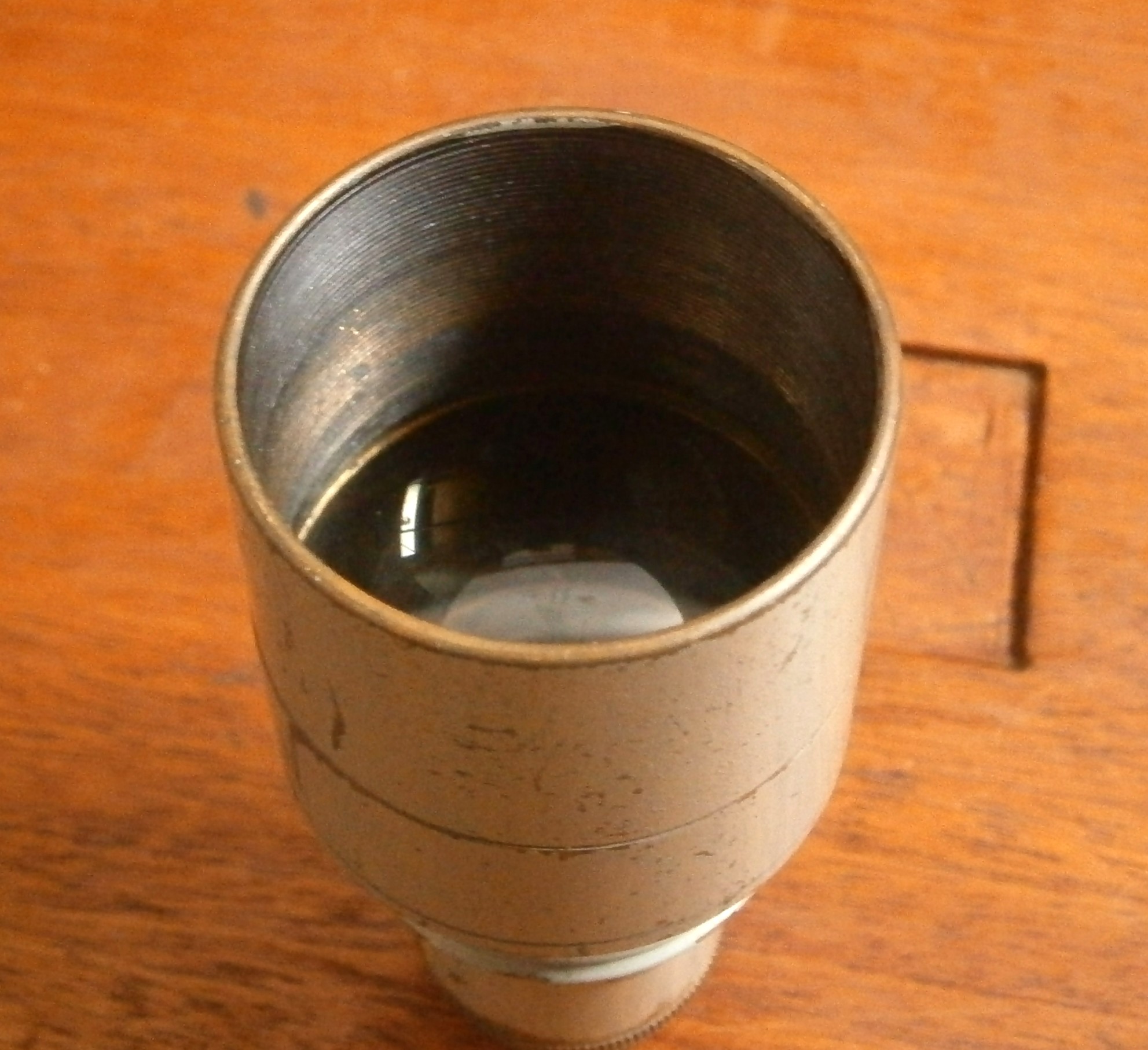
A very useful feature of the Galilean telescopes is the provision of hoods to prevent glare from around the horizon mirror reaching the eye, as the hood limits the field of view to the mirror alone (Figure 8).

A5 telescope hood

Figure 8: Telescope hood.

Figure 9 shows the sextant and its telescopes etc. in its fine mahogany case. As usual from about 1900 onwards, the corners have box comb joints. In all Hughes and Son sextants, the handle is on the right hand side, to avoid setting down the box on its hinges.

A7 in box

Figure 9: The sextant in its case.

Figure 10, shows the case standing on its left hand side. This, together with the hook latches which always face to the left, so that they tend to remain latched in the carrying position, identifies the sextant as a Hughes and Son, if it were not obvious from the circular “Husun” emblem attached to the index arm.

A8 latches

Figure 10: Hook latches in closed position.

If you have enjoyed reading this account, you will find much more of the same in my book “The Nautical Sextant”, but do not expect to find anything about in it about navigation. It is about the structure of the sextant.You can find plenty of positive reviews of the book on the amazon.com web site.


Carl Plath’s earliest sextant.

20 04 2017

This post was preceded by “C Plath Yachting sextant“ “Making a shades adjusting tool” and “Eighty years of Carl Plath Sextants”. Other posts on C Plath sextants may be found by entering “C Plath” in the search box on the right.

C Plath bought the business of David Filby, Hamburg’s member of Parliament, in 1862 and shortly after he disposed of the book and chart side of the business while retaining the nautical instrument side. Around about the time that he moved into the address known as Stubbenhuk 25, he acquired a dividing machine from Repsold, his former apprentice master, and began to make his own instruments, including sextants. A year or so ago I acquired an early C Plath sextant for a very modest sum on e-bay. It and its case were not in good condition and so I restored them, but other commitments have until now prevented me from writing about it.

Case as received

Figure 1: The case

Figure 1 shows the case as received, with shrinkage cracks in the top and signs of water damage. Much of the varnish had crumbled, so I stripped off all the old varnish from the outside, filled cracks, made good loose joints, re-lacquered the hardware, re-stained the mahogany and applied several coats of modern varnish to give the result shown in Figure 2. The corner joints are rebate joints, reinforced with steel pins at a time when most makers were using hand-cut corner dovetails. The top, however, is attached with brass screws, while the bottom is glued and pinned on, following the practice of nearly every maker throughout history. The pins tend to rust, being “out of sight, out of mind”.

Case restored

Figure 2: Case restored.

The interior  as received is shown in Figure 3. Apart from dust and many flakes of paint the green felt lining of the floor and roof of the box had decayed. Fortunately for the instrument, the pocket for the handle and the pads for the legs were attached by screws and glue which had not given way.

Interior as received

Figure 3: Interior as received

Cleaning the interior and fitting new felt  completed the restoration of the case, and restoring the instrument itself presented few problems as everything was present and intact. Figure 4 shows the back of the frame, which is a heavily ridged bronze casting. In the nineteenth and early twentieth century, a very large range of frame patterns was offered by the major makers, but it was not until the early part of the twentieth century that Plath left behind this initial pattern in favour of the ladder pattern, with the occasional three circle or “Dreikreis” pattern being offered (see my post for January 2010). Note the heavy re-inforcement in the areas where the telescope and horizon mirror brackets are mounted.

Rear as received

Figure 4: Frame before re-painting.

The traces of paint that remained were a pale green, but the sextant illustrated on page 50 of Friedrich Jerchow’s history of C Plath, From Sextant to Satellite Navigation, is painted black, so I surmise that the green represents perhaps a primer coat. At any event, I stripped it all off and re-coated the parts black, taking the illustration as a pattern. Figure 5 shows the sextant in its case after restoration.

Interior restored

Figure 5: After restoration

Figure 6 shows the kit of telescopes and other parts supplied. Well into the twentieth century, sextants were often supplied with several telescopes and supplementary eye-pieces. I doubt that there was ever a time when most of them were used at sea. The 6 x 16 Galilean telescope has a tiny field of view and the 10 x 17 inverting telescope is no better. There may have been a time when they were used on land with an artificial horizon to check on the rate of chronometers in distant ports of known longitude, but at sea the 3 x 28 Galilean was probably the one used most, with the ‘zero magnification” sighting tube being substituted in rough weather. The eyepiece shade may have been used to check index error using the sun, but again, most people would probably have used the horizon, as it is easier on the neck to do so.

Telescope kit

Figure 6: Telescope kit

The shades and mirror brackets are perfectly conventional and avoid the complications used by French makers in particular and also by Brandis and successors. The tangent screw is of some interest and is shown complete in Figure 7. With slight modification it was also used in the Dreikreis sextant before the micrometer sextant was developed by C Plath around about 1907.

Tangent screw

Figure 7: Tangent screw

The spring box, which I have called a “sliding block” in different designs, slides in a close-fitting pocket on the rear of the index arm expansion and can be clamped to the limb using the clamp. A leaf spring keeps the box in place when un-clamped. The end of the tangent screw bears on a tongue projecting from the back of the index arm against the pressure of a coil spring within the spring box. thus, as the screw is turned, the index arm moves along the arc in slow motion. On releasing the clamp, the index arm can be swung rapidly by hand. Figure 8, which shows the mechanism exploded, may help to make this clearer.

Tangent screw exploded

Figure 8: Tangent screw mechanism exploded.

The mechanism for raising and lowering the axis of the telescope so that more or less light from the horizon can enter it is shown in Figure 9. It represents an intermediate stage of complexity on its way to the simplicity of the second half of the twentieth century.

Rising piece

Figure 9: Telescope rise and fall.

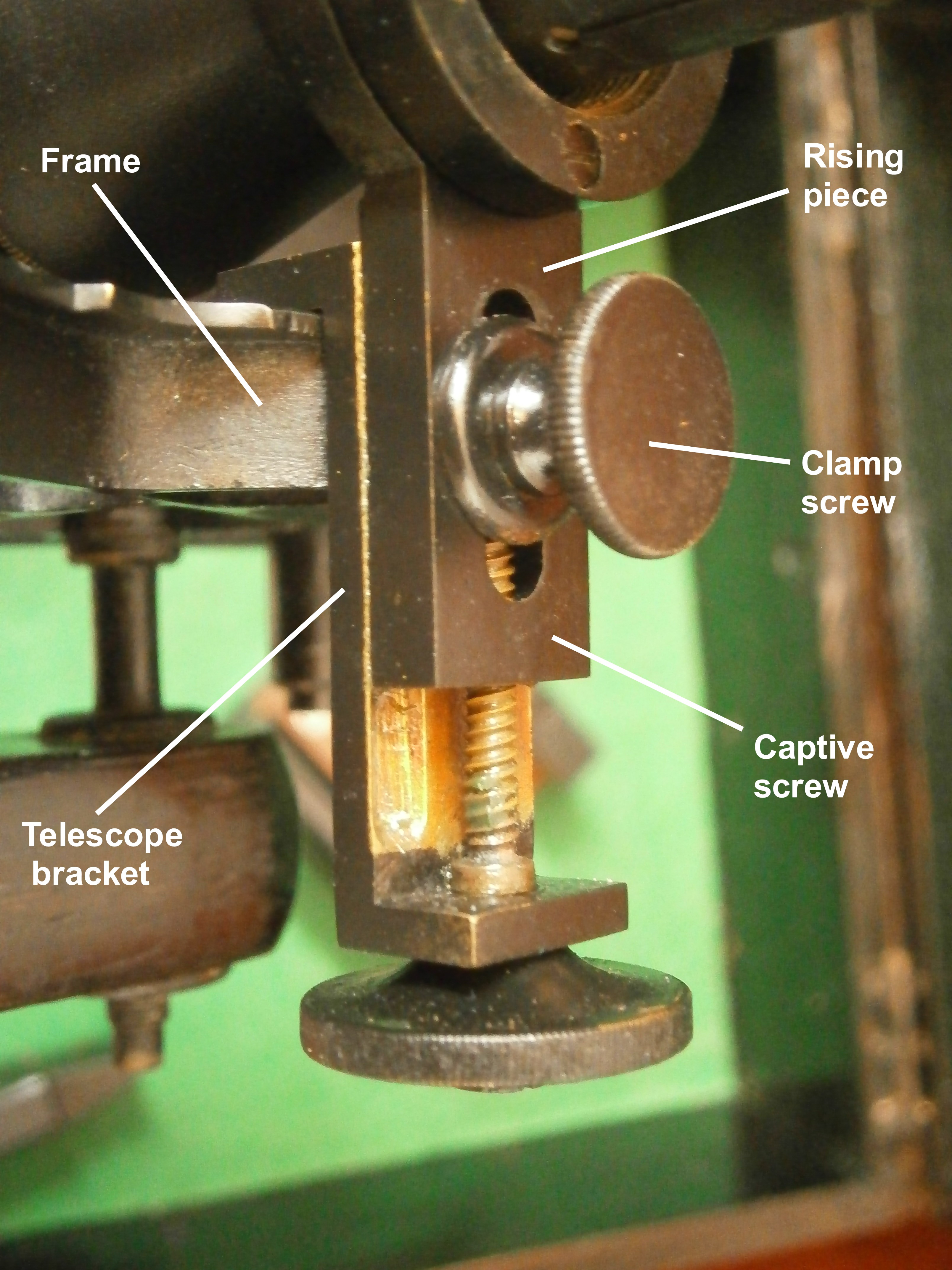
A telescope bracket having a vee groove and flat machined into it is attached to the frame of the sextant. The rising piece of the telescope has a matching vee and flat to guide it up and down. The lower end of the rising piece has a threaded hole for a screw that is held captive in the telescope bracket, to that when the screw is rotated, the rising piece rises or descends. A clamp holds the rising piece at the selected height.

Arc and name

Figure 10: The arc.

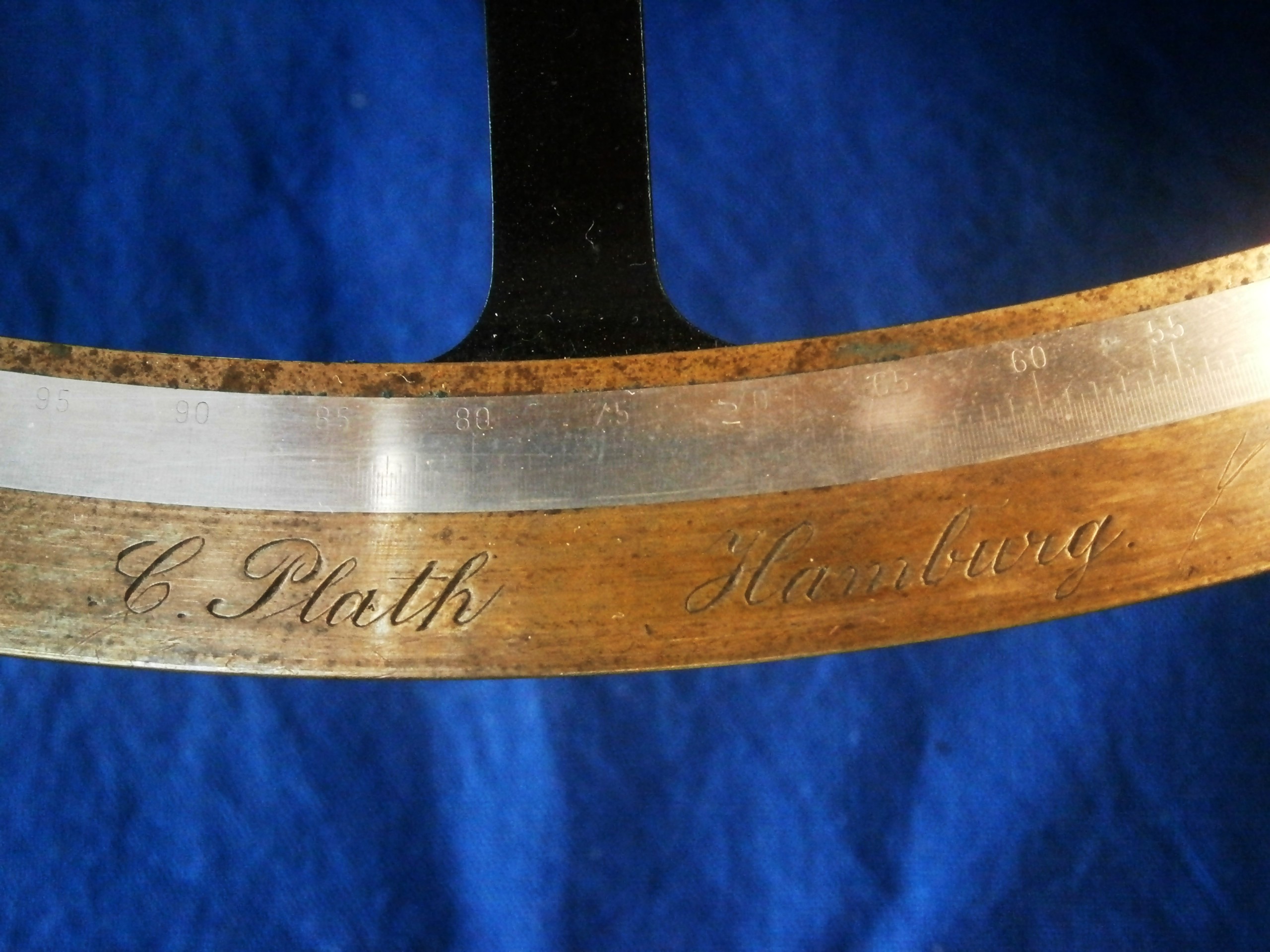
The silver arc, let into the bronze limb, is divided to 10 minutes (Figure 10) and the silver vernier allows readings to ten seconds, though, as with many similar verniers, it is usually impossible to decide which particular pair of lines coincide. It is easier to decide which two pairs of lines just do not coincide and to choose the middle value between them. It bears the C Plath name in flowing copper plate script, a feature of Plath’s earlier sextants.

Serial and S

Figure 11: Serial number and inspection mark.

 Dr Andreas Philipp has kindly provided me with the date of early 1899 for the instrument, or at least, its certification by Deutsche Seewarte. He tells me that both “S” and “D S” were used irrespective of date. He also sent me an illustration from Plath’s number V catalogue of  1906, which I reproduce below (click on this image to enlarge it). Based on the D.S. records, it seems that between 1876 and 1901, Plath produced an average of only 27 sextants per year.

Cat photo 001.JPG

Catalogue entry 1906 (Courtesy of Dr Andreas Philipp)


C Plath Yachting Sextant

14 06 2015

This post was preceded by “Making a shades adjusting tool” and “Eighty years of Carl Plath Sextants”. Other posts on C Plath sextants may be found by entering “C Plath” in the search box on the right. All figures may be enlarged by clicking on them. Return to the text by using the back arrow.

Several makers, including C Plath, made sextants directed at the yachting market with more or less success. There seems to be a fair number of Freiberger yachting sextants around, but I have only ever seen two Plath Yachtsman sextants. In the years after WWII, many full-size sextants must have flooded the market, especially the USN Mark II sextant and those made by Henry Hughes and Son. The latter also made half size sextants for use in sea planes and presumably they were attractive to yachtsmen, as some have survived. A variety of plastic sextants derived from the Maritime Commission version for lifeboats came on to the market and evolved into instruments that looked like “proper”metal sextants, though few were rigid enough to behave like one. Francis Barker produced a box sextant labelled “Small Craft Precision Sextant” intended for sale to yachtsmen, but despite having been provided with a horizon shade and an eyepiece shade in addition to the usual index shade, I doubt that it found much favour with nautical users. A box sextant is a fiddly instrument at the best of times and it is difficult enough to take sights from a rolling yacht. Ilon industries made an ingenious little micrometer sextant provided with a tiny prismatic monocular (https://sextantbook.com/category/ilon-industries-sextant/) that may have found favour with the well-heeled and Tamaya made a light weight 5/6ths sized micrometer sextant. The French firm of Roger Poulin made an interesting little sextant that was plainly aimed at the yachting market and I have described it here: https://sextantbook.com/?s=Poulin .

It is not clear whether the yachtsman wished a smaller sextant because of lack of space aboard yachts or because a smaller sextant might be cheaper than a full-sized version. At any rate the saving in space and weight must have been insignificant, and the savings made by buying a smaller sextant cannot have been great when compared with the cost of the vessel.

Unlike the Freiberger Yacht Sextant (https://sextantbook.com/?s=Freiberger+yacht), which attempts in a way to echo the full sized instrument, the frame of the C Plath sextant is monolithic and exceptionally rigid. Figure 1 shows a general view of the front. The bases of the index and horizon mirror brackets are identical though the horizon mirror itself is half silvered. Both are circular, presumably because it is easier to seal the mirrors against the intrusion of salt water behind them, but as can be seen in some of the later figures, the index mirror has suffered around the edges. The two index shades and one horizon shade are adequate in most circumstances. Their brackets are simple and no provision is made for adjustment of friction. A notch in the edge of the frame allows the horizon shade to be folded completely out of the line of sight.

The rack in which the micrometer worm engages in machined into the edge of the limb, together with a slot for a keeper to keep correct engagement. The radius of the rack is about 140 mm (5.5 ins) and the instrument weighs 1260G (2lbs 12 oz).

Figure 1: General view of front.

Figure 1: General view of front.

The telescope has a simple draw tube for focusing, and  has an aperture of 25 mm and a power of about 2.5 diameters, giving a field of view of a little over 6 degrees. This is about the same as one gets from a 4 x 40 mm telescope of a full-sized instrument. Though a C Plath leaflet says the aperture is 30 mm with a magnification of x 4, the inside diameter of the tube in front of the objective lens of my sextant is only 27.5 mm and it has to sit on a shoulder, so the aperture behind the lens is only 25.1 mm. The measured magnification is about x 2.5.

The telescope is not demountable, a disadvantage on a small vessel when it is rolling and pitching, as with a standard field of view it can be difficult to acquire the heavenly body and bring it down to the horizon. Removing the telescope altogether makes it much easier to find the body and to bring it down, when the telescope can be replaced and the horizon swept to re-acquire the body. However, the telescope mounting is very robust so that it is not only resistant to knocks, but the sextant can safely be picked up by the telescope without fear of damaging or displacing it. The micrometer mechanism is well protected against knocks and the release catch is simple to operate. Figure 2 shows a rear view of the instrument.

Figure 2: Back view.

Figure 2: Back view.

The frame is closed off at the back by a back plate, which is attached to the frame by three screws and a leg. The handle, adapted from a full-sized instrument battery handle, is attached to the back plate via pillars by two countersunk screws. Removing the back plate reveals the index arm as shown in Figure 3. Note that if the sextant gets drenched in salt water, it is an easy matter to rinse out the interior with fresh water without necessarily removing the back plate.

Figure 3:  Rear view without back plate.

Figure 3: Rear view without back plate.

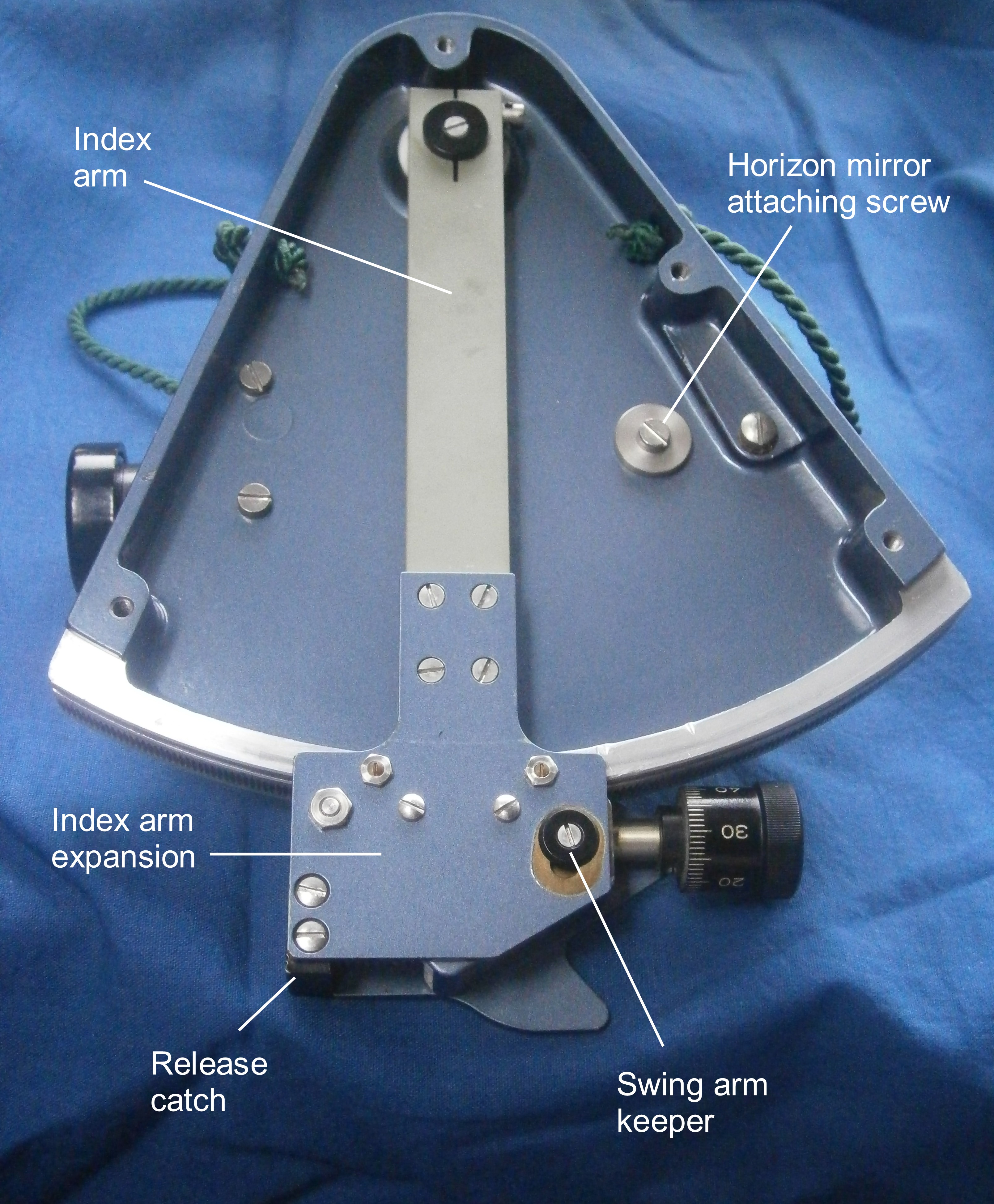
The index arm is in two pieces: a stout rectangular bar attached to the index mirror bearing at the top; and  a plate that I have christened the index arm expansion at the bottom. This plate carries the micrometer mechanism. I have labelled the screw for attaching the horizon mirror and the swing arm keeper in Figure 3 for future reference below. Also seen are the two stout screws that attach the telescope to the frame.

Figure 3: Index arm bearing.

Figure 4: Index arm bearing.

The anatomy of the index arm bearing is revealed in Figure 4. A micro-finished journal runs in a parallel bearing machined directly into the frame, with two PTFE washers acting as spacers and also taking any minor thrust forces that may arise. A flange above the journal carries the index mirror in its bracket, while a spigot below attaches the index arm. Figure 5 shows how the upper end of the index arm is split, with a pinch screw to close it around the spigot. This allows adjustment of the mirror in the horizontal plane as well as axial adjustment to take up any axial movement in the bearing.

Figure 5: Upper end of index arm.

Figure 5: Upper end of index arm.

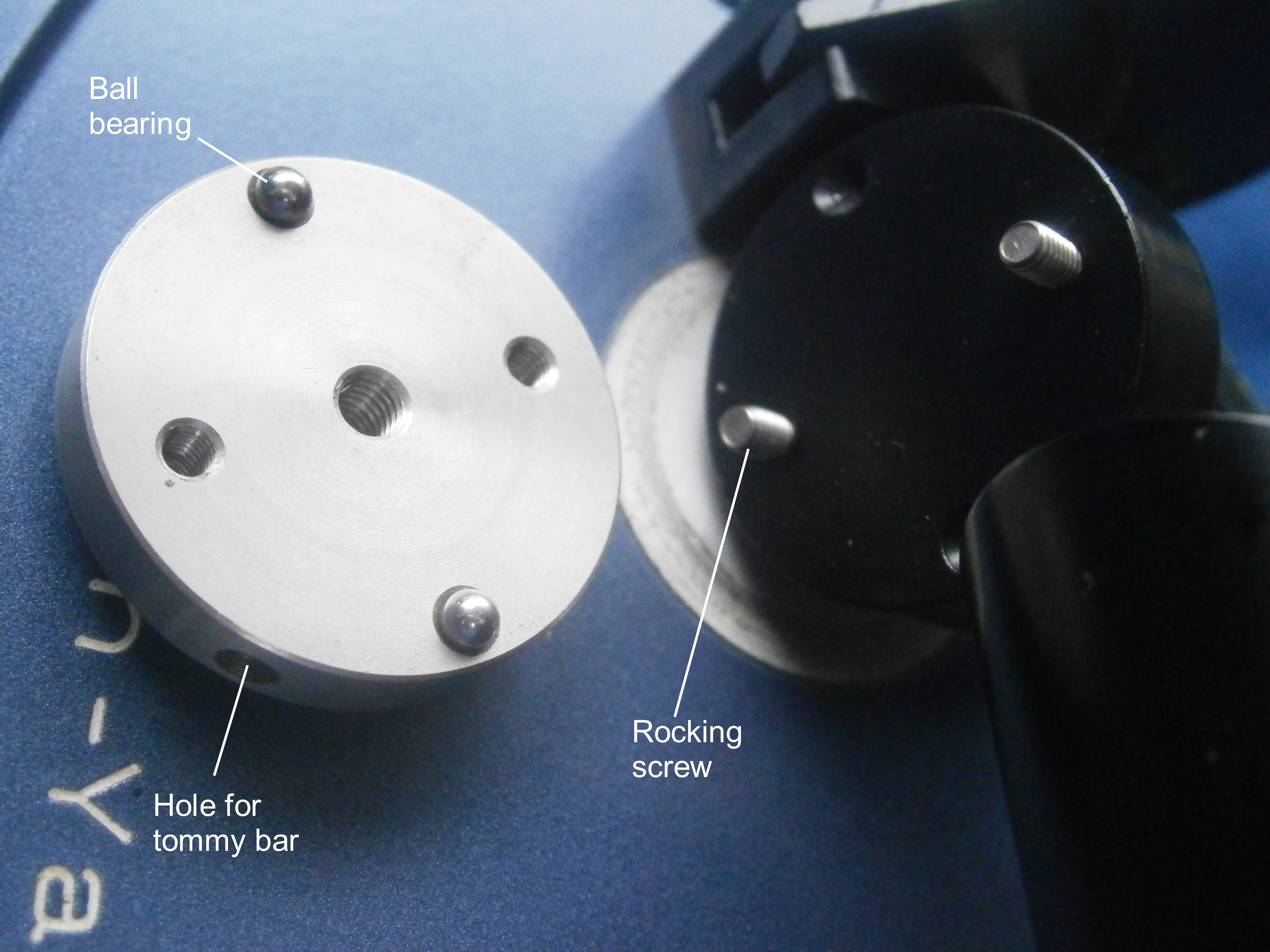
Figure 6 shows how the index mirror is adjusted for perpendicularity and the horizon mirror for side error (the horizon mirror is illustrated) . The mirror bracket is rocked by means of two screws about two ball bearings sitting is depressions to form an axis of rotation.

Figure 6: Mirror bracket adjustment.

Figure 6: Mirror bracket adjustment.

As the reflective surface of the index mirror lies a little ahead of the axis of rotation of the index mirror it is necessary to use two vanes to raise the line of sight to somewhere near the centre of the mirror, as otherwise a minor error in perpendicularity may be introduced. Figure 7 shows how two small dominoes have been used, but any two identical objects objects of about the right height may be used, such as pieces cut from aluminium or steel angle, large hexagonal nuts or large rollers from a scrapped roller bearing. One is placed on the limb of the sextant at zero and the other at about 90 degrees. The index arm is then rotated until a reflected view of the second vane is seen alongside a direct view of the first, when the mirror is adjusted to bring their tops into line as shown. In many sextants, including this one, it may be necessary to remove the telescope and/or index shades to obtain the required view.

Figure 7: Adjusting index mirror for perpendicularity.

Figure 7: Adjusting index mirror for perpendicularity.

When adjusting the horizon mirror to remove index error, the screw arrowed in Figure 3 is slackened and a tommy bar used in the hole visible on the right in Figure 7 to rotate the whole base. This is a relatively coarse way of adjusting and may involve much trial and error, but once done, the whole set-up is rigid and not likely to drift out of adjustment in a way that is so annoying with plastic “instruments”.  Removing side error has already been mentioned in the paragraph following Figure 5. Note that index error cannot be removed by using the sun, as the single horizon shade is not dense enough for this method. There is no adjustment available for collimating the telescope, but quite large errors of collimation have relatively little effect on the accuracy of readings, especially for the class of sight likely to be made with this instrument. In any case, this is taken care of at manufacture and would require very rough handling indeed to disturb.

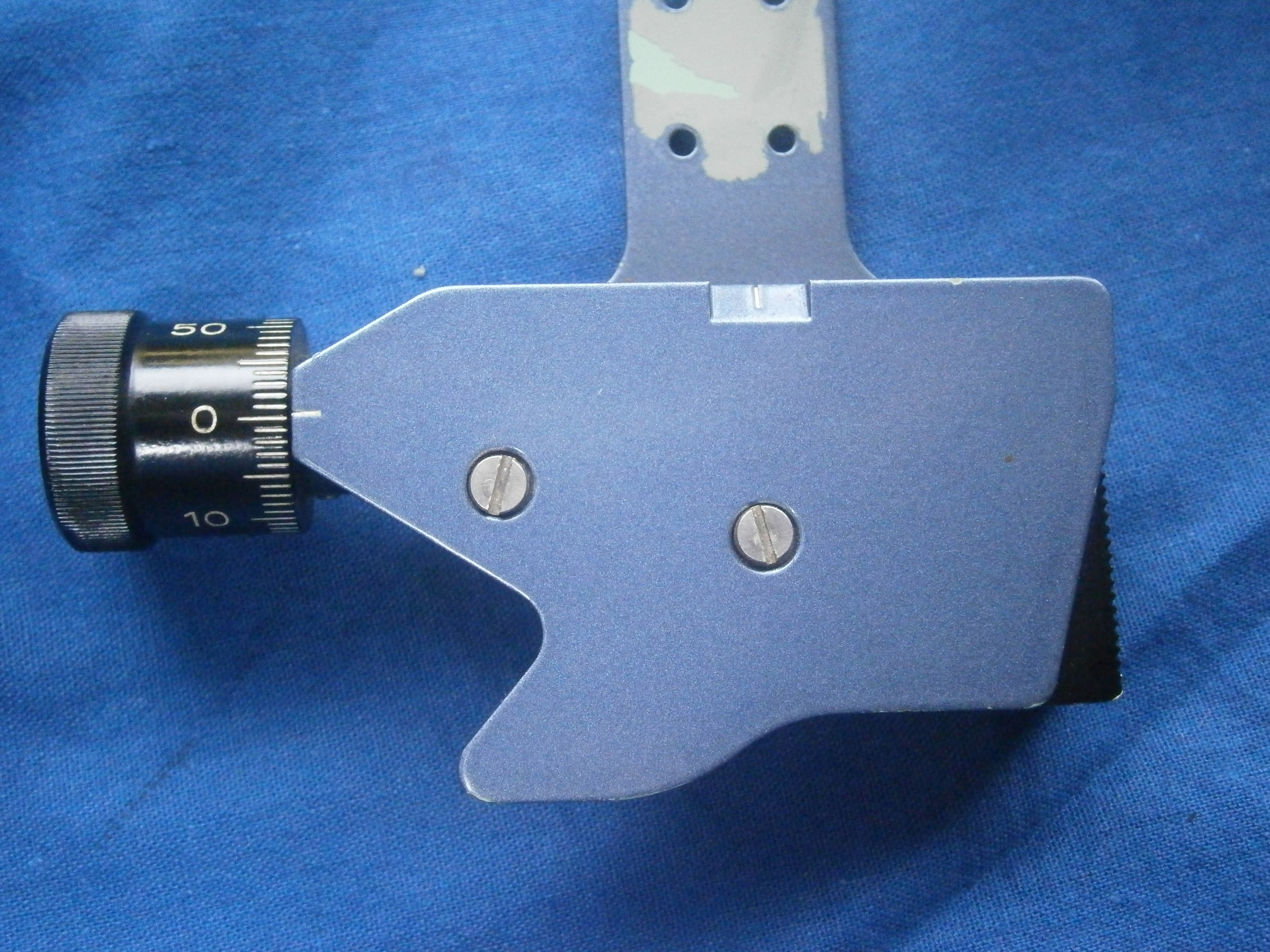
The micrometer mechanism is robust and well-protected. Figure 8 shows it detached from the index arm. The black release catch on the right in fact remains stationary when disengaging the worm and it is the horn extending down and to the left  on the plate that rotates when it and the black catch are squeezed together.

Figure : Micrometer mechanism detached from index arm.

Figure 8: Micrometer mechanism detached from index arm.

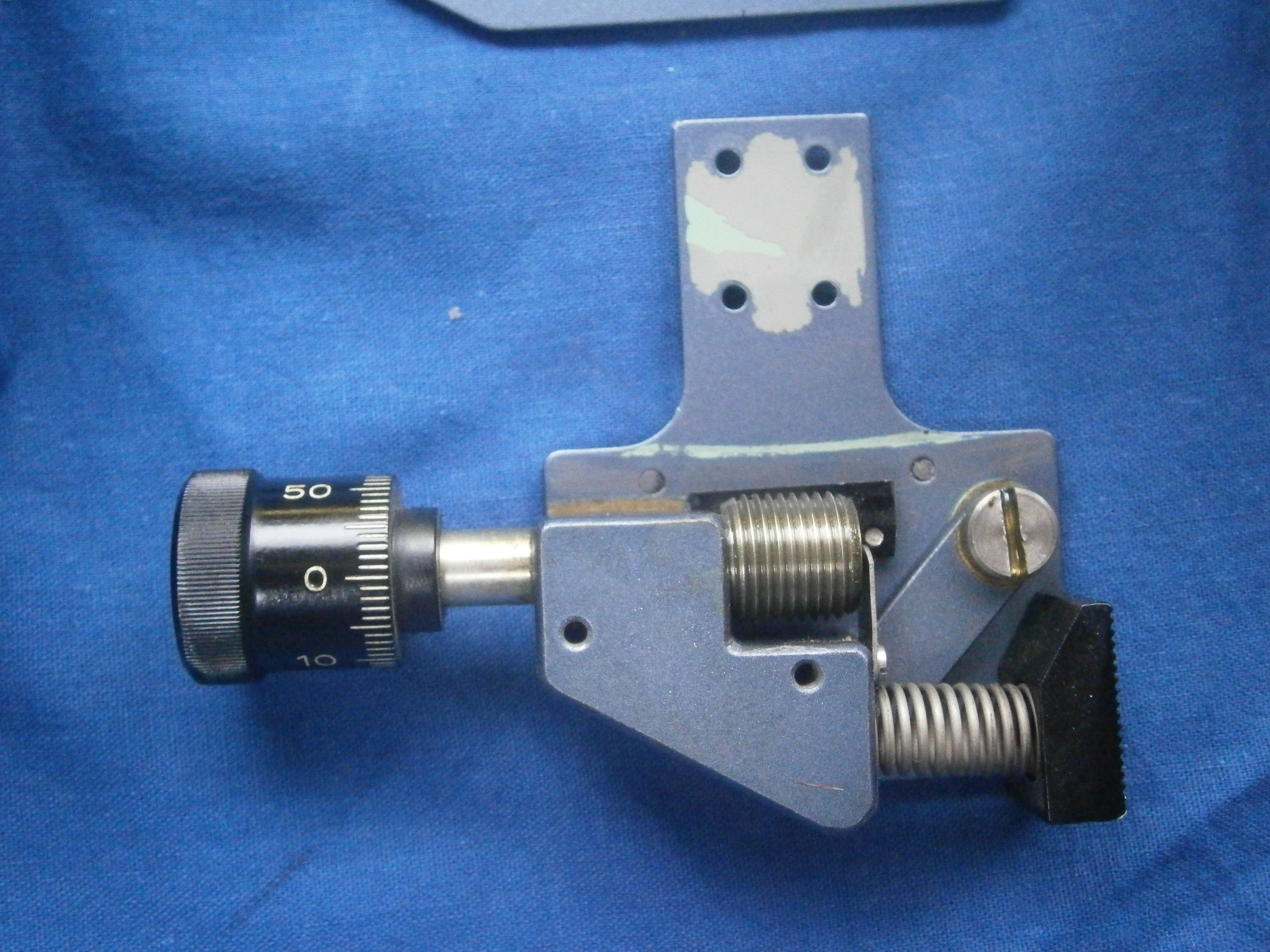
In Figure 9, the front plate which carries the fiducial lines for the degrees scale and the micrometer has been removed to show the swing arm chassis. This carries the micrometer worm in a plain parallel bearing, the axial play of which is taken up by a leaf spring. A swing arm extends upwards and to the right to a bearing in the form of a shouldered screw, about which the chassis rotates. A stout helical spring keeps the worm in engagement with the rack machined on the edge of the limb of the sextant.

Figure : Front plate removed to show interior of micrometer mechanism.

Figure 9: Front plate removed to show interior of micrometer mechanism.

Figure 10 shows these parts more clearly. In addition, there is a rectangular keeper that guides the index arm expansion and keeps the worm in correct engagement. It slides in a slot machined in the limb below the rack.

Figure : Micrometer mechanism exploded.

Figure 10: Micrometer mechanism exploded.

A further, circular, keeper ensures that the swing arm chassis cannot lift off the face of the index arm expansion. The spigot on the keeper slides in the oval slot and the keeper is retained in the chassis by means of a screw whose tapped hole is shown in Figure 11, centre, which illustrates the bearing surfaces for the swing arm chassis. The keeper can be seen in place in Figure 3, above.

Figure : Swing arm bearings.

Figure 11: Swing arm bearings.

The sextant frame, being made of aluminium alloy, is inherently resistant to corrosion, but parts that do not run together have a tough coating of blue paint. Other parts are made of bronze and all the screws and springs are of stainless steel. If the sextant should receive a soaking, it is a simple matter to rinse it with fresh water and allow it to dry, as all the parts of the interior are accessible. Nevertheless, at overhaul it would be wise to use waterproof marine grease  for all moving parts except for the rack, which should receive SAE 30 lubricating oil, brushed into the rack with surplus being brushed and wiped off.

The case provided was, like so many other sextant cases over the last fifty years, made of plywood. Quite why the makers did not usually specify marine grade ply is a mystery, as many of them, including those from C Plath, suffered from delamination if stored damp. It was stored face down in the case, leaving the handle ready for use, but as it cannot be set down on a table face down, this is a limited advantage. Perhaps though, it was to discourage users from leaving it in a position on a table to slide onto the floor. The general rule is that a sextant should be in the user’s hand or in its case, relatively easy to follow on a yacht, but more difficult on the bridge of a large ship. All in all, this is a robust sextant, well suited to its task.

Dr Andreas Philipp writes that at least 900 of these sextants were made from 1968, starting with a serial number of 101. They were sold mainly in the USA.


Making a Shades-adjusting Tool

5 10 2013

In my post of 18 December 2010 I described the restoration of a Plath micrometer sextant and in Figure 8 of that post I showed how the friction of the shades mountings was adjusted. The adjusting nut needs a special tool to adjust it and recently someone asked me where such a tool could be obtained. As it does not appear in any tools catalogue that I have seen and the C Plath company that made the sextant no longer makes them, the only solution seems to be to make a tool or to have one made.

As the drawing in Figure 1 suggests, the adjusting nut is a pin nut, that is to say it is rotated by a tool that has projecting pins to engage in the holes of the nut. Usually, there are two holes on a diameter, but for some reason, Plath decided to have three holes in their nuts. The drawing shows the pins to be on a pitch circle diameter of 6 mm, but as will be seen, it is much simpler to use one of the nuts as a jig for drilling the holes into which the pins will be fitted.

Figure 1: Drawing of tool.

Figure 1: Drawing of tool.

But first you will need to remove the nut, without having the tool to do so, a Catch 22.  I abused a pair of small spring-bow compasses, inserting the points into only two of the holes and tried to rotate the nut around its centre. It worked, and the dividers survived. If you encounter too much resistance, apply some releasing compound and leave overnight before trying again.

Start by turning a spigot on the end of a piece of 8 mm round bar stock (Figure 2) that closely fits into the 5 mm hole down the middle of the nut. Then mount the nut on the spigot in order to drill the 0.6 mm holes right through the nut and 3 mm into the bar (Figure 3). Drills of this size are both delicate and expensive, so it pays to make sure that the bar is vertical and that the drill enters the hole truly. Anything over 3 or 4 drill diameters counts as a deep hole, small drills have to be run very fast,  and they are particularly liable to jam on the swarf they produce and break. Apart from the expense, it may be impossible to extract the broken fragment, so take things slowly, withdrawing the drill frequently to clear the swarf. Once one hole has been deepened into the bar, insert a short length of 0.6mm piano wire into the hole to anchor the location of the nut for the other two holes.

Figure 2: Turn spigot to fit nut.

Figure 2: Turn spigot to fit nut.

Figure 3: Nut used as jig to drill holes.

Figure 3: Nut used as jig to drill holes.

When the holes have been completed, cross drill the bar (Figure 4) and return the bar to the lathe to turn away the spigot and drill a 5 mm clearance hole (Figure 5).

Figure 5: Cross drilled for tommy bar.

Figure 4: Cross drilled for tommy bar.

Figure 4: Clearance hole drilled.

Figure 5: Clearance hole drilled.

Then the bar can be knurled (Figure 6) , parted off, (Figure 7) and the end cleaned up to remove any sharp edges.

Figure 6: Knurling.

Figure 6: Knurling.

Figure 7: Parting off.

Figure 7: Parting off

You then glue three  5 mm lengths of 0.6 mm piano wire into the holes using a smear of industrial adhesive such as Locktite, though superglue would do as well. When piano wire has been cut with side cutters, sharp points are left, so these should be removed by holding the ends of the wires very carefully against a fine grindstone, or by using a diamond file or an old oilstone. Figure 8 shows the completed tool before the ends of the wires have been cleaned up and Figure 9 shows the tool in use.

Figure 8: The completed tool.

Figure 8: The completed tool.


Figure 10: The tool in use.

Figure 9: The tool in use.


If you are planning to make these tools for sale, it would pay to use a nut to make a hardened steel jig nut, but it would scarcely be worth the trouble, as the true cost of making the tool would probably be more than people are prepared to pay.


Eighty Years of Carl Plath Sextants

13 11 2012

See also my posts for 18 December 2010 and 6 December 2012

In this post I will be surveying some C Plath sextants in my possession. I have given detailed coverage already to the Plath Dreikreis or three-circle sextant in January 2010 and to a 1953 ladder pattern sextant in December 2011, so I will be only summarizing details of those instruments. I also looked at Plath’s standard wartime sextant of WWII in the context of detecting fakes in my post of 14 July 2010  and I will give a general overview of that instrument. The last production instrument was Plath’s Navistar Professional and as I have not previously given any cover to that, I will take a detailed look at it. The National Maritime Museum (NMM) at Greenwich has a few Plath nautical sextants  and the excellent photographs of the instruments allows one to follow the evolution of the micrometer sextant. Following this link will take you to their sextant collection: http://collections.rmg.co.uk/collections.html#!csearch;authority=subject-90227;collectionReference=subject-90227;makerFacetLetter=p;makerReference=agent-17323;start=0  ; and I will give the reference numbers to allow more rapid retrieval. Most of the photographs in this post will stand enlarging to 200 percent by right clicking on the figures. Use the back arrow to return.

Carl Christian Plath took over the business of David Filby in 1862. Philby was an instrument maker, but just as with clock and chronometer makers, he did not actually make the sextants he sold. However, Plath bought a dividing engine from Repsold in about 1865 and his own  first sextants probably date from  shortly after that date. As with most early instruments, few of them survive. It seems that they were regarded simply as tools of the trade by their users and most often unsentimentally discarded when their owners retired. No doubt, some were lost at sea and others found their way to attics and basements, only to be thrown out  as unidentifiable junk after the owner’s death. The earliest Plath sextant that I have dates from about 1909.

Figure 1: Front of Dreikreis vernier sextant

The main interest of the Dreikreis (three circle) sextant, apart from its relative rarity, is in the ribbed three circle frame, also adopted by Heath and Co and Hughes and Son, the two leading makers in Britain. That shown in Figure 1 is a vernier instrument. The sliding block arrangement (Figure 2) is rather more complex than usual and is covered in more detail in my post for 24 January 2010. Around about 1907, Plath began to advertise a micrometer sextant whose mechanism  scarcely changed for the remainder of the time that sextants were manufactured. A three circle micrometer sextant by Plath is illustrated in the NMM on line collection, reference NAV1130, and the photographs have sufficient detail to allow one to compare the micrometer mechanism with later ones.

Figure 2: Tangent screw mechanism of Dreikreis vernier sextant

Plath were still producing vernier instruments in 1920, the date of the sextants shown in Figure 3, but by then was using a fine adjustment system that was on its way to being a micrometer, in that the “endless tangent screw” operated on a fine rack cut into the back of the limb, as shown in Figure 4. More details will be found in my post of 4 December 2011. This layout was patented by Heath and Co in 1910 and required only the addition of a micrometer drum and the adoption of a suitable pitch for the rack, which was what Heath and Co did, but Plath had already placed the rack of their micrometer sextant on the edge of the limb and this was the pattern adopted by most other makers.

Figure 3: Plath vernier sextant with “endless tangent screw”.

Figure 4: Rack of sextant shown in Fig 3

A micrometer sextant with a ladder pattern frame of smaller radius dating from 1917 is in the NMM collection, reference number NAV1250 and this design of sextant remained standard until about 1942 when, on a war footing, an instrument that was easier to produce and used less strategic metals was standardised. However, as the magazine cover in Figure 5 shows, many earlier instruments were still in use on the Germany Navy or Kriegsmarine by December 1943. Note that the aperture of the telescope has also increased from 28 to 40 mm, more than doubling the light grasp, with a corresponding increase in the size of the mirrors. This increase in light grasp is important in conditions where contrast of the horizon is poor. When Plath resumed sextant production in the early 1950s it was this pattern that they used, with a bronze frame, rather than the technologically superior wartime sextant which behaved equally as well. Figure 6 gives a closer look at a 1953 sextant of the  type in use in Figure 5. The colour of the drum is different and is divided to whole mnutes rather than half-minutes, but otherwise the two sextants are the same

Fig 5: “Die Kriegsmarine” magazine, December 1943.

Figure 6: Standard ladder pattern sextant.

Figure 7 shows the micrometer mechanism in close-up. The worm is conical so that the end of the shaft that bears the drum is further away from the frame, allowing the use of a larger drum than would have been the case had a cylindrical worm been used. End play in the worm shaft bearings is taken up by the axial preload spring that bears on the rear end of the shaft. A radial pre-load spring keeps the worm in engagement with the rack and a keeper on each end of the expanded lower end of the index arm prevents the mechanism from lifting away from the front of the limb. The worm in its bearings  is attached to a swing arm that rotates about a bearing. When the release catch is operated, the worm swings out of engagement with the rack in the plane of the sextant frame, allowing the index arm to be swung rapidly to any desired position. When the catch is released, the worm swings back into engagement with the rack under the influence of the radial pre-load spring, ready for fine adjustments to be made via the worm. As will be seen, this mechanism was later simplified, probably to reduce production costs, before a final burst of simplification in the Navistar Professional model.

Figure 7: Standard Plath micrometer mechanism

While the standard sextant had a bronze frame with bronze mirror brackets and weighed with its telescope a hefty 1.9 kg (4.19 lbs), the wartime standard sextant had an aluminium alloy triangulated frame (Figure 8) with alloy brackets weighing a mere 1.2 kg (2.65 lbs). Once the very expensive moulds for the frame and brackets had been made, many thousands of the parts could be turned out rapidly by the pressure die-casting process; and the serial numbers increased by about 4,500 between mid 1942 and the end of the war in mid 1945. While aluminium alloy frames were perceived to be inferior to bronze ones by mariners, in fact they are rather more rigid and stable and at least as corrosion resistant. Figure 9 shows the instrument in use during wartime as illustrated by the magazine Die Woche for 14th April 1943. The 0.7 kg reduction in weight makes using this model of sextant a pleasure and it has not been my experience that a lighter sextant is more difficult to use when there is a strong wind.

Figure 8: WWII Kriegsmarine standard sextant

Figure 9: Sextant in use during WWII (1943).

As noted above, when Plath resumed sextant manufacture in the early 1950s, they produced their standard pattern bronze-framed instrument, but by 1975, while retaining the ladder pattern, it was slightly better designed with sharp corners eliminated. I give a general view of the front of this “Navistar” sextant in Figure 10 of this post. A battery handle with scale illumination via light guides had been added and the handle was canted at a  more ergonomic angle. The mirror brackets and shade frames were now of aluminium alloy and the classical tapered index arm bearing was replaced by a plain parallel one of white metal running directly in the frame. Its weight with batteries remained about the same at 1.9 kg. The telescope in older instruments can be dismantled for cleaning or drying out, but in the newer instruments, the objective lens was glued into place in the telescope body and the eye lens was glued into the plastic eyepiece, making any servicing rather problematic. Figure 11 of my post of  18 December 2010  shows how problematic it can be.

Figure 10: Front view of early Plath Navistar sextant

The shades were retained by a non-standard nut requiring a special tool (Figure 11 of this post) to tighten it if the shade friction was insufficient. Such a tool cannot be bought, so any one wishing to dis-assemble the shades for cleaning and greasing had to make one of their own. There was no question of simply sending the shades assembly to the makers for adjustment, as the bracket was now part of the frame (Figure 12), rather than being attached with screws as previously, so the whole instrument had to be sent.. It appeared as though a sextant too expensive to throw away had been made for a throw-away age.

Figure 11: Non-standard pin wrench to adjust shades friction.

Figure 12: Rear view of sextant in Figure 10

Figure 13 gives details of the micrometer, from which it can be seen that its manufacture had been considereably simplified without, one hopes, sacrificing quality. While the release catch itself was an alloy die casting, the fixed part of the release catch was an extension of the plastic of the light guide and was easily broken off.

Figure 13: Plath Navistar micrometer construction

These instruments were no longer supplied in mahogany cases like pre-war sextants, but in heavy, moulded, black bakelite cases with various retention systems that did not always survive heavy handling, though the cases themselves are almost indestructable (Figures 14 and 15).

Figure 14 : Case of Navistar sextant

Figure 15: Retaining latch and pocket of Navistar sextant

In 1977, Plath introduced their Navistar professional sextant, just in time for it to be made obsolete withn a few years by the advent of the Global Positioning System. The frame was a hefty triangle of aluminium alloy 14 mm (0.55 in) thick. While this undoubtedly made it cheaper to manufacture, it had the unfortunate corollary that there was nothing by means of which one could pick it up, except for the handle, so it was provided with a light moulded plastic case in which it sat handle uppermost. This led to a further difficulty: because it was not provided with legs, this is the only place that it can be put down and then only with the index set at – 6 degrees. Figure 16 shows a front  view of the instrument and Figure 17 shows it in its case. What appear to be stubby legs on the rear of the limb serve only to act as stops for the index arm.

Figure 16: Front view of Navistar Professional sextant.

Figure 17: Navistar Professional in its case, rear view.

Extensive use was made of high-impact moulded plastic, in the handle, the telescope body, the shades mountings. the lower end of the index arm and release catch and the micrometer drum.  The latter was a mere 15 mm (0.6 ins) in diameter with figures of a size to tax aging long-sighted eyes (Figure 18). The same slightly inadequate drum was used in the Plath Navistar “Traditional” in which the frame took the form shown in Figure 10. The shades, two each for the horizon and index mirrors, were mounted so that they rotated around their mirrors (Figure 19). They are easy to use, but if the sextant is placed carelessly on a flat surface face downwards it is the shades that will suffer. The two mirrors were identical so only one size was needed for replacement, but because the horizon is viewed directly rather than through glass as in a traditional full glass horizon mirror, overlap of images is rather limited. The mirrors were first surface with overcoating.

Figure 18: Micrometer drum and arc.

Figure 19: Horizon and index shades.

The index arm journal took the form of a bronze bush surrounding a boss extending from the bottom of the index mirror bracket and the bronze-coated journal ran directly in the frame, being secured by means of a C-ring and a nylon washer (Figure 20).

Figure 20: Index arm bearing.

The micrometer mechanism was even simpler than that shown in Figure 12. There was no longer a swing arm. The worm shaft bearing rotated about a boss formed on its base and an arm extended down wards. A spring at the end of the arm abutted against one wall of the plastic enclosure for the mechanism while a U-shaped wire link attached the arm to  the release catch, which formed another wall of the enclosure made springy by slotting the base of the wall. Axial preload for the worm was provided by a spring clip (Figure  21).

Figure 21: Micrometer mechanism of Navistar professional.

The scales were illuminated by a system of light guides within the black plastic covering to the lower end of the index arm. The source of the light was simplicity itself, being simply a wire bulb-holder that also embraced the battery. An orange cap when depressed pushed the positive end of the battery against the central contact of the bulb and thus compeleted the circuit (Figure 22). A ridge on the cap latched against an internal cut-out to prevent the whole falling out, but  slots cut in the cap to allow the ridge to spring into the cut-out had sharp corners which in my specimen have already led to a crack forming, and I anticipate having to machine a brass  replacement some time in the future. Meanwhile, I have drilled a hole at the end of the crack to reduce stress concentration.

Figure 22: Lighting system.

The 4 x 40 Galilean telescope and its integral bracket were of high-impact plastic and there was no provision for servicing the internal surfaces of the lenses as both are cemented into place. An interesting telescope could be supplied which has a front filter that allows normal viewing of extended sources but which acts as an astigmatiser for point sources (Figure 23).  Almost needless to say, this filter cannot be removed for servicing of the lens beneath.

Figure 23: Astigmatising telescope.

The sextant is quite easy to use and is no doubt very rigid for its weight of 1600 G (3.5 lb), but the placing of the handle at 120 degrees means that when it is turned to view the micrometer drum it is out of balance. The telescope has a fairly limited field of view and the micrometer is difficult to read. Instrumental accuracy was given as better than 20 seconds. I doubt that this sextant found much favour with traditonalists, but by the time my specimen was sold (1988) sextants were already falling into disuse.

If you enjoy reading about navigational instruments and technology of the sea, you will probably enjoy reading the book which gave rise to this web site, The Nautical Sextant as well as my more recent The Mariner’s Chronometer, both of which are available via the amazon web sites  in North America and Europe. The Nautical Sextant is also available from the joint publishers, Paracay and Celestaire.